THE CLASSIC COLLECTION✦Mr. Sponge’s Sporting TourCLASSIC FREE BOOKS
Mr. Sponge’s Sporting Tour
Robert Smith Surtees
THE CLASSIC COLLECTION · 1858
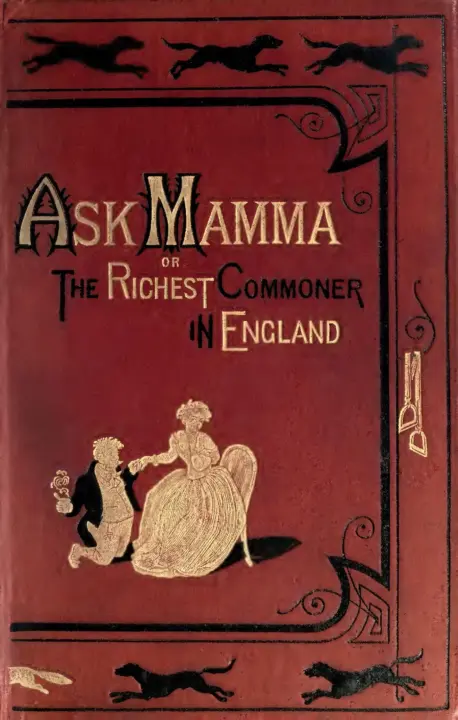
"Ask Mamma; or, The Richest Commoner In England" by Robert Smith Surtees is a novel written in the mid-19th century. The story centers around Billy Pringle, who aspires to be seen as a gentleman, despite his humble origins as part of a trading family. As he navigates social situations filled with humor and satire, themes of ambition, social class, and identity emerge. The opening of the novel introduces us to Billy Pringle, fondly referred to as "Fine Billy," who is characterized by his attempts to embody gentility despite his humble background. The narrative provides a glimpse into his interactions with various members of his family, revealing their dynamics and his desire to fit into a more affluent social circle. We also meet Miss Willing, a lady's maid with aspirations of her own, who captures Billy's attention during a coach journey. Their budding acquaintance sets the stage for the humorous and often absurd twists of social class and romance that will unfold throughout the story.
Introduction adapted from the source catalogue; source summaries may be automatically generated.
Free to read · English · 179,335 words · No account needed
MAKE TIME FOR A GOOD BOOK
On by default. Untick to stop anonymous reading totals. Each page counts after 10 seconds in view. How this works.
Anonymous counting is on unless you have switched it off.
Tom Findlater, as we said before, was an excellent huntsman, but he had his peculiarities, and in addition to that of getting drunk, he sometimes required to be managed by the rule of contrary, and made to believe that Sir Moses wanted him to do the very reverse of what he really did. Having been refused leave to go to Cleaver the butcher’s christening-supper at the sign of the Shoulder of Mutton, at Kimberley, Sir Moses anticipated that this would be one of his perverse days, and so he began taking measures accordingly.
“Good morning, Tom,” said he, as huntsman and whips now sky-scraped to his advance—“morning all of you,” added he, waving a general salute to the hound-encircling group.
“Now, Tom,” said he, pulling up and fumbling at his horn, “I’ve been telling Mr. Pringle that we’ll get him a gallop so as to enable him to arrive at Yammerton Grange before dark.”
“Yes, Sir Moses,” replied Tom, with a rap of his cap-peak, thinking he would take very good care that he didn’t.
“Now whether will Briarey Banks or the Reddish Warren be the likeliest place for a find?”
“Neither, Sir Moses, neither,” replied Tom confidently, “Tipthorne’s the place for us.”
This was just what Sir Moses wanted.
“Tipthorne, you think, do you?” replied he, musingly. “Tipthorne, you think—well, and where next?”
“Shillington, Sir Moses, and Halstead Hill, and so on to
Hatchington Wood.”
“Good!” replied the Baronet, “Good!” adding, “then let’s be
going.”
At a whistle and a waive of his hand the watchful hounds darted up, and Tom taking the lead, the mixed cavalcade swept after them over the now yellow-grassed park in a north-easterly direction, Captain Luff working his screw as if he were bent on treading on the hounds’ stems.
There being no one out to whom Sir Moses felt there would be any profitable investment of attention, he devoted himself to our hero, complimenting him on his appearance, and on the gallant bearing of his steed, declaring that of all the neat horses he had ever set eyes on the Lord Mayor was out-and-out the neatest. So with compliments to Billy, and muttered “cusses” at Luff, they trotted down Oxclose Lane, through the little village of Homerton, past Dewfield Lawn, over Waybridge Common, shirking Upwood toll-bar, and down Cornforth Bank to Burford, when Tipthorne stood before them. It was a round Billesdon Coplow-like hill, covered with stunted oaks, and a nice warm lying gorse sloping away to the south; but Mr. Tadpole’s keeper having the rabbits, he was seldom out of it, and it was of little use looking there for a fox.
Your reading position is saved on this browser. Take it to another device with a library code. Reading pages adapt to text, rather than matching a printed edition.
BEHIND THE BOOK
This eBook is for the use of anyone anywhere in the United States and most other parts of the world at no cost and with almost no restrictions whatsoever. You may copy it, give it away or re-use it under the terms of the Project Gutenberg License included with this eBook or online at www.gutenberg.org. If you are not located in the United States, you will have to check the laws of the country where you are located before using this eBook. Read the source licence.
The original source file, including credits and licence, is retained by this library. Request an original-format copy at no charge. Please include the book title and Project Gutenberg identifier #44822.
KEEP YOUR CURIOSITY GOING
Coulson Kernahan

Maurice Baring
Frances Wright
Cécile Tormay

Frederic Jesup Stimson

W. H. P. (William Henry Pope) Jarvis