THE CLASSIC COLLECTION✦Mr. Sponge’s Sporting TourCLASSIC FREE BOOKS
Mr. Sponge’s Sporting Tour
Robert Smith Surtees
THE CLASSIC COLLECTION · 1858
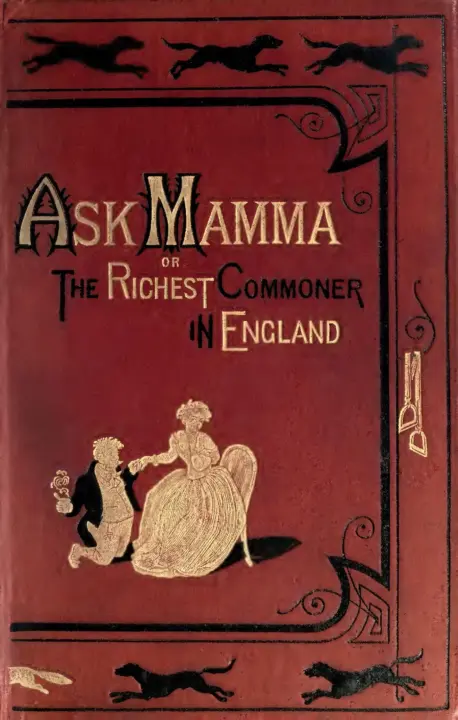
"Ask Mamma; or, The Richest Commoner In England" by Robert Smith Surtees is a novel written in the mid-19th century. The story centers around Billy Pringle, who aspires to be seen as a gentleman, despite his humble origins as part of a trading family. As he navigates social situations filled with humor and satire, themes of ambition, social class, and identity emerge. The opening of the novel introduces us to Billy Pringle, fondly referred to as "Fine Billy," who is characterized by his attempts to embody gentility despite his humble background. The narrative provides a glimpse into his interactions with various members of his family, revealing their dynamics and his desire to fit into a more affluent social circle. We also meet Miss Willing, a lady's maid with aspirations of her own, who captures Billy's attention during a coach journey. Their budding acquaintance sets the stage for the humorous and often absurd twists of social class and romance that will unfold throughout the story.
Introduction adapted from the source catalogue; source summaries may be automatically generated.
Free to read · English · 179,335 words · No account needed
MAKE TIME FOR A GOOD BOOK
On by default. Untick to stop anonymous reading totals. Each page counts after 10 seconds in view. How this works.
Anonymous counting is on unless you have switched it off.
He then composed himself in his capacious old saddle, and taking off his white shallow began mopping his great bald head, hoping that some one would sound the key-note of speculation ere the advancing parties arrived at the gate. They all, however, seemed to wish to defer to Mr. Gallon—Gallon was the man for their money, Gallon knew a thing or two, Gallon was up to snuff,—go it, Gallon!
“What does onybody say ‘boot it Frenchman?” at length asked he in his elliptical Yorkshire dialect, looking round on the company.
“What do you say ‘boot it Frenchman, Sir Moses?” asked he, not getting an answer from any one.
“Faith, I know nothing,” replied the Baronet, with a slight curl
of the lip.
“Nay, yeer tied to know summut, hooever,” replied Gallon, rubbing his nose across the back of his hand; “yeer tied to know summut, hooever. Why, he’s a stoppin’ at yeer house, isn’t he?”
“That may all be,” rejoined Sir Moses, “without my knowing anything of his riding. What do you say yourself? you’ve seen him.”
“Seen him!” retorted Gallon, “why he’s a queer lookin’ chap, ony hoo—that’s all ar can say: haw, haw, haw.”
“You won’t back him, then?” said Sir Moses, inquiringly.
“Hardly that,” replied Gallon, shaking his head and laughing heartily, “hardly that, Sir Moses. Ar’ll tell you whatar’ll do, though,” said he, “just to mak sport luike, ar’ll tak yeer two to one—two croons to one,” producing a greasy-looking metallic-pencilled betting-book as he spoke.
Just then a move outside the ring announced an arrival, and presently Mr. Heslop came steering Cuddy Flintoff along in his wife’s Croydon basket-carriage, Cuddy’s head docked in an orange-coloured silk cap, and his whole person enveloped in a blue pilot coat with large mother-of-pearl buttons. The ominous green-pointed jockey whip was held between his knees, as with folded arms he lolled carelessly in the carriage, trying to look comfortable and unconcerned.
“Mornin’, Flintoff’, how are ye?” cried Sir Moses, waving his hand from his loftier vehicle, as they drew up.
“Mornin’, Heslop, how goes it? Has anybody seen anything of Monsieur?” asked he, without waiting for an answer to either of these important inquiries.
“He’s coming, Sir Moses,” cried several voices, and presently the Marseillaise hymn of liberty was borne along on the southerly breeze, and Jack’s faded black hunting-cap was seen bobbing up and down in the crowd that encircled him, as he rode along on Paul Straddler’s shooting pony.
Jack had been at the brandy bottle, and had imbibed just enough to make him excessively noisy.
Your reading position is saved on this browser. Take it to another device with a library code. Reading pages adapt to text, rather than matching a printed edition.
BEHIND THE BOOK
This eBook is for the use of anyone anywhere in the United States and most other parts of the world at no cost and with almost no restrictions whatsoever. You may copy it, give it away or re-use it under the terms of the Project Gutenberg License included with this eBook or online at www.gutenberg.org. If you are not located in the United States, you will have to check the laws of the country where you are located before using this eBook. Read the source licence.
The original source file, including credits and licence, is retained by this library. Request an original-format copy at no charge. Please include the book title and Project Gutenberg identifier #44822.
KEEP YOUR CURIOSITY GOING
Coulson Kernahan

Maurice Baring
Frances Wright
Cécile Tormay

Frederic Jesup Stimson

W. H. P. (William Henry Pope) Jarvis