THE CLASSIC COLLECTION✦Mr. Sponge’s Sporting TourCLASSIC FREE BOOKS
Mr. Sponge’s Sporting Tour
Robert Smith Surtees
THE CLASSIC COLLECTION · 1858
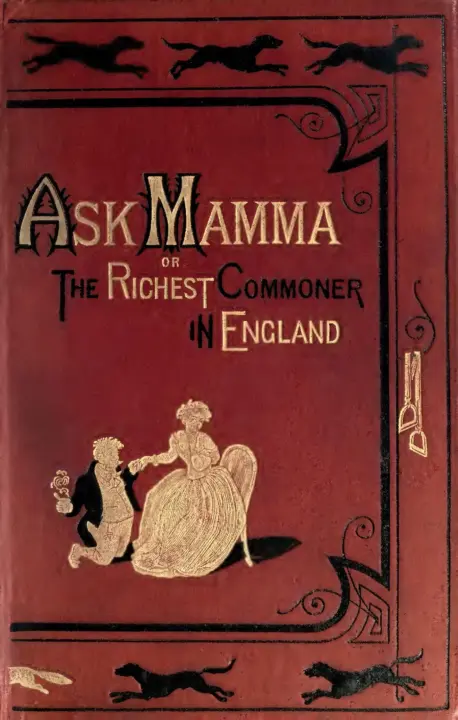
"Ask Mamma; or, The Richest Commoner In England" by Robert Smith Surtees is a novel written in the mid-19th century. The story centers around Billy Pringle, who aspires to be seen as a gentleman, despite his humble origins as part of a trading family. As he navigates social situations filled with humor and satire, themes of ambition, social class, and identity emerge. The opening of the novel introduces us to Billy Pringle, fondly referred to as "Fine Billy," who is characterized by his attempts to embody gentility despite his humble background. The narrative provides a glimpse into his interactions with various members of his family, revealing their dynamics and his desire to fit into a more affluent social circle. We also meet Miss Willing, a lady's maid with aspirations of her own, who captures Billy's attention during a coach journey. Their budding acquaintance sets the stage for the humorous and often absurd twists of social class and romance that will unfold throughout the story.
Introduction adapted from the source catalogue; source summaries may be automatically generated.
Free to read · English · 179,335 words · No account needed
MAKE TIME FOR A GOOD BOOK
On by default. Untick to stop anonymous reading totals. Each page counts after 10 seconds in view. How this works.
Anonymous counting is on unless you have switched it off.
“Now for distance, time, and stake,” reiterated Mr. Straddler. “Now for distance, time, and stake, Monsieur!” continued he, appealing to Jack. “What distance would you like to have it?”
“Vot you please, sare,” replied Monsieur, now depositing his tray on the sideboard; “vot you please, sare, much or little; ten miles, twenty miles, any miles he likes.”
“O, the fellow’s mad,” muttered Cuddy, with a jerk of his head, making a last effort to be off.
“Don’t be in a hurry, Cuddy, don’t be in a hurry,” interposed Heslop, adding, “he doesn’t understand it—he doesn’t understand it.”
“O, I understands it, nicely, vell enough,” replied Jack, with a shrug of his shoulders; “put us on to two orses, and see vich gets first to de money post.”
“Aye, yes, exactly, to be sure, that’s all right,” asserted Paul Straddler, looking up approvingly at Jack, “and you say you’ll beat Mr. Flintoff?”
“I say I beat Mr. Flintoff,” rejoined Jack—“beat im dem vell too—beat his ead off—beat him stupendous!” added he.
“O, dash it all, we can’t stand that, Caddy!” exclaimed Mr. Heslop, nudging Mr. Flintoff; “honor of the country, honor of the hunt, honor of England, honor of every thing’s involved.” Cuddy’s bristles were now up too, and shaking his head and thrusting his hands deep into his trousers pockets, “he declared he couldn’t stand that sort of language,—shot if he could.”
“No; nor nobody else,” continued Mr. Heslop, keeping him up to the indignity mark; “must be taught better manners,” added he with a pout of the lip, as though fully espousing Caddy’s cause.
“Come along, then! come along!” cried Paul Straddler, flourishing his dirty pen; “let’s set up a school for grown sportsmen. Now for the good boys. Master Bushey-heath says he’ll ride Master Bareacres a match across country—two miles say—for, for, how much?” asked he, looking up.
This caused a pause, as it often does, even after dinner, and not the less so in the present instance, inasmuch as the promoters of the match had each a share in the risk. What would be hundreds in other people’s cases becomes pounds in our own.
Flintoff and Straddler looked pacifically at each other, as much as to say, “There’s no use in cutting each other’s throats, you know.”
“Suppose we say,” (exhibiting four fingers and a thumb, slyly to indicate a five pound note), said Heslop demurely, after a conference with Cuddy.
“With all my heart,” asserted Straddler, “glad it was no more.”
“And call it fifty,” whispered Heslop.
Your reading position is saved on this browser. Take it to another device with a library code. Reading pages adapt to text, rather than matching a printed edition.
BEHIND THE BOOK
This eBook is for the use of anyone anywhere in the United States and most other parts of the world at no cost and with almost no restrictions whatsoever. You may copy it, give it away or re-use it under the terms of the Project Gutenberg License included with this eBook or online at www.gutenberg.org. If you are not located in the United States, you will have to check the laws of the country where you are located before using this eBook. Read the source licence.
The original source file, including credits and licence, is retained by this library. Request an original-format copy at no charge. Please include the book title and Project Gutenberg identifier #44822.
KEEP YOUR CURIOSITY GOING
Coulson Kernahan

Maurice Baring
Frances Wright
Cécile Tormay

Frederic Jesup Stimson

W. H. P. (William Henry Pope) Jarvis