THE CLASSIC COLLECTION✦Mr. Sponge’s Sporting TourCLASSIC FREE BOOKS
Mr. Sponge’s Sporting Tour
Robert Smith Surtees
THE CLASSIC COLLECTION · 1858
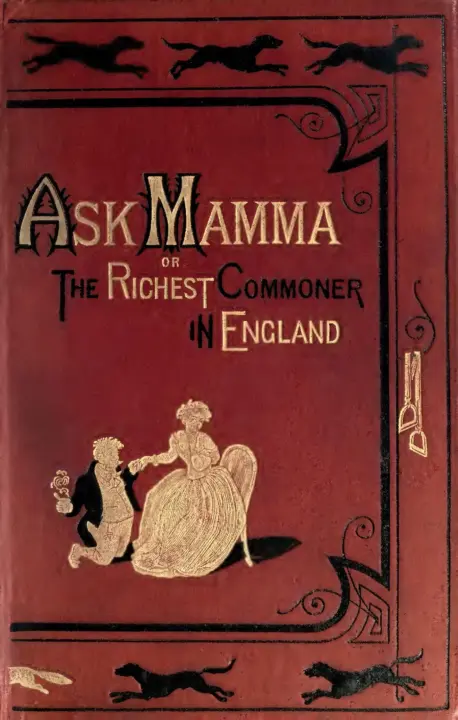
"Ask Mamma; or, The Richest Commoner In England" by Robert Smith Surtees is a novel written in the mid-19th century. The story centers around Billy Pringle, who aspires to be seen as a gentleman, despite his humble origins as part of a trading family. As he navigates social situations filled with humor and satire, themes of ambition, social class, and identity emerge. The opening of the novel introduces us to Billy Pringle, fondly referred to as "Fine Billy," who is characterized by his attempts to embody gentility despite his humble background. The narrative provides a glimpse into his interactions with various members of his family, revealing their dynamics and his desire to fit into a more affluent social circle. We also meet Miss Willing, a lady's maid with aspirations of her own, who captures Billy's attention during a coach journey. Their budding acquaintance sets the stage for the humorous and often absurd twists of social class and romance that will unfold throughout the story.
Introduction adapted from the source catalogue; source summaries may be automatically generated.
Free to read · English · 179,335 words · No account needed
MAKE TIME FOR A GOOD BOOK
On by default. Untick to stop anonymous reading totals. Each page counts after 10 seconds in view. How this works.
Anonymous counting is on unless you have switched it off.
“Come in!” cried he; and in obedience to the invitation, Flintoff stood in the doorway. “Don’t forget,” said he, “that we dine at Hinton to-day, and the Baronet’s ordered the trap at four,” adding, “I’m going to dress, and you’d better do the same.” So saying, Cuddy closed the door, and hunted himself along to his own room at the end of the passage—“E’leu in there! E’leu in!” oried he as he got to the door.
Hinton, once the second town in Hit-im and Hold-im shire, stands at the confluence of the Long Brawlinerford and Riplinton brooks, whose united efforts here succeed in making a pretty respectable stream. It is an old-fashioned country place, whose component parts may be described as consisting of an extensive market-place, with a massive church of the florid Gothic, or gingerbread order of architecture at one end, a quaint stone-roofed, stone-pillared market cross at the other, the Fox and Hounds hotel and posting-house on the north side, with alternating shops and public houses on the south.
Its population, according to a certain “sore subject” topographical dictionary, was 23,500, whilst its principal trade might have been described as “fleecing the foxhunters.” That was in its golden days, when Lord Martingal hunted the country, holding his court at the Fox and Hounds hotel, where gentlemen stayed with their studs for months and months together, instead of whisking about with their horses by steam. Then every stable in the town was occupied at very remunerative rents, and the inhabitants seemed to think they could never build enough.
Like the natives of most isolated places, the Hintonites were very self-sufficient, firmly believing that there were no such conjurors as themselves; and, when the Grumpletin railway was projected, they resolved that it would ruin their town, and so they opposed it to a man, and succeeded in driving it several miles off, thus scattering their trade among other places along the line. Year by year the bonnet and mantle shops grew less gay, the ribbons less attractive, until shop after shop lapsed into a sort of store, hardware on one side, and millinery, perhaps, on the other. But the greatest fall of all was that of the Fox and Hounds hotel and posting-house. This spacious hostelry had apparently been built with a view of accommodating everybody; and, at the time of our story, it loomed in deserted grandeur in the great grass-grown market-place. In structure it was more like a continental inn than an English one; quadrangular, entered by a spacious archway, from whose lofty ceiling hung the crooks, from whence used to dangle the glorious legs and loins of four-year-old mutton, the home-fed hams, the geese, the ducks, the game, with not unfrequently a haunch or two of presentation venison. With the building, however, the similarity ended, the cobble-stoned courtyard displaying only a few water-casks and a basket-caged jay, in lieu of the statues, and vases, and fountains, and flower-stands that grace the flagged courts of the continent. But in former days it boasted that which in the eye of our innkeeper passes show, namely, a goodly line of two-horse carriages drawn across its ample width. In those days county families moved like county families, in great, caravan-like carriages, with plenty of servants, who, having drunk the “Park or Hall” allowance, uphold their characters and the honour of their houses, by topping up the measure of intemperance with their own money. Their masters and mistresses, too, considered the claims of the innkeepers, and ate and drank for the good of the house, instead of sneaking away to pastry-cooks for their lunches at a third of the price of the inn ones. Not that any landlord had ever made money at the Fox and Hounds hotel. Oh, no! it would never do to admit that. Indeed, Mr. Binny used to declare, if it wasn’t “the great regard he had for Lord Martingal and the gents of his hunt, he’d just as soon be without their custom;” just as all Binnys decry, whatever they have—military messes, hunt messes, bar messes, any sort of messes. They never make anything by them—not they.
Your reading position is saved on this browser. Take it to another device with a library code. Reading pages adapt to text, rather than matching a printed edition.
BEHIND THE BOOK
This eBook is for the use of anyone anywhere in the United States and most other parts of the world at no cost and with almost no restrictions whatsoever. You may copy it, give it away or re-use it under the terms of the Project Gutenberg License included with this eBook or online at www.gutenberg.org. If you are not located in the United States, you will have to check the laws of the country where you are located before using this eBook. Read the source licence.
The original source file, including credits and licence, is retained by this library. Request an original-format copy at no charge. Please include the book title and Project Gutenberg identifier #44822.
KEEP YOUR CURIOSITY GOING
Coulson Kernahan

Maurice Baring
Frances Wright
Cécile Tormay

Frederic Jesup Stimson

W. H. P. (William Henry Pope) Jarvis