THE CLASSIC COLLECTION✦Mr. Sponge’s Sporting TourCLASSIC FREE BOOKS
Mr. Sponge’s Sporting Tour
Robert Smith Surtees
THE CLASSIC COLLECTION · 1858
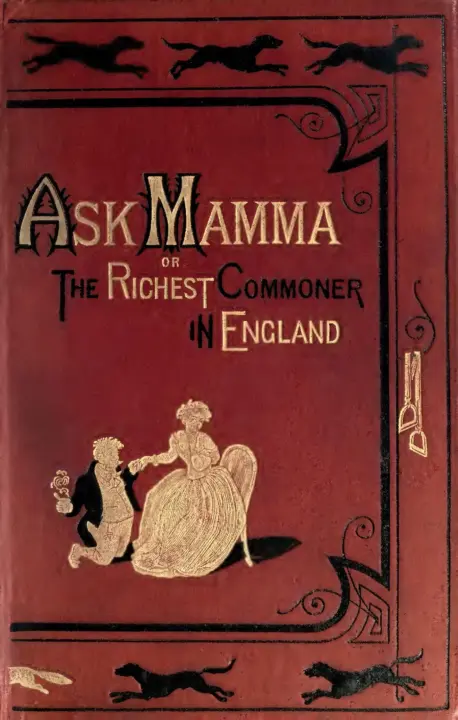
"Ask Mamma; or, The Richest Commoner In England" by Robert Smith Surtees is a novel written in the mid-19th century. The story centers around Billy Pringle, who aspires to be seen as a gentleman, despite his humble origins as part of a trading family. As he navigates social situations filled with humor and satire, themes of ambition, social class, and identity emerge. The opening of the novel introduces us to Billy Pringle, fondly referred to as "Fine Billy," who is characterized by his attempts to embody gentility despite his humble background. The narrative provides a glimpse into his interactions with various members of his family, revealing their dynamics and his desire to fit into a more affluent social circle. We also meet Miss Willing, a lady's maid with aspirations of her own, who captures Billy's attention during a coach journey. Their budding acquaintance sets the stage for the humorous and often absurd twists of social class and romance that will unfold throughout the story.
Introduction adapted from the source catalogue; source summaries may be automatically generated.
Free to read · English · 179,335 words · No account needed
MAKE TIME FOR A GOOD BOOK
On by default. Untick to stop anonymous reading totals. Each page counts after 10 seconds in view. How this works.
Anonymous counting is on unless you have switched it off.
It is said that a man who is never exactly sober is never quite drunk, and Jack Wetun was one of this order, he was always running to the “unsophisticated gin-bottle,” keeping up the steam of excitement, but seldom overtopping it, and could shake himself into apparent sobriety in an instant. Like most of Sir Moses’s people, he was one of the fallen angels of servitude, having lived in high places, from which his intemperate habits had ejected him; and he was now gradually descending to that last refuge of the destitute, the Ostlership of a farmer’s inn. Starting out of his nest at the rousing shake of the helper, who holloaed in his ear that “Mr. Pringle wanted to see his ‘orse,” Wetun stretched his brawny arms, and, rubbing his eyes, at length comprehended Billy, when he exclaimed with a start, “Oss, sir? Oh, by all means, sir;” and, bundling on his greasy-collared, iron-grey coat, he reeled and rolled out of the room, followed by our friend. “That (hiccup) oss of (hiccup) yours is (hiccup) amiss, I think (hiccup), sir,” said he, leading, or rather lurching the way. “A w-h-a-w-t?” drawled Billy, watching Weton’s tack and half-tack gait.
“Amiss (hiccup)—unwell—don’t like his (hiccup) looks,” replied the groom, rolling past the stable-door where he was. “Oh, beg pardon,” exclaimed he, bumping against Billy on turning short back, as he suddenly recollected himself; “Beg pardon, he’s in here,” added he, fumbling at the door. It was locked. Then, oh dear, he hadn’t got the (hiccup) key, then (hiccup); yes, he had got the (hiccup) key, as he recollected he had his coat on, and dived into the pocket for it. Then he produced it; and, after making several unsuccessful pokes at the key-hole, at length accomplished an entry, and Billy again saw Napoleon the Great, now standing in the promised two-stalled stable along with Sir Moses’s gig mare.
To a man with any knowledge of horses, Napoleon certainly did look very much amiss—more like a wooden horse at a harness-maker’s, than an animal meant to go,—stiff, with his fore-logs abroad, and an anxious care-worn countenance continually cast back at its bearing flanks.
“Humph!” said Billy, looking him over, as he thought, very knowingly. “Not so much amiss, either, is he?”
“Well, sir, what you think,” replied Wetun, glad to find that Billy didn’t blame him for his bad night’s lodgings.
“Oh, I dare say he’ll be all right in a day or two,” observed
Billy, half inclined to recommend his having his feet put into
warm water.
Your reading position is saved on this browser. Take it to another device with a library code. Reading pages adapt to text, rather than matching a printed edition.
BEHIND THE BOOK
This eBook is for the use of anyone anywhere in the United States and most other parts of the world at no cost and with almost no restrictions whatsoever. You may copy it, give it away or re-use it under the terms of the Project Gutenberg License included with this eBook or online at www.gutenberg.org. If you are not located in the United States, you will have to check the laws of the country where you are located before using this eBook. Read the source licence.
The original source file, including credits and licence, is retained by this library. Request an original-format copy at no charge. Please include the book title and Project Gutenberg identifier #44822.
KEEP YOUR CURIOSITY GOING
Coulson Kernahan

Maurice Baring
Frances Wright
Cécile Tormay

Frederic Jesup Stimson

W. H. P. (William Henry Pope) Jarvis