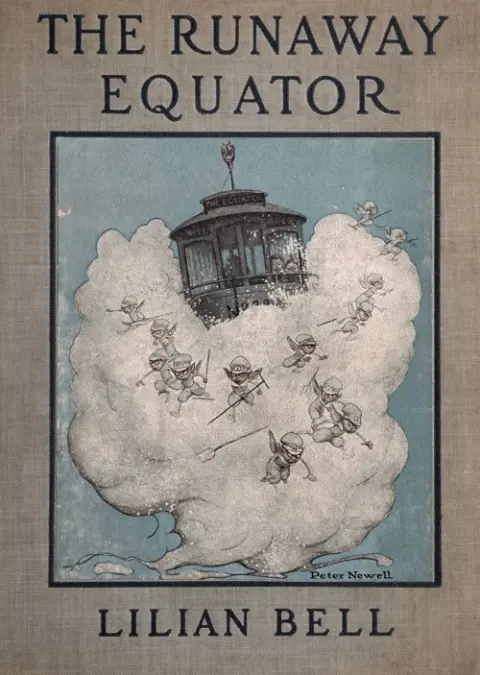
The Runaway Equator, and the Strange Adventures of a Little Boy in Pursuit of It
Lilian Bell
THE CLASSIC COLLECTION · 1900
"As Seen By Me" by Lilian Bell is a travel narrative written in the early 20th century. The book chronicles the author's experiences and observations during her extensive travels across Europe, particularly highlighting her insights and reflections on the cultures she encounters. The narrative carries a personal touch, as it is presented through the author's unique perspective, offering readers a blend of humor, wit, and candid commentary on her journey. At the start of the narrative, the author introduces herself and her family's anticipation over her impending travel to Europe for the first time. The opening chapter captures the preparations for her journey, depicting familial interactions filled with humor and warmth, as well as her brother’s attempts to teach her about practicality in travel. The author's lively personality shines through as she contemplates her excitement and fears about becoming part of the traveling world. This combination of personal anecdotes, humorous exchanges, and the essence of embarking on a new adventure sets the stage for her explorations in Europe, making it clear that the narrative will offer more than simply travel information—rather, it promises a rich tapestry of experiences infused with the author’s distinctive voice.
Introduction adapted from the source catalogue; source summaries may be automatically generated.
Free to read · English · 68,112 words · No account needed
MAKE TIME FOR A GOOD BOOK
On by default. Untick to stop anonymous reading totals. Each page counts after 10 seconds in view. How this works.
Anonymous counting is on unless you have switched it off.
“If you would just snub her once, in your most ladylike way, it would settle her. As for me, I am satisfied to think we are paying much less, and we are twice as comfortable as we were at the hotel; and we get such good things to eat that our skeletons are filling out, and once more our clothes fit.”
“That is so,” said she, letting her thoughts wander to the number of hooks in her closet. “We do have more room, and I think our drawing-room with its palms and flowers will look lovely to-morrow.”
“Do you think it was wise,” she added, “to ask all those men to come at
once?”
“Oh yes; let them all come together, then we can weed them out afterwards. You never can have too many men.”
“I am glad you have asked in a few women.”
“Why?” I demanded. “Are you insinuating that we are not equal to a handful of Englishmen? Recall the Boston tea-party. We will give them the first strawberries of the season, and plenty of tea. Feed them; that’s the main thing,” I said, firmly, taking up my pen and looking steadily at her.
“I’ll go,” she said, hastily. “Do you have to go to the bank to-day? You know to-morrow we must pay our weekly bill.”
“It won’t be much,” I said, cheerfully; “I am sure I have enough.”
The next day the bill came. Our landlady sent it up on the breakfast-tray. I opened it, then shrieked for my sister. It covered four pages of note-paper.
“For heaven’s sake! what is the matter?” she cried. “Has anything
happened to Billy?”
“Billy! This thing is not an American letter. It is the bill for our cheap lodgings. Look at it! Look at the extras—gas, coals, washing bed—linen, washing table—linen, washing towels, kitchen fires, service, oil for three lamps, afternoon tea, and three shillings for sundries on the fourth page! What can sundries include? She hasn’t skipped anything but pew-rent.”
My sister looked at the total, and buried her face in the pillows to
smother a groan.
“Ring the bell,” I said; “I want the maid.”
“What are you going to do?”
“I’m going to find out what ‘sundries’ are.”
She gave the bell-cord such a pull that she broke the wire, and it fell
down on her head.
“That, too, will go in the bill. Wrap your handkerchief around your hand and give the wire a jerk. Give it a good one. I don’t care if it brings the police.”
The maid came.
“Martha, present my compliments to Mrs. Black, and ask her what
‘sundries’ include.”
Your reading position is saved on this browser. Take it to another device with a library code. Reading pages adapt to text, rather than matching a printed edition.
Lilian Bell
Lilian Bell
Lilian Bell
Lilian Bell
BEHIND THE BOOK
This eBook is for the use of anyone anywhere in the United States and most other parts of the world at no cost and with almost no restrictions whatsoever. You may copy it, give it away or re-use it under the terms of the Project Gutenberg License included with this eBook or online at www.gutenberg.org. If you are not located in the United States, you will have to check the laws of the country where you are located before using this eBook. Read the source licence.
The original source file, including credits and licence, is retained by this library. Request an original-format copy at no charge. Please include the book title and Project Gutenberg identifier #12416.
KEEP YOUR CURIOSITY GOING
Wilfrid Scawen Blunt
Wilfrid Scawen Blunt

E. W. (Edgar Watson) Howe
Francis Greenleaf Allinson & Anne C. E. (Anne Crosby Emery) Allinson
Cyrenus Cole

John Martineau