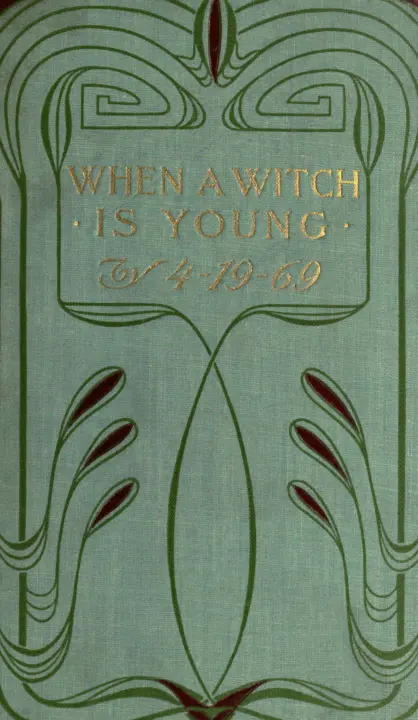
When a witch is young: a historical novel
Philip Verrill Mighels
THE CLASSIC COLLECTION · 1912
"As It Was in the Beginning" by Philip Verrill Mighels is a novel written in the early 20th century. The story begins with Grenville, a man chosen by his wealthy friend Fenton to travel to China and bring back Fenton's fiancée, Elaine. The narrative quickly develops into a tale of unexpected romance and peril as Grenville finds himself caught between loyalty to his friend and his growing feelings for Elaine during their ocean voyage. At the start of the novel, we are introduced to Grenville, who initially appears skeptical and reserved about his friend’s request. However, as he prepares for the journey, he begins to feel excitement for the adventure ahead. Along the way, Grenville and Elaine embark on a transformative journey across the sea, where they face personal conflicts, dangerous storms, and the mysterious wildlife of a deserted island after their ship wrecks. The opening sets up a tension-filled exploration of love, duty, and survival, hinting at the challenges they will face as they navigate this uncharted territory both physically and emotionally.
Introduction adapted from the source catalogue; source summaries may be automatically generated.
Free to read · English · 94,226 words · No account needed
MAKE TIME FOR A GOOD BOOK
On by default. Untick to stop anonymous reading totals. Each page counts after 10 seconds in view. How this works.
Anonymous counting is on unless you have switched it off.
The next word, according to his deductions, should be "Island." This, he felt, was indisputably confirmed by the fact it contained precisely the required number of "letters," with the sign for L, A, and D, already discovered, occupying their proper positions. He, therefore, added:
to his growing collection of letters, and promptly produced the following results by the process of substitution:
There could be so little doubt, after that, concerning such words as "Under," "High," "Important," and "Water," which supplied the characters, U, G, M, P, W, and O, which was also suggested in "Or," before "Haunted," that a bit of additional substitution very promptly cleared the entire affair.
Grenville jotted it down, to make sense, in the following fashion:
"Under tree, Three-Hill, or Haunted Island, Cave. Get in (during) high water (in) Spring time when noise loud. Important. Make no mistake. Map on Buli shows same."
The one word which he felt to be doubtful was "Buli," which, he confessed, might as readily be "Zuli," "Juli," or "Quli," but this was of no significance, one way or another. Its meaning was still obscure.
There were several things in the message or statement, however, that confirmed his earlier uneasiness. The principal of these was the statement that it was important for the possible seekers of some cavern under the greater wall of rock to visit the island only during the time when the hideously haunting sounds were at their height. This argued, he thought, that the sounds would finally subside, or altogether cease, when complications--doubtless in the form of visitors--might be expected to develop.
That the visitors would be natives and, probably, Dyaks, Grenville could have no doubt. As to what there was in the cave beneath the rock, he had small curiosity only, since it was hardly likely such tools as he desired would be so concealed from a prying world, and tools alone had value for him now.
He could not doubt, however, that something there was in the cave here described, for which men had risked their lives. He thought of the headless skeletons, and then of the mummy in chains.
Suddenly, at thought of that guardian of the barque, his heart gave an added leap. He snatched from his pocket the parchment referred to as a map. He could instantly see, by the light of day, that the leathery substance was leather, indeed, of the most grewsomely repellent description! It was simply tanned human skin!
And abruptly he understood that phrase--"Map on Buli shows same." The pyramids represented the island's three great hills, and other signs the cave. The pole with a knob, on the tallest hill, was the tree so near his camp.
Your reading position is saved on this browser. Take it to another device with a library code. Reading pages adapt to text, rather than matching a printed edition.
Philip Verrill Mighels
Philip Verrill Mighels
Philip Verrill Mighels
BEHIND THE BOOK
This eBook is for the use of anyone anywhere in the United States and most other parts of the world at no cost and with almost no restrictions whatsoever. You may copy it, give it away or re-use it under the terms of the Project Gutenberg License included with this eBook or online at www.gutenberg.org. If you are not located in the United States, you will have to check the laws of the country where you are located before using this eBook. Read the source licence.
The original source file, including credits and licence, is retained by this library. Request an original-format copy at no charge. Please include the book title and Project Gutenberg identifier #22554.
KEEP YOUR CURIOSITY GOING
Coulson Kernahan

Maurice Baring
Frances Wright
Cécile Tormay

Frederic Jesup Stimson

W. H. P. (William Henry Pope) Jarvis