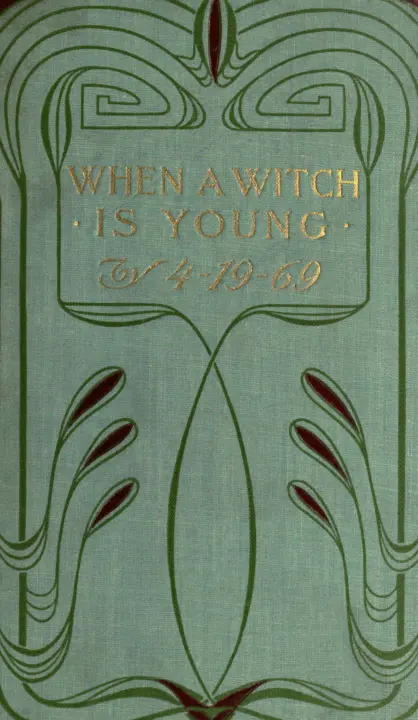
When a witch is young: a historical novel
Philip Verrill Mighels
THE CLASSIC COLLECTION · 1912
"As It Was in the Beginning" by Philip Verrill Mighels is a novel written in the early 20th century. The story begins with Grenville, a man chosen by his wealthy friend Fenton to travel to China and bring back Fenton's fiancée, Elaine. The narrative quickly develops into a tale of unexpected romance and peril as Grenville finds himself caught between loyalty to his friend and his growing feelings for Elaine during their ocean voyage. At the start of the novel, we are introduced to Grenville, who initially appears skeptical and reserved about his friend’s request. However, as he prepares for the journey, he begins to feel excitement for the adventure ahead. Along the way, Grenville and Elaine embark on a transformative journey across the sea, where they face personal conflicts, dangerous storms, and the mysterious wildlife of a deserted island after their ship wrecks. The opening sets up a tension-filled exploration of love, duty, and survival, hinting at the challenges they will face as they navigate this uncharted territory both physically and emotionally.
Introduction adapted from the source catalogue; source summaries may be automatically generated.
Free to read · English · 94,226 words · No account needed
MAKE TIME FOR A GOOD BOOK
On by default. Untick to stop anonymous reading totals. Each page counts after 10 seconds in view. How this works.
Anonymous counting is on unless you have switched it off.
For a moment Elaine was puzzled by this wholly irrelevant remark. Then her heart began to rock uneasily.
"You--wired we were coming home?"
"Wired I was fetching you home, after unavoidable delay."
She recognized the difference between the way that she and he had expressed the principal fact. She felt herself, as it were, already surrendered to a man grown singularly foreign to her nature. It seemed to her incredible that Sidney and she should ever again be parted, or work out their several destinies in any manner save together--especially after all he had said and even done.
"Was that--all you said?" she asked him, faintly.
"No. I said I'd be best man--or something of the sort."
Elaine felt something leaden go down to the point of her heart.
"You wanted him to know that you had no idea---- You wanted Gerald to understand----" She could not finish her sentence. Her face was hotly flaming, but at least she could turn it away.
Grenville's voice was hard and strange.
"It was barely his right to know that we were coming. I could do no less, as you'll certainly agree."
His speeches were constrained, unnatural, as Elaine had instantly felt. Her own were scarcely less embarrassed--after all these months when their entire world had comprised themselves alone. It seemed a monstrous error that anything but free, unfettered companionship and candor should exist between them now.
"I know," she said. "Of course." She added, after a moment, "It seems so peculiar, that's all--to--resume as we were before."
He was looking at his fist, for no good reason in the world.
"It is what you have hoped for every day."
"To get away from the Dyaks--why, of course."
Another silence supervened. After three unsuccessful efforts at speech, Elaine at last found the voice and the courage for a question:
"Do you wish to be--best man?"
Grenville spread out his fingers, for further inspection.
"I probably shouldn't have suggested it otherwise."
She turned upon him impulsively. "Sidney, are you absolutely honest?"
"Oh, I wouldn't trouble old Diogenes to get out of his grave and look me up," he answered, in his customary spirit, "but I've got a faint idea what honor means."
How well she knew his various manners of evasion! Her heart was pounding furiously. She leaned with all her weight against the rail, as if for fear he must hear its clamorous confessions.
She had never been so excited in her life--or more courageous. Likewise she felt she possessed certain God-given rights that were poised at the brink of disaster. For a love like hers comes never lightly and is not to be lightly dismissed. Her utterance was difficult, but mastered.
Your reading position is saved on this browser. Take it to another device with a library code. Reading pages adapt to text, rather than matching a printed edition.
Philip Verrill Mighels
Philip Verrill Mighels
Philip Verrill Mighels
BEHIND THE BOOK
This eBook is for the use of anyone anywhere in the United States and most other parts of the world at no cost and with almost no restrictions whatsoever. You may copy it, give it away or re-use it under the terms of the Project Gutenberg License included with this eBook or online at www.gutenberg.org. If you are not located in the United States, you will have to check the laws of the country where you are located before using this eBook. Read the source licence.
The original source file, including credits and licence, is retained by this library. Request an original-format copy at no charge. Please include the book title and Project Gutenberg identifier #22554.
KEEP YOUR CURIOSITY GOING
Coulson Kernahan

Maurice Baring
Frances Wright
Cécile Tormay

Frederic Jesup Stimson

W. H. P. (William Henry Pope) Jarvis