
The lost dirigible
Ralph Henry Barbour
THE CLASSIC COLLECTION · 1913
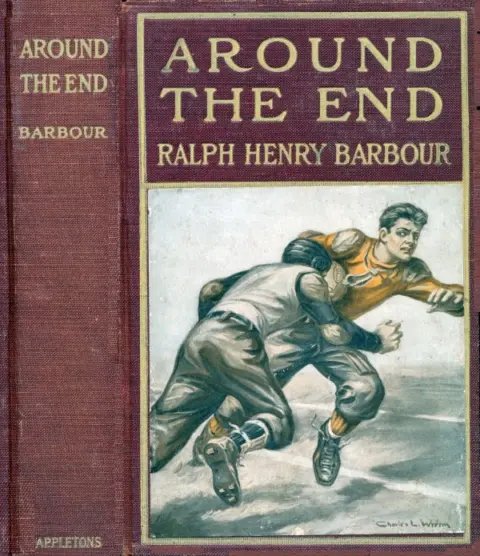
"Around the End" by Ralph Henry Barbour is a novel written in the early 20th century. The story revolves around the dynamics of youth and athletics, particularly focusing on the lives of students at a boarding school as they navigate challenges associated with football, friendship, and personal growth. The narrative offers an engaging glimpse into the experiences of the young characters, in particular, Kendall Burtis, as he strives to find his place within the school community. At the start of the novel, the reader is introduced to the atmosphere at Yardley Hall School as football practice begins. Coach Payson gathers candidates for the team, including characters like Kendall Burtis and his friend Harry Merrow, who discuss their hopes for the upcoming season. The dynamics of competition and camaraderie unfold, especially as new and old players vie for positions on the team, with particular focus on Kendall's rise to prominence due to his goal-kicking skills. As the narrative progresses, the interactions between the various personalities, including the somewhat awkward newcomer Charles Cotton, set the stage for the unfolding drama and rivalries in their athletic endeavors.
Introduction adapted from the source catalogue; source summaries may be automatically generated.
Free to read · English · 68,914 words · No account needed
MAKE TIME FOR A GOOD BOOK
On by default. Untick to stop anonymous reading totals. Each page counts after 10 seconds in view. How this works.
Anonymous counting is on unless you have switched it off.
“What is it?” asked Kendall, tossing aside his cap and leaning over the other’s shoulder. On the table lay a square of paper rudely scrawled with circles and figures. “I’m not much good at puzzles, Cotton.”
“Oh, this isn’t a puzzle. It’s something new in football signals.”
“You don’t say? What’s the idea?”
“Well, look here. Have you got another chair? Bring it up, like a good fellow. I’m awfully interested in this and I want you tell me what you think of it. Now then,” he continued when Kendall had drawn a chair to the table and seated himself, “here’s the idea. You know the signals they use now are dreadfully complicated.”
“Are they?”
“Well, aren’t they? Take the Yardley system, for instance. We have two sets of signals, like this.” Cotton indicated his diagram. “Here are the holes numbered from 1 to 8. Then the two ends, the two tackles and the four backs are numbered from 1 to 8. Now that’s confusing, isn’t it?”
“I don’t see why,” Kendall objected, getting interested now. “We use three numbers, the first a fake, the second indicating the runner, and the third the hole. That’s not hard.”
“Then we have special plays numbered, too.”
“Yes, a special play is called by tacking its number on to 500 and when Simms calls that he calls it right after the fake. You can’t get mixed up there, can you?”
“N-no,” replied Cotton doubtfully. “I suppose not. Still――now suppose left half was to take the ball through guard-tackle hole on the right. How would you call that?”
“We haven’t any such play. If we had, though, Simms would give us, say,
22, 76, 36.”
Cotton studied his diagram. “That sounds harder than need be. Your 22 is your fake, your 76 is your runner, the second numeral of the number indicating left half-back, and the 36 is the hole, the 6 meaning between right guard and tackle. That’s it, isn’t it?”
“Of course.”
“Have I got the positions numbered right?”
“Not quite. You’ve got quarter numbered 7; should be 5.”
“That so? Well, you draw a diagram for me, will you? I’m a lobster at it. Got another piece of paper?”
Kendall drew a pad toward him and quickly made a row of circles for the forwards and added four more beneath for the backs. Then he numbered the holes and the players. Cotton nodded approvingly.
“That’s fine and neat,” he commended. “Now suppose you were to punt, Burtis; what would be the signal for that?”
“‘Burtis back; 24, 49, 16.’”
“Nine means kick, doesn’t it?”
Your reading position is saved on this browser. Take it to another device with a library code. Reading pages adapt to text, rather than matching a printed edition.
Ralph Henry Barbour
Ralph Henry Barbour

Ralph Henry Barbour

Ralph Henry Barbour
BEHIND THE BOOK
This eBook is for the use of anyone anywhere in the United States and most other parts of the world at no cost and with almost no restrictions whatsoever. You may copy it, give it away or re-use it under the terms of the Project Gutenberg License included with this eBook or online at www.gutenberg.org. If you are not located in the United States, you will have to check the laws of the country where you are located before using this eBook. Read the source licence.
The original source file, including credits and licence, is retained by this library. Request an original-format copy at no charge. Please include the book title and Project Gutenberg identifier #59874.
KEEP YOUR CURIOSITY GOING
Coulson Kernahan

Maurice Baring
Frances Wright
Cécile Tormay

Frederic Jesup Stimson

W. H. P. (William Henry Pope) Jarvis