
The lost dirigible
Ralph Henry Barbour
THE CLASSIC COLLECTION · 1913
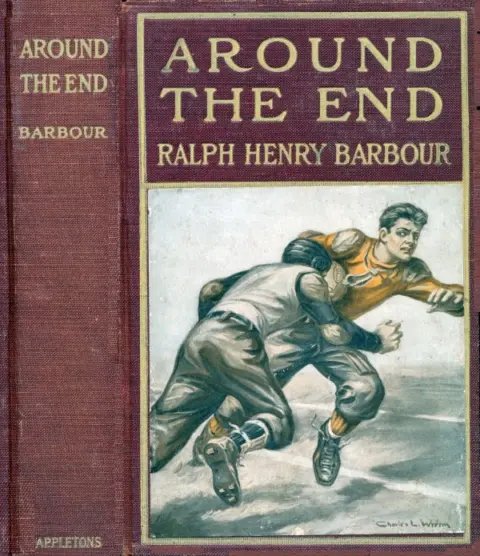
"Around the End" by Ralph Henry Barbour is a novel written in the early 20th century. The story revolves around the dynamics of youth and athletics, particularly focusing on the lives of students at a boarding school as they navigate challenges associated with football, friendship, and personal growth. The narrative offers an engaging glimpse into the experiences of the young characters, in particular, Kendall Burtis, as he strives to find his place within the school community. At the start of the novel, the reader is introduced to the atmosphere at Yardley Hall School as football practice begins. Coach Payson gathers candidates for the team, including characters like Kendall Burtis and his friend Harry Merrow, who discuss their hopes for the upcoming season. The dynamics of competition and camaraderie unfold, especially as new and old players vie for positions on the team, with particular focus on Kendall's rise to prominence due to his goal-kicking skills. As the narrative progresses, the interactions between the various personalities, including the somewhat awkward newcomer Charles Cotton, set the stage for the unfolding drama and rivalries in their athletic endeavors.
Introduction adapted from the source catalogue; source summaries may be automatically generated.
Free to read · English · 68,914 words · No account needed
MAKE TIME FOR A GOOD BOOK
On by default. Untick to stop anonymous reading totals. Each page counts after 10 seconds in view. How this works.
Anonymous counting is on unless you have switched it off.
“Well, he’s in here just the same,” declared Johnson.
“Oh, sure! I’ve got him in my pocket!”
“He’s in a closet,” whispered another fellow audibly.
“Under a bed, probably,” growled a third. “Say, whose room is this,
anyway?”
“This room belongs to my friend, Mr. Burtis,” returned Gerald amiably. “If you ask him nicely he will probably allow you to come in and search it to your heart’s content. Mind if this committee of thugs looks around, Burtis?”
“N-no, I suppose not,” answered Kendall. “But I don’t see why they
should.”
“I don’t see any reason myself,” agreed Gerald, carefully avoiding a glance toward the further bed. “Johnson, on the whole, I guess you’d better run away. And you might close the door after you.”
“Then he isn’t here?” asked Johnson doubtfully.
“Who isn’t here?” demanded Gerald with a fine show of irritability. “Can’t you see he isn’t here? Who the dickens do you want, anyhow?”
“Maybe he did sneak downstairs, after all,” someone suggested. “We’ll get him when he comes back, fellows.”
“All right,” said Johnson. “Abject apologies for disturbing you, Pennimore, but the law must be enforced, you know.”
“Oh, certainly,” replied Gerald carelessly. “Go as far as you like, but close the door after you.”
The door closed and the footfalls died away up the stairs. After a
minute:
“Come out, Mr. Rabbit,” said Gerald softly. “The hounds have gone.”
There was a scuffling under Kendall’s bed and, feet first, the quarry emerged. “Much obliged,” he panted. “Are you sure they’ve gone?”
“Mm; fairly sure. I’ll lock the door, anyhow. Sit down and recover your savoir faire, whatever that is. You must be a newcomer, Mr. Rabbit. I don’t recall your features.”
“Yes, I――I came last week,” replied the other, seating himself on the foot of the bed and brushing the dust from his clothes. He had eyes that, for want of a better word, might be called hazel, and the rims were inflamed; Gerald decided, however, that the redness was not from too much poring over text-books, for the youth didn’t look like that sort. He was lanky, ungainly and none too attractive. His mouth was unpleasant and his face didn’t look quite clean. And the red-rimmed eyes had a sly look in them very unlike a rabbit’s. In age he seemed about seventeen.
“May I ask,” continued Gerald, “why the gentlemen were so eager to
discover you?”
The boy’s eyes shifted and dropped. “They――they were hazing me,” he
muttered.
Your reading position is saved on this browser. Take it to another device with a library code. Reading pages adapt to text, rather than matching a printed edition.
Ralph Henry Barbour
Ralph Henry Barbour

Ralph Henry Barbour

Ralph Henry Barbour
BEHIND THE BOOK
This eBook is for the use of anyone anywhere in the United States and most other parts of the world at no cost and with almost no restrictions whatsoever. You may copy it, give it away or re-use it under the terms of the Project Gutenberg License included with this eBook or online at www.gutenberg.org. If you are not located in the United States, you will have to check the laws of the country where you are located before using this eBook. Read the source licence.
The original source file, including credits and licence, is retained by this library. Request an original-format copy at no charge. Please include the book title and Project Gutenberg identifier #59874.
KEEP YOUR CURIOSITY GOING
Coulson Kernahan

Maurice Baring
Frances Wright
Cécile Tormay

Frederic Jesup Stimson

W. H. P. (William Henry Pope) Jarvis