
Love Letters of a Violinist, and Other Poems
Eric Mackay
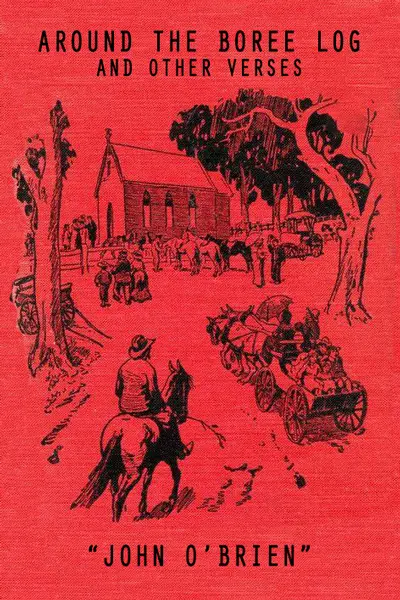
THE CLASSIC COLLECTION · 1921
"Around the Boree Log, and Other Verses" by John O'Brien is a collection of poems published in 1921. This Australian poetry collection contains 46 poems that paint vivid portraits of bush life, Irish-Australian pioneers, and the struggles of backcountry families. Written with swinging rhythms and humor, the verses invite readers to gather around a symbolic fire and hear stories of sunburnt plains, mountain ranges, and the brave mothers who shaped early Australian history. The collection blends religious faith with celebration of the Australian landscape.
Introduction adapted from the source catalogue; source summaries may be automatically generated.
Free to read · English · 23,480 words · No account needed
MAKE TIME FOR A GOOD BOOK
On by default. Untick to stop anonymous reading totals. Each page counts after 10 seconds in view. How this works.
Anonymous counting is on unless you have switched it off.
When sped abroad the message stern
On cantering hoofbeats borne
That old man Carey “took a turn,”
And might not see the morn.
What though debarred from Carey’s set,
What though ’twas plainly seen
The new house and its etiquette
Had made a gulf between,
What matter if they passed us by
And scorned us heretofore—
We could not spurn a neighbour’s cry
When trouble found his door.
So through the dark, a swinging light
Beneath the axle tied,
The neighbours braved the stormy night
When old man Carey died.
All blank was Carey’s new brick place
As, entering through the gloom
With noiseless step, we just might trace
Within a darkened room
The purple stole that purifies,
The old wife’s stricken head,
The Carey girls, with swollen eyes,
All kneeling round the bed—
We’d move the world to help them, then:
Our feuds were laid aside,
For all were neighbours once again
When old man Carey died.
And, when he’d paid the debt perforce
That every man must pay,
We came again with hearse and horse
To bear him on his way.
We left behind the new brick place
So strangely silent now,
The death-mask on its staring face,
The ashes on its brow;
Slow straggling down the winding road,
Past ripening crops a-sweep
Which old man Carey’s hands had sowed
But other hands would reap,
With slap and tap of unshod heels
We followed one by one,
And fifty sets of idling wheels
Were twinkling in the sun.
With many a tale of deeds unguessed,
Deeds of the early years,
We brought him to his long, long rest
Among the pioneers.
They have brought the news, my darlin’, that I’ve waited for so long. Faith, ’twas little news they brought me; every story, every song That I’ve heard since you enlisted seemed to bear the one refrain, Till the whole world used to tell me that you’d never come again. They’ve been cruel times, alannah, since you left us for the fight, Potterin’ dazed-like all the daytime, thinkin’, thinkin’ through the night; Yerra, what’s the use complainin’, when the world is all amiss, When the hopin’ and the strivin’ ever come to dust like this. ’Twas the green months when you left me; now the brown, brown months have come, Stand the ripe crops in the paddocks, but the harvesters are dumb. There’ll be flowers again in plenty, and a carpet o’er the plain— Oh, it’s hard you won’t be comin’ when the green months come again! Still, I’m thankful, oh, I’m thankful for one golden memory, That the last time spent together was to say The Rosary. Don’t you mind it, boy? we said it in my own room there beyond, Where I have the little altar where your early prayers you conned, By the statue that I cherish of the Holy Mother fair, With the blue cloak round her shoulders, and her white hands crossed in prayer. They were singin’ in the parlour, them that came to say good-bye; And they sang their gay songs to me—och, I knew the reason why! They are always land in trouble in this big warm-hearted land; Ah, but their way wasn’t my way, and they mightn’t understand. So I lit the little candles, and I beckoned you away, And you came—God bless you for it, boy—the partin’ prayer to say. Ay, the partin’ Rosary, darlin’—I can see you kneelin’ there, With your big broad shoulders bendin’, and your hands joined on the chair, And your man’s voice like an organ rollin’ out its soul apart— Och, to-night, boy, in my dreamin’ it is dronin’ in my heart. Yes, we said it with the music strummin’ ragtime songs throughout, Just our two selves there together, answerin’ t’other turn about. ’Tis a quare, quare world, alannah, when the storm can work its stress On the strong limb, while the withered leaf is left in loneliness. “Lay your treasure up in Heaven,” for there’s nothing here below; Och, we Irish mothers learned it in the old land long ago! Short life’s springtime with its blossom; and it comes not back again, Only haggard trees in winter stretchin’ naked limbs in pain. Oh, I’m thankin’ God, my bouhal,[11] though the achin’s in my breast, ’Twas He took you from me, darlin’, and He knoweth what is best: And His Holy Mother Mary, with her Baby on her knee, Sure she lost Him in His manhood, for He died at thirty-three. There’s a numbin’ in my heart, boy; like a cold, cold hand it grips— Oh, I’m thankful that we parted with the Rosary on your lips. It has ever been my refuge; it has been my hope and stay, Been my hymn of sweet thanksgivin’ for what good there came my way. It has been my only comfort when the heart was sick and sore, When the bad days past the countin’ flung their troubles round my door. I was taught it by my mother; ay, and when we crossed the sea For to seek the gold we never found—the old man there and me (Sure he stood six feet and higher then, and coal-black was his hair— Och, you’d never know ’twas him at all, that bent old man in there)— We have said it in the slab hut, strong and clear in flood and drought, Just our two selves there together “answerin’ up” and “givin’ out.” We have said it by the cradle, we have said it by the cot; When the babes the angels brought us made us happy in our lot, When the house was full of childer, and the pride of livin’ glowed, Och, we said it till the neighbours heard us, passin’ on the road. But ye’ve gone and left me lonely; one by one, my doves, ye flew; One by one the circle’s dwindled, till the Rosary’s said by two— Said by two old husky voices, old and weak and wearin’ out, Just our two old selves together, answerin’ t’other turn about. Sure it won’t be long, alannah, till the troubled sea is calm, And the beads drop from my fingers, and they bind them on my arm. You would tease me with the “trimmin’s” in the dear days that are dead, There’s another trimmin’ now, boy, every time the Rosary’s said. But there won’t be many Rosaries, for the singin’s in my ears And the Holy Mother’s beckonin’—I can see her through my tears. These old feet have done their journey, better leave them restin’, then; They will bring me to the hill-side ere the green months come again. Sure I’ll tread the House of Glory, where the soul is free from harm, And you’ll know ’tis me, alannah, by the Rosary on my arm.
Your reading position is saved on this browser. Take it to another device with a library code. Reading pages adapt to text, rather than matching a printed edition.
BEHIND THE BOOK
This eBook is for the use of anyone anywhere in the United States and most other parts of the world at no cost and with almost no restrictions whatsoever. You may copy it, give it away or re-use it under the terms of the Project Gutenberg License included with this eBook or online at www.gutenberg.org. If you are not located in the United States, you will have to check the laws of the country where you are located before using this eBook. Read the source licence.
The original source file, including credits and licence, is retained by this library. Request an original-format copy at no charge. Please include the book title and Project Gutenberg identifier #65204.
KEEP YOUR CURIOSITY GOING
Eric Mackay
Edmund Gosse
Sophia Margaretta Hensley
Gilbert Parker
George MacDonald

Elizabeth Bibesco