
Letters to a Friend, Written to Mrs. Ezra S. Carr, 1866-1879
John Muir
THE CLASSIC COLLECTION · 1923
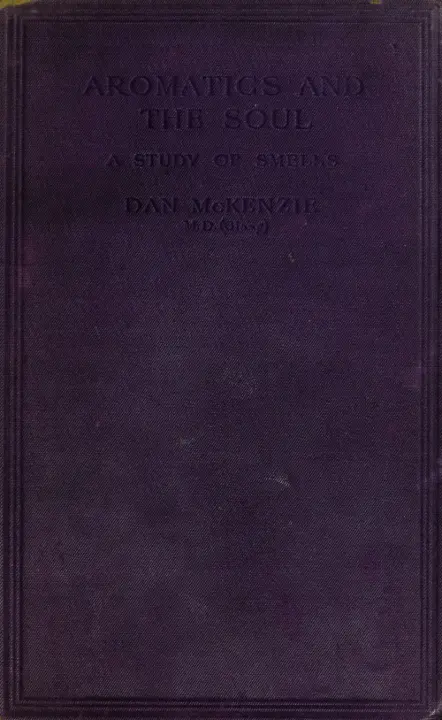
"Aromatics and the Soul: A Study of Smells" by Dan McKenzie is a scientific publication written in the early 20th century. The work delves into the significance of smells in human experience, particularly focusing on olfaction and its implications for public health, cultural practices, and memory. The author explores the various dimensions of scent, looking into both the physiological aspects and the emotional connections associated with aromas. The opening of the text begins with a preface that sets the stage for examining olfaction as a vital yet often overlooked sense in human life. McKenzie reflects on the criticisms received from a friend regarding the omission of certain anatomical details in the manuscript, including the vomero-nasal organ. He uses this critique to introduce the themes of the book, emphasizing the subjective nature of perceiving smells and their symbolic significance. McKenzie proceeds to outline the chapters ahead, hinting at a rich exploration of olfaction's role in health, history, and individual perception. He intertwines scientific insight with personal anecdotes, effectively engaging the reader while presenting olfaction as a profound aspect of human experience.
Introduction adapted from the source catalogue; source summaries may be automatically generated.
Free to read · English · 37,530 words · No account needed
MAKE TIME FOR A GOOD BOOK
On by default. Untick to stop anonymous reading totals. Each page counts after 10 seconds in view. How this works.
Anonymous counting is on unless you have switched it off.
Thus the flavour of peaches can be compounded artificially of aldehyde, acetate, formate, butyrate, valerianate, œnanthylate, and sebate of ethyl, and salicylate of methyl, with glycerine, glycerine being added to the fruit essences, as it is to wines, in order to restrain the evaporation of the volatile bodies. (The fruit essences are used only in the making of flavours. They cannot be employed as perfumes, as they are too irritating to the nose.)
The union of components to form a product different from any one of them is found also in vision. When the colours of the spectrum, for example, are commingled, the resultant white light is devoid of any colour.
Thus the potential responsiveness of the olfactory organ seems to be practically inexhaustible. So far, at all events, it has not yet reached the limits of its capacity.
The number and variety of recognised smells being so great, then, one can readily understand how difficult it is to construct a classification of odours. Many attempts have, in fact, been made, but, depending as they do more or less upon subjective sensation, no two classifiers give us the same classification. Indeed, a division of all smells into “nice,” “neutral,” and “nasty” would be about as good as many much more ambitious efforts.
Zwaardemaker’s is the classification most usually followed at present, and as it is to him we owe most of our knowledge of scientific olfaction, we shall detail it here:
(1) Ethereal or fruity odours; (2) aromatic, including as sub-classes camphrous, herbaceous, anisic and thymic, citronous, and the bitter almond group; (3) balsamic, with sub-groups floral, liliaceous, and vanillar; (4) ambrosial or muscous; (5) garlicky (including garlic), oniony, fishy, and the bromine type of odour; (6) empyreumatic (guaiacol); (7) caprylic (valerianic acid); (8) disgusting; and (9) nauseating.
The subjective character of these classes is obvious, especially in the last two groups, but, apart from that objection, most people will be inclined to protest when they learn that chloroform and iodoform are put into the first, the ethereal or fruity, group, while it is suggested, though to be sure with a query, that coffee, bread, and burnt sugar may belong to the “repulsive” (pyridine) group!
The fact is that Zwaardemaker’s classification is based upon a chemical foundation, that is to say, upon properties which, as we shall see later on, do not necessarily correspond with the odours as we smell them. That, no doubt, explains his inclusion of iodoform among the “fruity” odours.—Iodoform fruity!—Shades of George Saintsbury and his “Cellar Book”!
Your reading position is saved on this browser. Take it to another device with a library code. Reading pages adapt to text, rather than matching a printed edition.
BEHIND THE BOOK
This eBook is for the use of anyone anywhere in the United States and most other parts of the world at no cost and with almost no restrictions whatsoever. You may copy it, give it away or re-use it under the terms of the Project Gutenberg License included with this eBook or online at www.gutenberg.org. If you are not located in the United States, you will have to check the laws of the country where you are located before using this eBook. Read the source licence.
The original source file, including credits and licence, is retained by this library. Request an original-format copy at no charge. Please include the book title and Project Gutenberg identifier #60584.
KEEP YOUR CURIOSITY GOING
John Muir

Asa Gray
Asa Gray

Florence Nightingale
Elizabeth Robins Pennell
Denison Olmsted