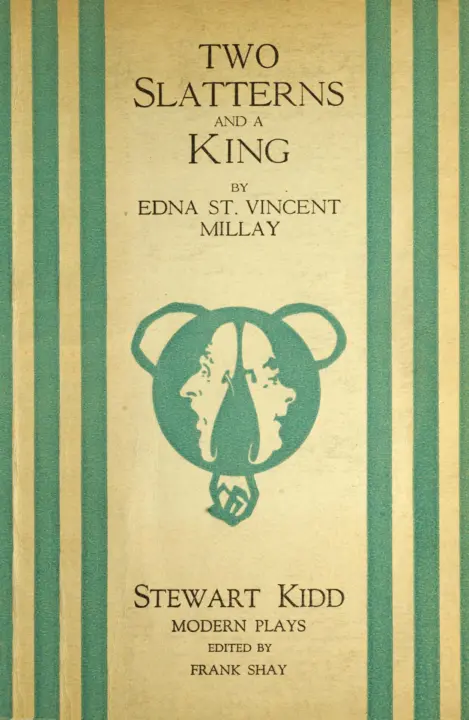
Two Slatterns and a King: A Moral Interlude
Edna St. Vincent Millay
THE CLASSIC COLLECTION · 1920
"Aria da Capo" by Edna St. Vincent Millay is a play in one act written in the early 20th century. This theatrical work presents a whimsical yet poignant narrative that delves into themes of love, the intricacies of relationships, and the contrast between tragedy and farce. Set within a colorful and metaphorical framework, it intertwines elements of both comedy and seriousness, presenting a unique commentary on human emotions and societal expectations. The story unfolds in a two-part structure, beginning with the main characters, Pierrot and Columbine, engaged in a seemingly trivial dining conversation filled with humor and banter. Their light-hearted interaction is interrupted by Cothurnus, a figure representing the weight of tragedy, who attempts to integrate a more serious tone. Meanwhile, shepherds Thyrsis and Corydon illustrate their own narrative of conflict and disillusionment as they quarrel over imaginary boundaries between themselves and their sheep. The play juxtaposes these two dialogues, ultimately leading to a tragic conclusion where misunderstandings and jealousy culminate in violent circumstances, only to be ignored and transformed back into farce by Pierrot and Columbine. This cyclical structure emphasizes the absurdity of life, a reflection on the human condition wrapped in humor and sorrow.
Introduction adapted from the source catalogue; source summaries may be automatically generated.
Free to read · English · 7,320 words · No account needed
MAKE TIME FOR A GOOD BOOK
On by default. Untick to stop anonymous reading totals. Each page counts after 10 seconds in view. How this works.
Anonymous counting is on unless you have switched it off.
PIERROT: Of course not.
There never was. “Moon’s” just a word to swear by.
“Mutton!”—now there’s a thing you can lay the hands on,
And set the tooth in! Listen, Columbine:
I always lied about the moon and you.
Food is my only lust.
COLUMBINE: Well, eat it, then,
For Heaven’s sake, and stop your silly noise!
I haven’t heard the clock tick for an hour.
PIERROT: It’s ticking all the same. If you were a fly, You would be dead by now. And if I were a parrot, I could be talking for a thousand years!
[Enter COTHURNUS.]
PIERROT: Hello, what’s this, for God’s sake?—
What’s the matter?
Say, whadda you mean?—get off the stage, my friend,
And pinch yourself,—you’re walking in your sleep!
COTHURNUS: I never sleep.
PIERROT: Well, anyhow, clear out.
You don’t belong on here. Wait for your own scene!
Whadda you think this is,—a dress‐rehearsal?
COTHURNUS: Sir, I am tired of waiting. I will wait
No longer.
PIERROT: Well, but whadda you going to do?
The scene is set for me!
COTHURNUS: True, sir; yet I
Can play the scene.
PIERROT: Your scene is down for later!
COTHURNUS: That, too, is true, sir; but I play it now.
PIERROT: Oh, very well!—Anyway, I am tired
Of black and white. At least, I think I am.
[Exit COLUMBINE.]
Yes, I am sure I am. I know what I’ll do!— I’ll go and strum the moon, that’s what I’ll do. . . . Unless, perhaps . . . you never can tell . . . I may be, You know, tired of the moon. Well, anyway, I’ll go find Columbine. . . . And when I find her, I will address her thus: “Ehè, Pierrette!”— There’s something in that.
[Exit PIERROT.]
COTHURNUS: You, Thyrsis! Corydon!
Where are you?
THYRSIS: [Off stage.] Sir, we are in our dressing‐room!
COTHURNUS: Come out and do the scene.
CORYDON: [Off stage.] You are mocking us!—
The scene is down for later.
COTHURNUS: That is true;
But we will play it now. I am the scene.
[Seats himself on high place in back of stage.]
[Enter CORYDON and THYRSIS.]
CORYDON: Sir, we are counting on this little hour.
We said, “Here is an hour,—in which to think
A mighty thought, and sing a trifling song,
And look at nothing.”—And, behold! the hour,
Even as we spoke, was over, and the act begun,
Under our feet!
THYRSIS: Sir, we are not in the fancy
To play the play. We had thought to play it later.
Your reading position is saved on this browser. Take it to another device with a library code. Reading pages adapt to text, rather than matching a printed edition.
Edna St. Vincent Millay
Edna St. Vincent Millay
Edna St. Vincent Millay
Edna St. Vincent Millay
BEHIND THE BOOK
This eBook is for the use of anyone anywhere in the United States and most other parts of the world at no cost and with almost no restrictions whatsoever. You may copy it, give it away or re-use it under the terms of the Project Gutenberg License included with this eBook or online at www.gutenberg.org. If you are not located in the United States, you will have to check the laws of the country where you are located before using this eBook. Read the source licence.
The original source file, including credits and licence, is retained by this library. Request an original-format copy at no charge. Please include the book title and Project Gutenberg identifier #5790.
KEEP YOUR CURIOSITY GOING
Maurice Baring
W. B. (William Butler) Yeats
Edward Martyn

John Brougham & Charlotte Brontë
Marguerite Merington
Leonid Andreyev