THE CLASSIC COLLECTION✦Salve Venetia, gleanings from Venetian history; vol. IICLASSIC FREE BOOKS
Salve Venetia, gleanings from Venetian history; vol. II
F. Marion (Francis Marion) Crawford
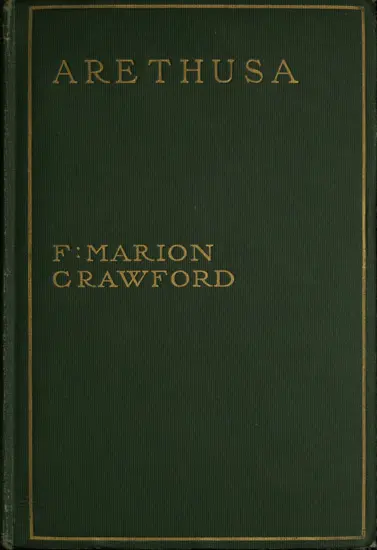
THE CLASSIC COLLECTION · 1906
"Arethusa" by F. Marion Crawford is a historical novel written in the early 20th century. Set in 14th century Constantinople, the narrative centers around Carlo Zeno, a Venetian merchant with a colorful past, as he navigates both the complexities of the city and the societal issues of his time, including slavery and intrigue. The story aims to explore themes of identity, survival, and social class through the lens of its characters, particularly focusing on the dynamics between privilege and poverty. At the start of the narrative, we are introduced to Carlo Zeno, who is settling into his life as a merchant in Constantinople after a tumultuous past. He observes the city around him, filled with its vibrant cultures and discord between different nationalities, particularly between Venetians and Genoese. As the plot unfolds, Zeno receives a letter from a friend in Venice, requesting him to purchase a slave girl for his wife, setting the stage for the exploration of human relationships under the conditions of slavery. The narrative simultaneously introduces a young girl named Zoë, living in the depths of poverty with her ailing mother, whose fate is intricately linked to Zeno’s decision about the slave market. This opening serves as a critical setup for the characters' intertwining destinies and the moral dilemmas they face.
Introduction adapted from the source catalogue; source summaries may be automatically generated.
Free to read · English · 101,479 words · No account needed
MAKE TIME FOR A GOOD BOOK
On by default. Untick to stop anonymous reading totals. Each page counts after 10 seconds in view. How this works.
Anonymous counting is on unless you have switched it off.
She had been sold herself, when she was thirteen.
'Of course,' she added, 'the handsome ones were kept apart from us and were better fed before they were sold, but we waited on them--we whom no one would buy except to make us work--and so we saw them every day.'
'He says he will give a hundred Venetian ducats for me, does he not?'
'Yes; and you are worth three hundred anywhere,' answered the old slave, and the tears came to her eyes, though she tried to squeeze them back with her crooked fingers.
The sick woman called to the two in a weak voice. Zoë was at her side instantly, and Nectaria shuffled as fast as she could to the pan of coals and crouched down to blow upon the embers in order to warm some milk.
'I am cold,' complained the sufferer, 'so cold!'
Zoë found one of her hands and began to chafe it gently between her
own.
'It is like ice,' she said.
The girl was ill-clothed enough, as it was, and the early spring night was chilly; but she slipped off her ragged outer garment, the long-skirted coat of the Greeks, and spread it over the other wretched coverings of the bed, tucking it in round her mother's neck.
'But you, child?' protested the sick woman feebly.
'I am too hot, mother,' answered Zoë, whose teeth were chattering.
Nectaria brought the warm milk, and Zoë lifted the pillow as she had done before, and held the cup to the eager lips till the liquid was all gone.
'It is of no use,' sighed her mother. 'I shall die. I shall not live
till morning.'
She had been a very great lady of Constantinople, the Kyría Agatha, wife of the Protosparthos Michael Rhangabé, whom the Emperor Andronicus had put to death with frightful tortures more than a year ago, because he had been faithful to the Emperor Johannes. Until her husband had been imprisoned, she had spent her life in a marble palace by the Golden Horn, or in a beautiful villa on the Bosphorus. She had lived delicately and had loved her existence, and even after all her husband's goods had been confiscated as well as all her own, she had lived in plenty for many months with her children, borrowing here and there of her friends and relatives. But they had forsaken her at last; not but that some of them were generous and would have supported her for years, if it had been only a matter of money, but it had become a question of life and death after Rhangabé had been executed, and none of them would risk being blinded, or maimed, or perhaps strangled for the sake of helping her. Then she had fallen into abject poverty; her slaves had all been taken from her with the rest of the property and sold again in the market, but old Nectaria had hidden herself and so had escaped; and she, who knew the city, had brought Kyría Agatha and her three children to the beggars' quarter as a last refuge, when no one would take them in. The old slave had toiled for them, and begged for them, and would have stolen for them if she had not been profoundly convinced that stealing was not only a crime punishable at the very least by the loss of the right hand, but that it was also a much greater sin because it proved that the thief did not believe in the goodness of Providence. For Providence, said Nectaria, was always right, and so long as men did right, men and Providence must necessarily agree; in other words, all would end well, either on earth or in heaven. But to steal, or kill by treachery, or otherwise to injure one's neighbour for one's own advantage, was to interfere with the ways of Providence, and people who did such things would in the end find themselves in a place diametrically opposite to that heaven in which Providence resided. Of its kind, Nectaria's reasoning was sound, and whether truly philosophical or not, it was undeniably moral.
Your reading position is saved on this browser. Take it to another device with a library code. Reading pages adapt to text, rather than matching a printed edition.
F. Marion (Francis Marion) Crawford
F. Marion (Francis Marion) Crawford
F. Marion (Francis Marion) Crawford
F. Marion (Francis Marion) Crawford
BEHIND THE BOOK
This eBook is for the use of anyone anywhere in the United States and most other parts of the world at no cost and with almost no restrictions whatsoever. You may copy it, give it away or re-use it under the terms of the Project Gutenberg License included with this eBook or online at www.gutenberg.org. If you are not located in the United States, you will have to check the laws of the country where you are located before using this eBook. Read the source licence.
The original source file, including credits and licence, is retained by this library. Request an original-format copy at no charge. Please include the book title and Project Gutenberg identifier #41929.
KEEP YOUR CURIOSITY GOING
Cécile Tormay

Moritz Busch
Coulson Kernahan
John L. Ransom

Maurice Baring
Frances Wright