THE CLASSIC COLLECTION✦Salve Venetia, gleanings from Venetian history; vol. IICLASSIC FREE BOOKS
Salve Venetia, gleanings from Venetian history; vol. II
F. Marion (Francis Marion) Crawford
THE CLASSIC COLLECTION · 1906
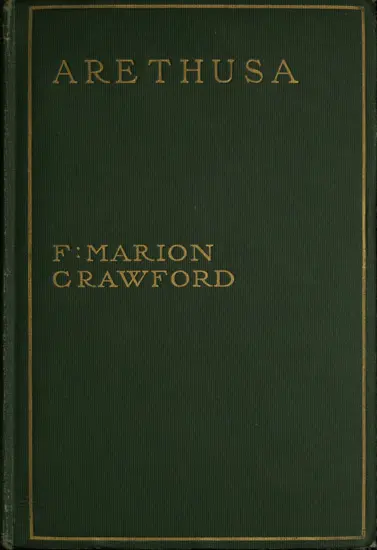
"Arethusa" by F. Marion Crawford is a historical novel written in the early 20th century. Set in 14th century Constantinople, the narrative centers around Carlo Zeno, a Venetian merchant with a colorful past, as he navigates both the complexities of the city and the societal issues of his time, including slavery and intrigue. The story aims to explore themes of identity, survival, and social class through the lens of its characters, particularly focusing on the dynamics between privilege and poverty. At the start of the narrative, we are introduced to Carlo Zeno, who is settling into his life as a merchant in Constantinople after a tumultuous past. He observes the city around him, filled with its vibrant cultures and discord between different nationalities, particularly between Venetians and Genoese. As the plot unfolds, Zeno receives a letter from a friend in Venice, requesting him to purchase a slave girl for his wife, setting the stage for the exploration of human relationships under the conditions of slavery. The narrative simultaneously introduces a young girl named Zoë, living in the depths of poverty with her ailing mother, whose fate is intricately linked to Zeno’s decision about the slave market. This opening serves as a critical setup for the characters' intertwining destinies and the moral dilemmas they face.
Introduction adapted from the source catalogue; source summaries may be automatically generated.
Free to read · English · 101,479 words · No account needed
MAKE TIME FOR A GOOD BOOK
On by default. Untick to stop anonymous reading totals. Each page counts after 10 seconds in view. How this works.
Anonymous counting is on unless you have switched it off.
'Yes, sir. I pray every day for strength to withstand it. Nevertheless, though I know it is a sin it sometimes leads me to learn things which are of use. I do not think that if you knew what I know, sir, you would contemplate the possibility of disposing of----'
'You talk too much,' said Zeno. 'If you have anything to say, then say it. If you have nothing to say, then say nothing. But do not talk. What have you found out?'
Thus deprived of the pleasure of telling a long story, Omobono
conscientiously tried to impart his information in the fewest possible
words.
'The lady is not called Arethusa, sir. Before she sold herself to Rustan to save her people from starvation she was called Zoë Rhangabé, the daughter of the Protosparthos who was executed by Andronicus----'
'Rhangabé?' repeated Zeno, not believing him; for it was a great name,
and is still.
'Yes, sir. But that was not her name, either, for he and his wife had adopted her because they had no children, but afterwards two boys were born to them----'
'Confound their boys!' interrupted Zeno. 'Who is she?'
'Her real name is Bianca Giustiniani; she is a Venetian by birth, and her father and mother died of the plague here soon after she was born. You see, sir, under the circumstances, and although the lady called herself a slave, such a commission as Messer Marco Pesaro's----'
'Omobono,' said Zeno, interrupting him again, 'get a priest here at once. I am going to be married.'
'Married, sir?' The little secretary was aghast.
'Send Vito for the priest!'
And before Omobono could say more, Zeno had left the room.
He found Zoë standing by the open window, and the morning sun was still streaming in. Her hair was not taken up yet, but lay like silk all over her shoulders, still damp from the bath. She was a little pale, as a flower that has blossomed in a dark room, and the rough white silk of the robe she drew closely round her showed by contrast the delicate tint and texture of her skin, and the sweet freshness of the tender and spiritual mouth.
He took her hand and looked at her earnestly before he spoke. Only a night, a day and a night, had passed since he had understood what had hidden itself in his heart for weeks. That same truth had stolen into hers, too, but she had known what it meant.
'You kept your secret well,' he said--'too well!'
She shook her head, thinking he spoke of her love.
Your reading position is saved on this browser. Take it to another device with a library code. Reading pages adapt to text, rather than matching a printed edition.
F. Marion (Francis Marion) Crawford
F. Marion (Francis Marion) Crawford
F. Marion (Francis Marion) Crawford
F. Marion (Francis Marion) Crawford
BEHIND THE BOOK
This eBook is for the use of anyone anywhere in the United States and most other parts of the world at no cost and with almost no restrictions whatsoever. You may copy it, give it away or re-use it under the terms of the Project Gutenberg License included with this eBook or online at www.gutenberg.org. If you are not located in the United States, you will have to check the laws of the country where you are located before using this eBook. Read the source licence.
The original source file, including credits and licence, is retained by this library. Request an original-format copy at no charge. Please include the book title and Project Gutenberg identifier #41929.
KEEP YOUR CURIOSITY GOING
Cécile Tormay

Moritz Busch
Coulson Kernahan
John L. Ransom

Maurice Baring
Frances Wright