THE CLASSIC COLLECTION✦Salve Venetia, gleanings from Venetian history; vol. IICLASSIC FREE BOOKS
Salve Venetia, gleanings from Venetian history; vol. II
F. Marion (Francis Marion) Crawford
THE CLASSIC COLLECTION · 1906
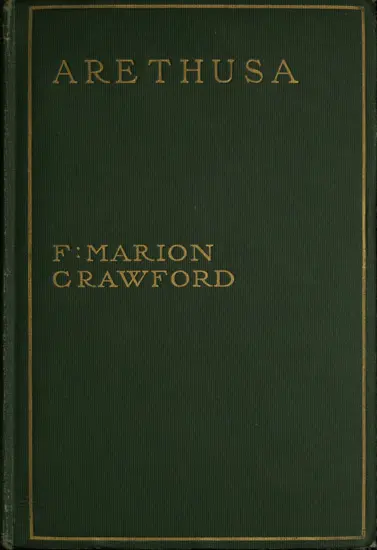
"Arethusa" by F. Marion Crawford is a historical novel written in the early 20th century. Set in 14th century Constantinople, the narrative centers around Carlo Zeno, a Venetian merchant with a colorful past, as he navigates both the complexities of the city and the societal issues of his time, including slavery and intrigue. The story aims to explore themes of identity, survival, and social class through the lens of its characters, particularly focusing on the dynamics between privilege and poverty. At the start of the narrative, we are introduced to Carlo Zeno, who is settling into his life as a merchant in Constantinople after a tumultuous past. He observes the city around him, filled with its vibrant cultures and discord between different nationalities, particularly between Venetians and Genoese. As the plot unfolds, Zeno receives a letter from a friend in Venice, requesting him to purchase a slave girl for his wife, setting the stage for the exploration of human relationships under the conditions of slavery. The narrative simultaneously introduces a young girl named Zoë, living in the depths of poverty with her ailing mother, whose fate is intricately linked to Zeno’s decision about the slave market. This opening serves as a critical setup for the characters' intertwining destinies and the moral dilemmas they face.
Introduction adapted from the source catalogue; source summaries may be automatically generated.
Free to read · English · 101,479 words · No account needed
MAKE TIME FOR A GOOD BOOK
On by default. Untick to stop anonymous reading totals. Each page counts after 10 seconds in view. How this works.
Anonymous counting is on unless you have switched it off.
'That is it. But without the master's orders----'
Vito looked at her doubtfully, for he had been reminded that she considered herself a slave, and it occurred to him that she meant to escape in Zeno's absence.
'Messer Carlo would wish me to go, if he were here,' said Zoë quietly, and not at all as if she were insisting, for she saw what was the matter.
'I have no doubt it is as you say,' Vito answered. 'But I have no
orders.'
'There is a message from the master to some one in the palace,' Zoë explained. 'No one but I can deliver it.'
'That is easily said,' observed Vito bluntly. 'There are no orders.'
Zoë felt the blood rising to her forehead at the man's rudeness and distrust of her, but she controlled herself, for much depended on obtaining what she wished.
'It is not a message,' she said; 'it is a letter.'
'Where is it?' asked Vito incredulously.
'I will show it to you,' Zoë answered, but she first turned to the maids, who waited at the end of the room. 'Go and prepare me the bath,' she said.
The two disappeared, though they did not believe that their mistress really wished to bathe again so soon. When they were gone, she stooped and took the letter from her shoe, unfolded it, and spread it out for Vito to see. The effect it made upon him was instantaneous; he looked at it carefully, and took a corner of it between his thumb and finger.
'This is the paper on which the master writes,' he said, as if
convinced.
It did not occur to him that the slave Arethusa could write at all, nor any one else in the house except Omobono; and as for the latter, if he had written anything he must have done so under Zeno's orders. Writing of any sort commanded his profound and almost superstitious respect.
'This is certainly a letter from the master,' he said, satisfied at last, after what he considered a thoroughly conscientious inspection.
'And he wishes me to deliver it,' Zoë said. 'If I am to do that, you must be good enough to take me to the landing in the boat. There is no other way.'
'I could take the letter myself,' Vito suggested.
'No. Only a woman will be allowed to pass, where this must go.'
Vito began to understand, and nodded his head wisely.
Your reading position is saved on this browser. Take it to another device with a library code. Reading pages adapt to text, rather than matching a printed edition.
F. Marion (Francis Marion) Crawford
F. Marion (Francis Marion) Crawford
F. Marion (Francis Marion) Crawford
F. Marion (Francis Marion) Crawford
BEHIND THE BOOK
This eBook is for the use of anyone anywhere in the United States and most other parts of the world at no cost and with almost no restrictions whatsoever. You may copy it, give it away or re-use it under the terms of the Project Gutenberg License included with this eBook or online at www.gutenberg.org. If you are not located in the United States, you will have to check the laws of the country where you are located before using this eBook. Read the source licence.
The original source file, including credits and licence, is retained by this library. Request an original-format copy at no charge. Please include the book title and Project Gutenberg identifier #41929.
KEEP YOUR CURIOSITY GOING
Cécile Tormay

Moritz Busch
Coulson Kernahan
John L. Ransom

Maurice Baring
Frances Wright