
Last letters from the living dead man
David Patterson (Spirit) Hatch
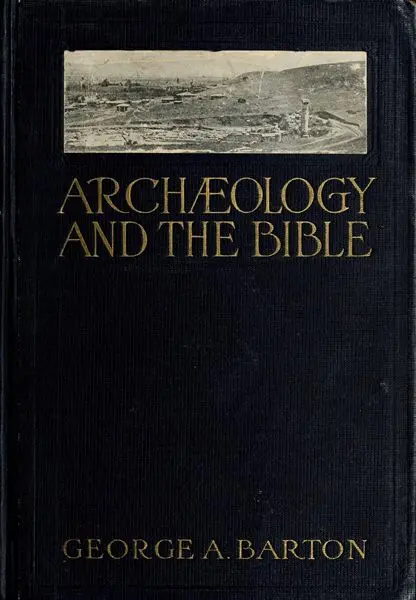
THE CLASSIC COLLECTION · 1916
"Archæology and the Bible" by George A. Barton is a scholarly work that intertwines archaeology with biblical studies, written in the early 20th century. The book systematically explores how archaeological findings illuminate and enrich our understanding of the Bible, particularly in the context of the biblical lands including Egypt and Palestine. Barton aims to provide valuable insights into the historical backdrop of scripture, offering translations of ancient texts that confirm or enhance biblical narratives. The opening of the book introduces the significance of archaeological exploration over the previous century, which has dramatically changed perceptions of biblical history. The author explains that discoveries in regions like Egypt and Palestine have uncovered artifacts and texts that bring clarity and vividness to biblical accounts, especially those related to key figures and events. Barton outlines his intention to collate this vast array of findings into a single volume that serves as a comprehensive reference for pastors and educators, while simultaneously inviting wider readership to appreciate the depth and context that archaeology adds to the biblical text.
Introduction adapted from the source catalogue; source summaries may be automatically generated.
Free to read · English · 195,167 words · No account needed
MAKE TIME FOR A GOOD BOOK
On by default. Untick to stop anonymous reading totals. Each page counts after 10 seconds in view. How this works.
Anonymous counting is on unless you have switched it off.
=4. A Babylonian Hymn to Sin, the Moon-god.=[564]
O brilliant barque of the heavens, ruler in thy own right, Father Nannar, lord of Ur, Father Nannar, lord of Ekishshirgal, Father Nannar, lord of the brilliant rising, 5. O lord, Nannar, firstborn son of Bel, Thou standest, thou standest Before thy father Bel. Thou art ruler, Father Nannar; thou art ruler, thou art guide. O barque, when standing in the midst of heaven, thou art ruler. 10. Father Nannar, thou thyself ridest to the brilliant temple. Father Nannar, when, like a ship, thou goest in the midst of the deep, Thou goest, thou goest, thou goest, Thou goest, thou shinest anew, thou goest, Thou shinest anew, thou livest again, thou goest. 15. Father Nannar, the herd thou restorest. When thy father looketh on thee with joy, he commandeth thy waxing, Then with the glory of a king brilliantly thou risest. Bel a scepter for distant days for thy hands has completed. In Ur as the brilliant barque thou ridest, 20. As the lord, Nudimmud, thou art established; In Ur as the brilliant boat thou ridest. ...........................................
Reverse
............................................... The river of Bel (?) [Nannar] fills with water. The brilliant (?) river [Nannar] fills with water. The river Tigris [Nannar] fills with water. 5. The brilliance of the Euphrates [Nannar] fills with water. The canal with its gate Lukhe, [Nannar] fills with water. The great marsh and the little marsh Nannar fills with water.
The preceding hymn is made up of a description of the movements and changes of the moon, together with the expression of a superstition, which is still widely prevalent, that the moon’s changes control the rainfall. It is a fair example of a Babylonian nature-psalm. It lacks the inspired and inspiring power of such Hebrew nature-psalms as Psalms 8, 19, 146, 147, and 148.
=5. A Babylonian Hymn to Bel.=[565]
O lord of wisdom ................ ruler in thy own right, O Bel, lord of wisdom .......... ruler in thy own right, O father Bel, lord of the lands, O father Bel, lord of truthful speech, 5. O father Bel, shepherd of the black-headed ones,[566] O father Bel, who thyself openest the eyes, O father Bel, the warrior, prince among soldiers, O father Bel, supreme power of the land, Bull of the corral, warrior who leadest captive all the land. 10. O Bel, proprietor of the broad land, Lord of creation, thou art chief of the land, The lord whose shining oil is food for an extensive offspring, The lord whose edicts bind together the city, The edict of whose dwelling place strikes down the great prince 15. From the land of the rising to the land of the setting sun. O mountain, lord of life, thou art indeed lord! O Bel of the lands, lord of life, thou thyself art lord of life. O mighty one, terrible one of heaven, thou art guardian indeed! O Bel, thou art lord of the gods indeed! 20. Thou art father, Bel, who causest the plants of the gardens to grow! O Bel, thy great glory may they fear! The birds of heaven and the fish of the deep are filled with fear [of thee]. O father Bel, in great strength thou goest, prince of life, shepherd of the stars! O lord, the secret of production thou openest, the feast of fatness establishest, to work thou callest! 25. Father Bel, faithful prince, mighty prince, thou createst the strength of life!
Your reading position is saved on this browser. Take it to another device with a library code. Reading pages adapt to text, rather than matching a printed edition.
BEHIND THE BOOK
This eBook is for the use of anyone anywhere in the United States and most other parts of the world at no cost and with almost no restrictions whatsoever. You may copy it, give it away or re-use it under the terms of the Project Gutenberg License included with this eBook or online at www.gutenberg.org. If you are not located in the United States, you will have to check the laws of the country where you are located before using this eBook. Read the source licence.
The original source file, including credits and licence, is retained by this library. Request an original-format copy at no charge. Please include the book title and Project Gutenberg identifier #43070.
KEEP YOUR CURIOSITY GOING
David Patterson (Spirit) Hatch

David Patterson (Spirit) Hatch

David Patterson (Spirit) Hatch

Edwin Abbott Abbott

Richard Watson
T. G. (Theophilus Gould) Steward