
Last letters from the living dead man
David Patterson (Spirit) Hatch
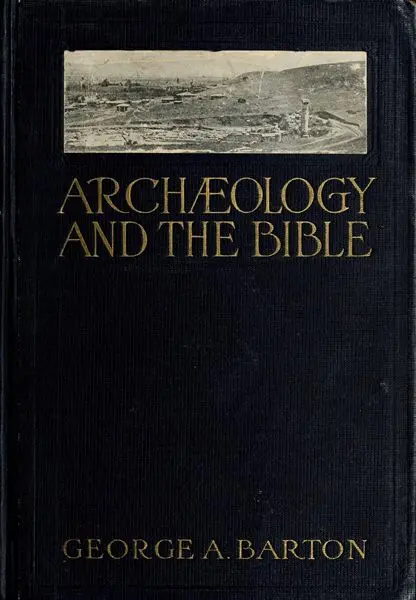
THE CLASSIC COLLECTION · 1916
"Archæology and the Bible" by George A. Barton is a scholarly work that intertwines archaeology with biblical studies, written in the early 20th century. The book systematically explores how archaeological findings illuminate and enrich our understanding of the Bible, particularly in the context of the biblical lands including Egypt and Palestine. Barton aims to provide valuable insights into the historical backdrop of scripture, offering translations of ancient texts that confirm or enhance biblical narratives. The opening of the book introduces the significance of archaeological exploration over the previous century, which has dramatically changed perceptions of biblical history. The author explains that discoveries in regions like Egypt and Palestine have uncovered artifacts and texts that bring clarity and vividness to biblical accounts, especially those related to key figures and events. Barton outlines his intention to collate this vast array of findings into a single volume that serves as a comprehensive reference for pastors and educators, while simultaneously inviting wider readership to appreciate the depth and context that archaeology adds to the biblical text.
Introduction adapted from the source catalogue; source summaries may be automatically generated.
Free to read · English · 195,167 words · No account needed
MAKE TIME FOR A GOOD BOOK
On by default. Untick to stop anonymous reading totals. Each page counts after 10 seconds in view. How this works.
Anonymous counting is on unless you have switched it off.
At that time I marched along Mount Lebanon, unto the great sea of the land of the Amorites I went up. In the great sea I cleansed my weapons. I made sacrifices to the gods. The tribute of the kings by the side of the sea, from the land of the Tyrian, the land of the Sidonian, the land of the Gebalite, the land of the Maḫallatite, the land of the Maisite, the land of the Kaisite, the land of the Amorite, and the city Arvad, which is in the midst of the sea; silver, gold, lead, copper, copper vessels, garments of bright colored stuffs, cloth, a great pagutu, a small pagutu, ushu-wood, ukarinnu-wood, teeth of a sperm-whale porpoise, a creature of the sea, as their tribute I received; they embraced my feet. To Mount Amanus I ascended; beams of cedar, cypress, juniper, pine, I cut. Sacrifices to my gods I offered. A pillar recording my warlike deeds I set up.
This inscription records the first approach of an Assyrian king to Hebrew territory. He did not actually come into contact with the Israelites, though he took tribute from their neighbors, the Tyrians and Sidonians. The expedition of Ashurnasirpal was, however, the precursor of many others which progressed further.
Ashurnasirpal, like Gudea and Hrihor, secured wood from this region for his buildings, thus affording another parallel to Solomon’s procedure.
=6. Shalmaneser III.=
Shalmaneser III, the son and successor of Ashurnasirpal, reigned from 859 to 825 B. C. He not only approached more closely to Palestine, but claims to have taken tribute from her kings. In the case of King Jehu the claim is no doubt true. The following extracts give the accounts in Shalmaneser’s own words.[500]
In the eponym year of Dan-Ashur (i. e., 854 B. C.), month Aru, 14th day, I departed from the city of Nineveh; I crossed the river Tigris ....... to the city Qarqar I approached. Qarqar, his royal city, I destroyed, I devastated, I burned with fire. 1,200 chariots, 1,200 horsemen, 20,000 men of Hadadidri (Benhadad) of Damascus; 700 chariots, 700 horsemen, 10,000 men of Irhulina, the Hamathite; 2,000 chariots, 10,000 men of Ahab, the Israelite; 500 men of the Quæan (i. e., Que, in Cilicia); 1,000 men of the Musræan; 10,000 chariots, 10,000 men of the Irqantæan; 200 men of Matinu-ba’li, the Arvadite; 200 men of the Usantæan; 30 chariots, 10,000 men of Adunu-ba’li, the Shianian; 1,000 camels of Gindibu, the Arabian; 1,000 (?) men of Basa, son of Ruhubi, the Ammonite--these 12 kings he took as his helpers and they came to make battle and war against me. With the exalted power which Ashur, the lord, had given me, with powerful weapons, which Nergal, who goes before me, had presented me, I fought with them; from Qarqar to Gilzan I accomplished their defeat. 14,000 of their troops I overthrew with arms, like Adad I poured out a flood upon them; I flung afar their corpses, I filled the plain with their mighty troops. With weapons I made their blood to flow .......... The field was too narrow for smiting (?) them, the broad plain (?) was used (?) for burying their bodies. With their corpses I dammed the Orontes as with a dam (?). In that battle their chariots, their horsemen, their horses, harnesses, and yokes I took.
Your reading position is saved on this browser. Take it to another device with a library code. Reading pages adapt to text, rather than matching a printed edition.
BEHIND THE BOOK
This eBook is for the use of anyone anywhere in the United States and most other parts of the world at no cost and with almost no restrictions whatsoever. You may copy it, give it away or re-use it under the terms of the Project Gutenberg License included with this eBook or online at www.gutenberg.org. If you are not located in the United States, you will have to check the laws of the country where you are located before using this eBook. Read the source licence.
The original source file, including credits and licence, is retained by this library. Request an original-format copy at no charge. Please include the book title and Project Gutenberg identifier #43070.
KEEP YOUR CURIOSITY GOING
David Patterson (Spirit) Hatch

David Patterson (Spirit) Hatch

David Patterson (Spirit) Hatch

Edwin Abbott Abbott

Richard Watson
T. G. (Theophilus Gould) Steward