Fortune
J. C. (John Collis) Snaith
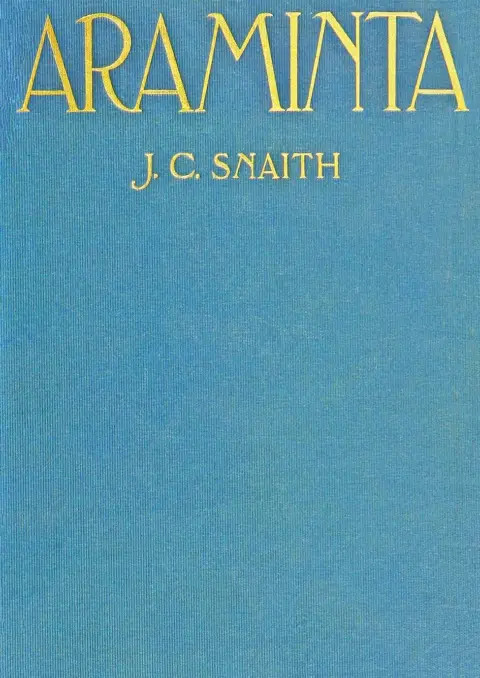
THE CLASSIC COLLECTION · 1908
"Araminta" by J. C. Snaith is a novel written in the early 20th century. The story revolves around an elderly, formidable woman named Caroline Crewkerne, who is preparing to celebrate her seventy-fourth birthday amidst a gathering of eccentric characters and social nuances. The narrative sets the stage for the introduction of her neice, Araminta, whose arrival may bring about unexpected changes in Caroline's meticulously structured life. The opening portion of the novel introduces readers to the cantankerous yet charming old lady, Caroline, showcasing her sharp wit and disdain for societal pretensions. As she contemplates her own discontent, her thoughts turn to the arrival of her niece, Araminta, who is unknowingly stepping into a humorous and chaotic family dynamic. The character of Miss Perry, Araminta’s first appearance as she arrives in a mismatched outfit, sets a lively tone for the narrative and emphasizes themes of class absurdity and familial tensions. The stage is cleverly set for the ensuing conflicts and comedic situations that arise as Miss Perry’s presence disrupts Caroline’s established order.
Introduction adapted from the source catalogue; source summaries may be automatically generated.
Free to read · English · 99,221 words · No account needed
MAKE TIME FOR A GOOD BOOK
On by default. Untick to stop anonymous reading totals. Each page counts after 10 seconds in view. How this works.
Anonymous counting is on unless you have switched it off.
“I hope you are quite free of the old trouble?” said Cheriton,
solicitously.
“Free as I ever shall be,” said George.
“As I haven’t seen you about lately I was beginning to fear that you
were laid up again.”
“No,” said George; and then, like the consummate blunderer he was, he fell into the trap. “Why,” he said, “didn’t I see you at Hill Street yesterday?”
“Hill Street!” said Cheriton, with an air of complete innocence. “You might have seen me, but I didn’t see you.”
“You were there, anyhow,” said George, “and so was I.”
“Were you?” said his friend. “Then why the dooce didn’t I see you?”
“I remember now,” said George. “I called round to see Caroline Crewkerne, and you called too, but she thought you had better not come up, as the two of us might prove too much for her.”
“She erred on the side of caution, my dear fellow. Two and twenty like you and me would not prove too much for that old woman.”
“No, I dare say,” said George, with a grunt of approbation. “How is she
this morning?”
“Getting stronger by degrees. In my opinion, if that old woman is kept in bed much longer she will wreck the premises.”
“Remarkably vigorous mind for a woman of her age.”
“Her mind, in my humble judgment, is much too vigorous for one of her years,” said Cheriton, with the air of one who imparts a profound truth to an intellectual equal. “In my opinion, Caroline Crewkerne is a rather embarrassing phenomenon. She has the education of a Whig, and the instincts of a Jesuit.”
“I dare say,” grunted George, who felt that Cheriton, as usual, was becoming tedious. He showed a marked inclination to resume the study of the prices made at Tattersall’s the week before last. Cheriton’s next remark, however, did something to recapture his interest.
“You remember that gal of hers, that niece?” said Cheriton, speaking in a rather aggrieved tone.
“Ye-es,” said George, heavily, but with attention. “Gal with the ginger
hair.”
“Well, now, George,” said his old friend, impressively, “I am going to tell you something.”
Cheriton looked round the room to make quite sure that none of his fellow-members were within hearing.
“When that gal came to London a few weeks ago,” said he, “she arrived at Hill Street in a turn-out that any self-respecting butter-woman would disdain to go to market in. She was the most untutored child of nature that I ever saw in the house of a Christian.”
George nodded to show that he was following the course of his friend’s
narrative.
Your reading position is saved on this browser. Take it to another device with a library code. Reading pages adapt to text, rather than matching a printed edition.
J. C. (John Collis) Snaith
J. C. (John Collis) Snaith
J. C. (John Collis) Snaith
J. C. (John Collis) Snaith
BEHIND THE BOOK
This eBook is for the use of anyone anywhere in the United States and most other parts of the world at no cost and with almost no restrictions whatsoever. You may copy it, give it away or re-use it under the terms of the Project Gutenberg License included with this eBook or online at www.gutenberg.org. If you are not located in the United States, you will have to check the laws of the country where you are located before using this eBook. Read the source licence.
The original source file, including credits and licence, is retained by this library. Request an original-format copy at no charge. Please include the book title and Project Gutenberg identifier #73133.
KEEP YOUR CURIOSITY GOING
Coulson Kernahan

Maurice Baring
Frances Wright
Cécile Tormay

Frederic Jesup Stimson

W. H. P. (William Henry Pope) Jarvis