The justice of Gideon
Eleanor Gates
THE CLASSIC COLLECTION · 1917
"Apron-Strings" by Eleanor Gates is a novel written in the early 20th century. The story explores the complex dynamics between mothers and daughters, illuminating the various types of mothers that exist. Central to the narrative are the characters of Mrs. Milo and her daughter, Susan, along with a cast of supporting characters, including a bride named Hattie and the parish’s new rector, Mr. Farvel, weaving together themes of familial love and societal expectation. The opening of the book introduces us to the setting of a parish rectory as preparations are made for Hattie's wedding. Various conversations unfold, revealing the personalities and backgrounds of the characters, particularly focusing on Mrs. Milo, who exhibits a controlling and somewhat judgmental nature, contrasting with the more open-hearted and nurturing qualities of Susan. As Sue interacts with the orphan boys from the nearby orphanage, the underlying tensions between her and her mother become evident, suggesting deeper themes of maternal expectations and social responsibilities. The dialogue is rich with humor and light-heartedness, juxtaposed with poignant moments, setting the stage for the emotional developments to follow.
Introduction adapted from the source catalogue; source summaries may be automatically generated.
Free to read · English · 53,037 words · No account needed
MAKE TIME FOR A GOOD BOOK
On by default. Untick to stop anonymous reading totals. Each page counts after 10 seconds in view. How this works.
Anonymous counting is on unless you have switched it off.
The sitting-room of the Club was a full sister to that garish front-parlor of Tottie's, but a sister tastefully dressed. The woodwork was ivory. The walls were covered with silk tapestry in which an old-blue shade predominated. The curtains of velvet, and the chairs upholstered in the same material, were of a darker blue that toned in charmingly with the walls. Oriental rugs covered the floor.
"You need not have brought an--excuse," Clare observed, as she closed
the door to the hall.
"Well, I thought," he explained, smiling a little sheepishly, "that
perhaps----"
"Particularly," she interrupted, cuttingly, "as I remember how you said a little while ago that you hate a liar." She lifted her brows.
She had caught him squarely. The cage was a lie. He put it behind a chair, where it would be out of sight.
"Well, you see," he went on lamely, "if you hadn't wanted to see me, why--why----" (Here he was, apologetic!)
"Oh, I quite understand. It's always legitimate for a man to cheat a woman, isn't it? It's not legitimate for a woman to cheat a man." She seated herself.
He winced. He had expected something so different--weeping, pleading, the wringing of hands; or, a hidden face and heaving shoulders, and, of course, more lies. Instead, here was only quiet composure, more dignity of carriage than he had ever noted in her before, and a firmly shut mouth. He had anticipated being hurt by the sobbing confessions he would force from her. But her cool indifference, her self-possession, were hurting him far more. Their positions were unpleasantly reversed. And he was standing before her, as if he, and not she, was the culprit!
"Sit down, please," she bade, courteously.
He sat, pulling at his mustache. Now he was getting angry. His look roved beyond her, as he sought for the right beginning.
"What I'd like to ask," he commenced, "is, are you prepared to tell me all I ought to know--about yourself?" ("Tell me the truth" was what he would have liked to say, but the confounded cage made impossible any allusion to truth!)
She smiled. "And I'd like to know, are you prepared to tell me all--all I ought to know--about yourself?"
"Oh, now come!" he returned--and could go no further. Here was more of the unexpected: he was being put on the defensive!
"You've been a soldier," she went on; "you've seen a lot of the world before you met me. But you didn't recite anything you'd done. You expected me to take you 'as is,' and I thought, naturally enough, that that was the way you meant to take me."
Your reading position is saved on this browser. Take it to another device with a library code. Reading pages adapt to text, rather than matching a printed edition.
Eleanor Gates
Eleanor Gates
Eleanor Gates
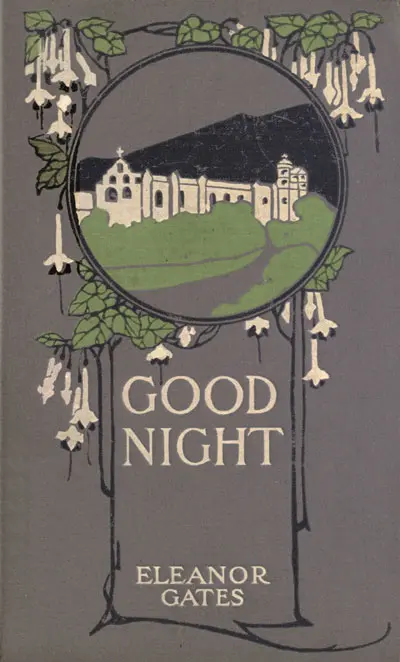
Eleanor Gates
BEHIND THE BOOK
This eBook is for the use of anyone anywhere in the United States and most other parts of the world at no cost and with almost no restrictions whatsoever. You may copy it, give it away or re-use it under the terms of the Project Gutenberg License included with this eBook or online at www.gutenberg.org. If you are not located in the United States, you will have to check the laws of the country where you are located before using this eBook. Read the source licence.
The original source file, including credits and licence, is retained by this library. Request an original-format copy at no charge. Please include the book title and Project Gutenberg identifier #22804.
KEEP YOUR CURIOSITY GOING
Coulson Kernahan

Maurice Baring
Frances Wright
Cécile Tormay

Frederic Jesup Stimson

W. H. P. (William Henry Pope) Jarvis