The justice of Gideon
Eleanor Gates
THE CLASSIC COLLECTION · 1917
"Apron-Strings" by Eleanor Gates is a novel written in the early 20th century. The story explores the complex dynamics between mothers and daughters, illuminating the various types of mothers that exist. Central to the narrative are the characters of Mrs. Milo and her daughter, Susan, along with a cast of supporting characters, including a bride named Hattie and the parish’s new rector, Mr. Farvel, weaving together themes of familial love and societal expectation. The opening of the book introduces us to the setting of a parish rectory as preparations are made for Hattie's wedding. Various conversations unfold, revealing the personalities and backgrounds of the characters, particularly focusing on Mrs. Milo, who exhibits a controlling and somewhat judgmental nature, contrasting with the more open-hearted and nurturing qualities of Susan. As Sue interacts with the orphan boys from the nearby orphanage, the underlying tensions between her and her mother become evident, suggesting deeper themes of maternal expectations and social responsibilities. The dialogue is rich with humor and light-heartedness, juxtaposed with poignant moments, setting the stage for the emotional developments to follow.
Introduction adapted from the source catalogue; source summaries may be automatically generated.
Free to read · English · 53,037 words · No account needed
MAKE TIME FOR A GOOD BOOK
On by default. Untick to stop anonymous reading totals. Each page counts after 10 seconds in view. How this works.
Anonymous counting is on unless you have switched it off.
"Oh, Miss Susan!" All nonsense was frightened out of her. "Don't send me away! I tried to do my best--to keep her from coming here! But, oh, Deuteronomy, nine, thirteen!"
"Deuteronomy, nine, thirteen," repeated Mrs. Milo, wrinkling her brows. Her eyes moved as she cudgeled her brain. "Deuteronomy----"
Sue gave Dora another shake. "Listen, my dear! I'm sending you after a little girl. Here! Twenty dollars, and it's Mr. Farvel's."
"Oh, Miss Susan!"--with abject relief. "Gladly do I devote my gifts, poor as they are, to your service." And in her best ministerial manner, "Where is the child?" She tucked the paper bill into a glove.
"Poughkeepsie,"--Sue gave her the address. "Go up this afternoon--right away. And return the first thing in the morning. Bring her straight to the Rectory. Now, you'll have quite a ride with that baby, Dora. And I want you to get her ready for the happiest moment in all her little life! Do you hear?--the happiest, Dora! And, oh, here's where you must be eloquent!"
"Oh, Miss Susan, 'I am of slow speech, and of a slow tongue.'"
"I'll tell you what to say," reassured Sue. "You say to her that you're bringing her to her mother; and that she's going to live with her mother, in a little cottage somewhere--a cottage running over with roses."
"Roses," echoed Dora, and counting on her fingers, "--mother, cottage,
garden----"
"And tell her that she's got a dear mother--so brave, and good, and sweet, and pretty. And her mother loves her--don't forget that!--loves her better than anything else in the whole world----"
"Loves her," checked off Dora, pulling aside another finger; "--brave,
good, sweet, pretty----"
"Yes, and there's going to be no more boarding out--no more forever! Oh, the lonely little heart!" Sue took Dora by both shoulders. "Her mother's waiting for her! Her mother! Her own mother!"
"Boarding out,"--checking again; "--waiting mother. Miss Susan, I shall return by the first train tomorrow, Providence permitting." This last was accompanied by a solemn look at Mrs. Milo, and a roguish hop-skip that freed her from Sue's hold.
"Oh, the very first!" urged Sue. "Dora!"
Dora swung herself out.
Now Mrs. Milo seemed her usual self once more. "Then Mrs. Farvel will not remain at the Rectory?" she inquired.
"Oh, how could she? Of course not! They called me in to tell me: Mrs. Farvel and Barbara will leave New York in two or three days."
"Good! Meanwhile, we shall stay at the hotel with Mrs. Balcome."
"But I must go to the Rectory."
"I see no necessity."
Your reading position is saved on this browser. Take it to another device with a library code. Reading pages adapt to text, rather than matching a printed edition.
Eleanor Gates
Eleanor Gates
Eleanor Gates
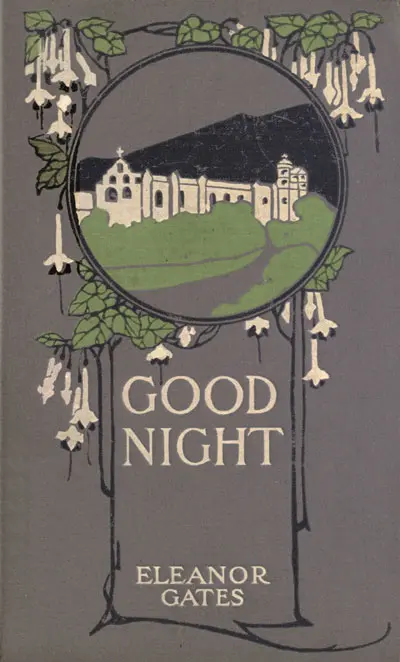
Eleanor Gates
BEHIND THE BOOK
This eBook is for the use of anyone anywhere in the United States and most other parts of the world at no cost and with almost no restrictions whatsoever. You may copy it, give it away or re-use it under the terms of the Project Gutenberg License included with this eBook or online at www.gutenberg.org. If you are not located in the United States, you will have to check the laws of the country where you are located before using this eBook. Read the source licence.
The original source file, including credits and licence, is retained by this library. Request an original-format copy at no charge. Please include the book title and Project Gutenberg identifier #22804.
KEEP YOUR CURIOSITY GOING
Coulson Kernahan

Maurice Baring
Frances Wright
Cécile Tormay

Frederic Jesup Stimson

W. H. P. (William Henry Pope) Jarvis