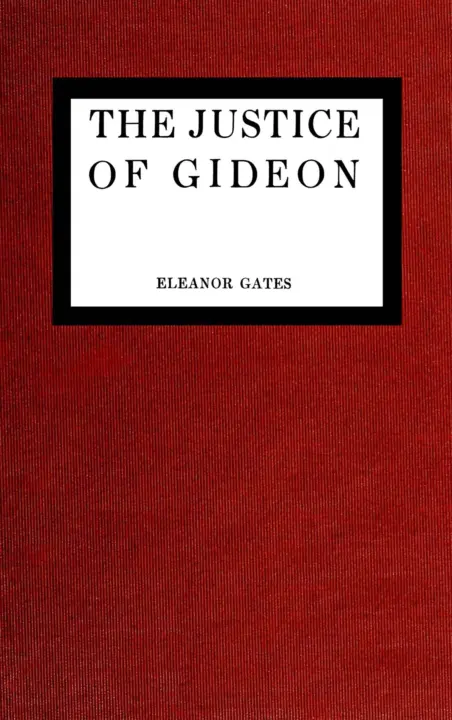
The justice of Gideon
Eleanor Gates
THE CLASSIC COLLECTION · 1917
"Apron-Strings" by Eleanor Gates is a novel written in the early 20th century. The story explores the complex dynamics between mothers and daughters, illuminating the various types of mothers that exist. Central to the narrative are the characters of Mrs. Milo and her daughter, Susan, along with a cast of supporting characters, including a bride named Hattie and the parish’s new rector, Mr. Farvel, weaving together themes of familial love and societal expectation. The opening of the book introduces us to the setting of a parish rectory as preparations are made for Hattie's wedding. Various conversations unfold, revealing the personalities and backgrounds of the characters, particularly focusing on Mrs. Milo, who exhibits a controlling and somewhat judgmental nature, contrasting with the more open-hearted and nurturing qualities of Susan. As Sue interacts with the orphan boys from the nearby orphanage, the underlying tensions between her and her mother become evident, suggesting deeper themes of maternal expectations and social responsibilities. The dialogue is rich with humor and light-heartedness, juxtaposed with poignant moments, setting the stage for the emotional developments to follow.
Introduction adapted from the source catalogue; source summaries may be automatically generated.
Free to read · English · 53,037 words · No account needed
MAKE TIME FOR A GOOD BOOK
On by default. Untick to stop anonymous reading totals. Each page counts after 10 seconds in view. How this works.
Anonymous counting is on unless you have switched it off.
Mrs. Milo showed her dislike of the remark, with its implied criticism of her own judgment. And she was uneasy over the turn that the whole matter had taken. Farvel married, no matter to whom, was one thing: Farvel very insecurely tied, and possessed of a small daughter whose mother repudiated her, that was quite another. She watched Sue narrowly, for Sue was watching Farvel.
"But the little one," said the clergyman, turning to Clare; "I'd like
to see her."
"Sure!" She was all eagerness. "Why not?--Yes."
"Where is she?"
"Out of town. At Poughkeepsie. She boards with some people."
"Ah, good little mother!" said Sue, smiling. "Your baby's not in an
Institution!"
Clare blushed under the compliment. "No, I--I shouldn't like to have
her in an Orphanage."
"Can she come down right away?" asked Farvel.
"Yes! Right away! I'll go after her now."
"I'll go with you," suggested Sue. "May I?"
She tried to catch Farvel's eye, to warn him.
"But, Susan," objected Mrs. Milo; "I can't spare you."
"Oh, I can go alone," protested Clare. "I don't need anybody."
Behind her back, Balcome held up a lead-pencil at Sue.
She understood, "We'll send for the baby. Now, what's the address?" She proffered Clare the pencil and an envelope from one of Balcome's sagging pockets. Then to him, as Clare wrote, "Would you mind going back to the Rectory and sending me Dora?"
"Good idea!" He pulled on the big hat.
"Dora?" cried Mrs. Milo. "That child?"
"Child!" laughed Sue. "Why, I'd send her to Japan. You don't think she'd ever succumb to the snares and pitfalls of this wicked world! She'll set the whole train to memorizing Lamentations!"
Mrs. Milo's eyes narrowed. Sue's sudden interest in Farvel's daughter was irritating and disturbing. "Wait, Brother Balcome," she begged. "Sue, I don't see why the little girl's own mother shouldn't go for her."
"Of course, I can."
Balcome waited no longer. With a meaning glance at Sue, and a scowl for Mrs. Milo, he hurried out.
"Oh, let Dora go, Mrs. Farvel," urged Sue. "And meanwhile, you can be getting settled somewhere."
Clare looked pleased. "Yes. All right."
"Then she will leave here?" inquired Mrs. Milo.
"Oh, she must," declared Sue, "if she's going to have her baby come to her." She indicated the suitcase. "Is there more?"
"A trunk. And it won't take me ten minutes." As she turned to go, Clare's look rested on the bird-cage, and she put out a hand toward it involuntarily--then checked her evident wish to take it with her, and disappeared into her own room.
"Where had she better go?" asked Farvel, appealing to Sue. "You'll
know best, I'm sure----"
Your reading position is saved on this browser. Take it to another device with a library code. Reading pages adapt to text, rather than matching a printed edition.
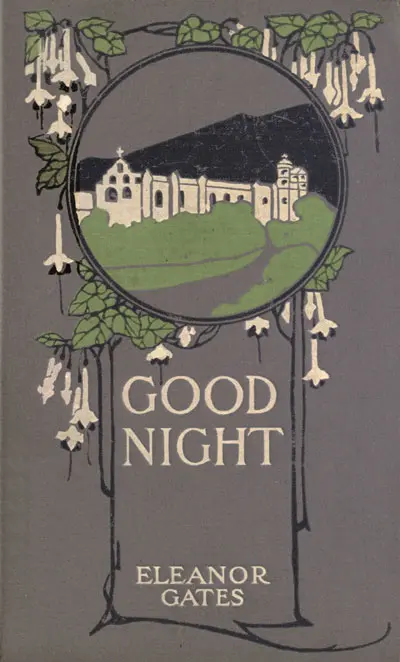
Eleanor Gates
Eleanor Gates
Eleanor Gates
Eleanor Gates
BEHIND THE BOOK
This eBook is for the use of anyone anywhere in the United States and most other parts of the world at no cost and with almost no restrictions whatsoever. You may copy it, give it away or re-use it under the terms of the Project Gutenberg License included with this eBook or online at www.gutenberg.org. If you are not located in the United States, you will have to check the laws of the country where you are located before using this eBook. Read the source licence.
The original source file, including credits and licence, is retained by this library. Request an original-format copy at no charge. Please include the book title and Project Gutenberg identifier #22804.
KEEP YOUR CURIOSITY GOING
Coulson Kernahan

Maurice Baring
Frances Wright
Cécile Tormay

Frederic Jesup Stimson

W. H. P. (William Henry Pope) Jarvis