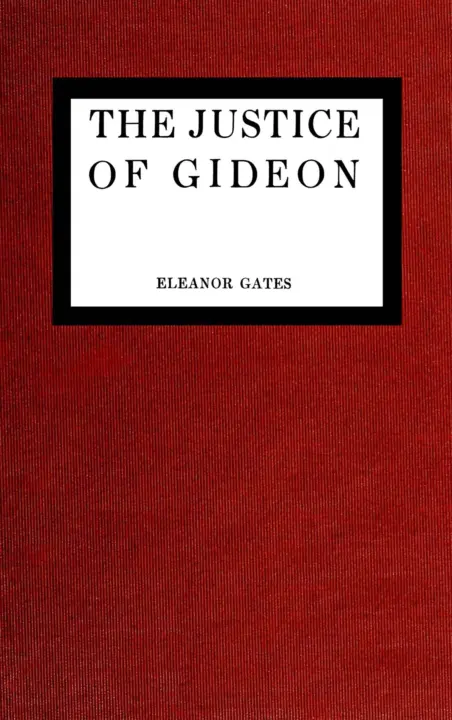
The justice of Gideon
Eleanor Gates
THE CLASSIC COLLECTION · 1917
"Apron-Strings" by Eleanor Gates is a novel written in the early 20th century. The story explores the complex dynamics between mothers and daughters, illuminating the various types of mothers that exist. Central to the narrative are the characters of Mrs. Milo and her daughter, Susan, along with a cast of supporting characters, including a bride named Hattie and the parish’s new rector, Mr. Farvel, weaving together themes of familial love and societal expectation. The opening of the book introduces us to the setting of a parish rectory as preparations are made for Hattie's wedding. Various conversations unfold, revealing the personalities and backgrounds of the characters, particularly focusing on Mrs. Milo, who exhibits a controlling and somewhat judgmental nature, contrasting with the more open-hearted and nurturing qualities of Susan. As Sue interacts with the orphan boys from the nearby orphanage, the underlying tensions between her and her mother become evident, suggesting deeper themes of maternal expectations and social responsibilities. The dialogue is rich with humor and light-heartedness, juxtaposed with poignant moments, setting the stage for the emotional developments to follow.
Introduction adapted from the source catalogue; source summaries may be automatically generated.
Free to read · English · 53,037 words · No account needed
MAKE TIME FOR A GOOD BOOK
On by default. Untick to stop anonymous reading totals. Each page counts after 10 seconds in view. How this works.
Anonymous counting is on unless you have switched it off.
"Haw-haw!" roared Balcome, with a scornful flop of the hat.
Sue went close to her brother. "Then she is the girl who disappeared," she said under her breath.
"Well--yes."
"And she'll go again! She'll be lost!" She started toward the hall.
"Susan!" cried her mother, peremptorily. And as Sue halted, "We want nothing to do with that girl. Come back."
"What harm could come of my going?" argued Sue.
"That is not the question."
"Mother, I don't like to oppose you, but in this case----"
"I shall not allow it," said her mother, decisively.
"Then I must go against your wishes." Sue opened the door.
"I forbid it, I tell you!" That note of shrillness now appeared in
Mrs. Milo's voice.
"Oh, mother!" Sue came back a little way. "Don't treat me like a
child!"
Now Mrs. Milo became all gentleness once more. She put a hand on Sue's arm. "Your mother is the best judge of your actions," she reminded. "And she wants you to stay."
Sue backed. "No; I'm sorry," she answered. "In all my life I can't remember disobeying you once. But today I must." Again she started.
"My daughter!" Mrs. Milo's voice broke pathetically. "You--you mean you won't respect my wishes?"
Checked by that sign of tears so near, again Sue halted, but without turning. "I want to help her," she urged, a little doggedly.
"But your mother," went on Mrs. Milo, "--my feelings--my love--are you going to trample them under foot?"
"Oh, not that!"
Mrs. Milo fell to weeping. "Oh, what do you care for my peace of mind!" she mourned. "For my heartache!"
It brought Sue to her mother's side. "Why! Why!" She put an arm about the elder woman tenderly.
Mrs. Milo dropped to a chair. "This is the child I bore!" she sobbed. "I've devoted my whole life to her! And now--oh, if your dear father knew! If he could only see----" Words failed her. She buried her face in her handkerchief.
Sue knelt at her side. "Oh, mother! Mother!" she comforted. "Hush,
dear! Hush!"
"I'm going to be ill," wept Mrs. Milo. "I know I am! My nerves can't stand it! But it's just as well"--mournfully. "I'm in your way. I can see that. And it's t-t-t-time that I died!" She shook convulsively.
Commands, arguments, appeals, tears--how often Mrs. Milo and her daughter went through the several steps of just such a scene as this. Exactly that often, Sue capitulated, as she capitulated now, with eyes brimming.
"Ah, don't say that, mother," she pleaded. "You'll break my heart! You're my whole life--with Wallace away, why I've got nobody else in the whole world!" And looking up, "Wallace, you go."
Your reading position is saved on this browser. Take it to another device with a library code. Reading pages adapt to text, rather than matching a printed edition.
Eleanor Gates
Eleanor Gates
Eleanor Gates
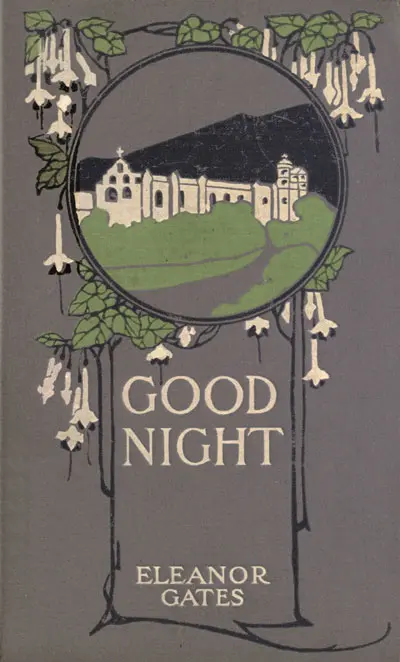
Eleanor Gates
BEHIND THE BOOK
This eBook is for the use of anyone anywhere in the United States and most other parts of the world at no cost and with almost no restrictions whatsoever. You may copy it, give it away or re-use it under the terms of the Project Gutenberg License included with this eBook or online at www.gutenberg.org. If you are not located in the United States, you will have to check the laws of the country where you are located before using this eBook. Read the source licence.
The original source file, including credits and licence, is retained by this library. Request an original-format copy at no charge. Please include the book title and Project Gutenberg identifier #22804.
KEEP YOUR CURIOSITY GOING
Coulson Kernahan

Maurice Baring
Frances Wright
Cécile Tormay

Frederic Jesup Stimson

W. H. P. (William Henry Pope) Jarvis