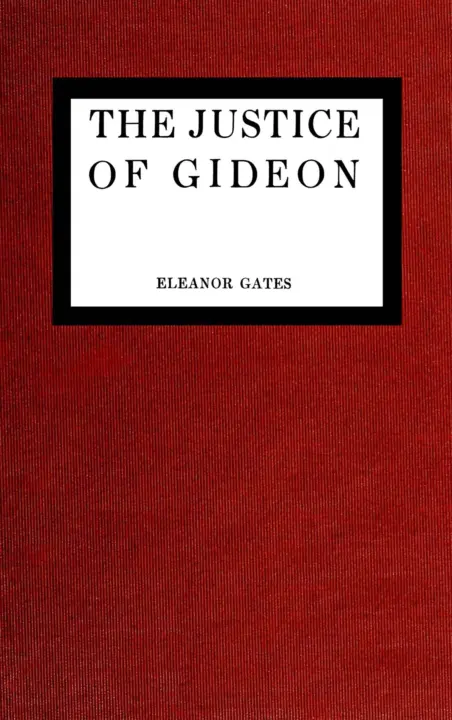
The justice of Gideon
Eleanor Gates
THE CLASSIC COLLECTION · 1917
"Apron-Strings" by Eleanor Gates is a novel written in the early 20th century. The story explores the complex dynamics between mothers and daughters, illuminating the various types of mothers that exist. Central to the narrative are the characters of Mrs. Milo and her daughter, Susan, along with a cast of supporting characters, including a bride named Hattie and the parish’s new rector, Mr. Farvel, weaving together themes of familial love and societal expectation. The opening of the book introduces us to the setting of a parish rectory as preparations are made for Hattie's wedding. Various conversations unfold, revealing the personalities and backgrounds of the characters, particularly focusing on Mrs. Milo, who exhibits a controlling and somewhat judgmental nature, contrasting with the more open-hearted and nurturing qualities of Susan. As Sue interacts with the orphan boys from the nearby orphanage, the underlying tensions between her and her mother become evident, suggesting deeper themes of maternal expectations and social responsibilities. The dialogue is rich with humor and light-heartedness, juxtaposed with poignant moments, setting the stage for the emotional developments to follow.
Introduction adapted from the source catalogue; source summaries may be automatically generated.
Free to read · English · 53,037 words · No account needed
MAKE TIME FOR A GOOD BOOK
On by default. Untick to stop anonymous reading totals. Each page counts after 10 seconds in view. How this works.
Anonymous counting is on unless you have switched it off.
Mrs. Milo stood up, on her face conscious guilt for her suspicion and her lack of charity. But she was appalled--almost stunned. Never in all her life before had her daughter left her in such a way. "I declare!" burst forth the elder woman. "I declare!" Then following Sue a few steps, and calling after her through the open door, "Well, what fills that basket out there? And what fills our Orphanage?" And more weakly, but still in an effort to justify herself, "What--what other reason can you suggest, I'd like to know! And--and it's just plain, common sense!" She came back to stand alone, staring before her. Then she sank to a chair.
Wallace returned. "Where's Sue, mother?" he asked.
"What?--Oh, it's you, darling? She--she stepped out."
"Out?"
"Into the Close."
"Oh." He hurried across the room.
Mrs. Milo fluttered to her feet. "I--I can't have that choir in the library any longer," she declared decisively. And left the room.
Sue entered in answer to her brother's call, and came straight to him. She had forgotten her anger by now; her look was anxious.
"Sue, let's go ahead with the rehearsal," he begged.
"Wallace,"--she gripped both of his wrists, as if she were determined to hold him until she had the answers she sought--"you knew her--that girl?"
He averted his eyes. "Why, yes."
She spoke very low. "Was she--sweet?"
"Yes; sweet,"--with a note of impatience.
"Light--or dark?"
"Rather dark." Again he showed irritation.
"Was she--was she pretty?"
"She was beautiful."
Her hands fell. She turned away. "And she dropped right out of his life," she said, as if to herself. Then coming about suddenly, "Why, Wallace? You don't know?"
"I--do--not--know." He dragged at his hair with a nervous hand.
She lowered her voice again. "Wallace,--she--she didn't have to go?"
Her brother made a gesture of angry impatience. "Oh, I'm disappointed in you!" he cried. "I thought you were different from other women. But you're just as quick to think wrong!"
She brought her hands together; and a look, wistful and appealing, gave to her face that curiously childlike expression. "Well, influence of the basket," she admitted ruefully, and hung her head.
He thrust his hands into his pockets sulkily, and turned his back.
Mrs. Balcome came puffing in. "Say, you know dear Babette is getting very tired," she announced pettishly. "And I wish----"
As if in answer to her complaining, there came a burst of song. The library door swung wide. And forward, with serene and uplifted faces, came the choir, singing the wedding-march. Each cotta swayed in time.
Your reading position is saved on this browser. Take it to another device with a library code. Reading pages adapt to text, rather than matching a printed edition.
Eleanor Gates
Eleanor Gates
Eleanor Gates
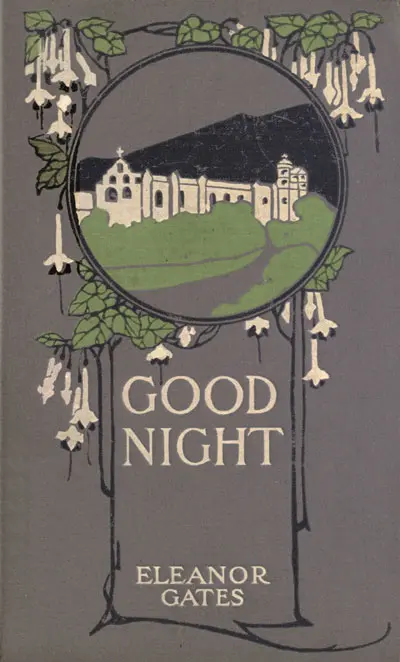
Eleanor Gates
BEHIND THE BOOK
This eBook is for the use of anyone anywhere in the United States and most other parts of the world at no cost and with almost no restrictions whatsoever. You may copy it, give it away or re-use it under the terms of the Project Gutenberg License included with this eBook or online at www.gutenberg.org. If you are not located in the United States, you will have to check the laws of the country where you are located before using this eBook. Read the source licence.
The original source file, including credits and licence, is retained by this library. Request an original-format copy at no charge. Please include the book title and Project Gutenberg identifier #22804.
KEEP YOUR CURIOSITY GOING
Coulson Kernahan

Maurice Baring
Frances Wright
Cécile Tormay

Frederic Jesup Stimson

W. H. P. (William Henry Pope) Jarvis