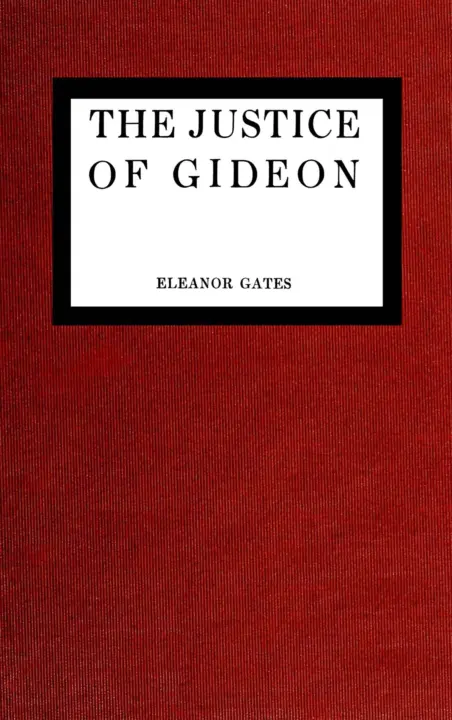
The justice of Gideon
Eleanor Gates
THE CLASSIC COLLECTION · 1917
"Apron-Strings" by Eleanor Gates is a novel written in the early 20th century. The story explores the complex dynamics between mothers and daughters, illuminating the various types of mothers that exist. Central to the narrative are the characters of Mrs. Milo and her daughter, Susan, along with a cast of supporting characters, including a bride named Hattie and the parish’s new rector, Mr. Farvel, weaving together themes of familial love and societal expectation. The opening of the book introduces us to the setting of a parish rectory as preparations are made for Hattie's wedding. Various conversations unfold, revealing the personalities and backgrounds of the characters, particularly focusing on Mrs. Milo, who exhibits a controlling and somewhat judgmental nature, contrasting with the more open-hearted and nurturing qualities of Susan. As Sue interacts with the orphan boys from the nearby orphanage, the underlying tensions between her and her mother become evident, suggesting deeper themes of maternal expectations and social responsibilities. The dialogue is rich with humor and light-heartedness, juxtaposed with poignant moments, setting the stage for the emotional developments to follow.
Introduction adapted from the source catalogue; source summaries may be automatically generated.
Free to read · English · 53,037 words · No account needed
MAKE TIME FOR A GOOD BOOK
On by default. Untick to stop anonymous reading totals. Each page counts after 10 seconds in view. How this works.
Anonymous counting is on unless you have switched it off.
Farvel permitted himself to be half-led. But he paused part way to look back at the quartette of ladies standing, silent and watchful, at the center of the room. "It's all right," he assured them, smiling wanly at Hattie. He tried to speak casually. "Let me know when you're ready to rehearse." Wallace had reached out to draw Farvel through the door. It closed behind them.
Sue made as if to follow the two men. But once more her mother interposed. "Susan!" And then in explanation, "I wouldn't--they'll want to be alone."
Now, as if silenced by an order, the choir stopped in the middle of a
bar.
"Well!" exclaimed Mrs. Balcome. "Positively tragic!" She gathered up the dog and sank upon the sofa.
"Of course, you saw what did it," observed Mrs. Milo.
"What?" asked Hattie, almost challengingly.
"The wedding-march." And when that had sunk in, "Wallace knew. Didn't you hear what he said? He wanted Mr. Farvel to--to conquer the--the--whatever it was he felt. I'll wager" (Mrs. Milo permitted herself to "wager" under the stress of excitement, never to "bet") "that he's broken his engagement, or something of that sort."
Hattie stared resentfully.
"Engagement?" repeated Sue.
Mrs. Milo's blue eyes sparkled with triumph. "Well, it wouldn't
surprise me," she declared.
Sue's color deepened. "Why, of course, he isn't," she answered defensively. "He'd say so--he wouldn't keep a matter like that secret. It isn't like him--a whole year."
Her mother smiled at her fondly. "There's nothing to get excited
about, my daughter."
"But, mother, it's absurd."
Mrs. Milo strolled to a chair and seated herself with elaborate care. "Well, anyway," she argued, "he carries a girl's picture in his pocket."
In the pause that followed, a telephone began to ring persistently from the direction of the library. But Sue seemed not to hear it. "A picture," she said slowly. And as her mother assented, smiling, "And--and what did he say when he showed it to you?"
Mrs. Milo started. "Well,--er--the fact is," she admitted, "he didn't
exactly show it to me."
"Oh." It was scarcely more than a breath.
Mrs. Milo tossed her head. "No," she added tartly, a trifle ruffled by what the low-spoken exclamation so plainly implied. "If you must know, it fell out of his bureau drawer."
Mrs. Balcome threw out a plump arm across the bending back of the sofa and touched a sleeve of the satin gown covertly. "Hm!" she coughed, with meaning.
But Hattie only moved aside irritably. Of a sudden, she was strangely
pale.
Dora entered. "Miss Susan, a telephone summons," she announced.
"Yes--yes,"--absent-mindedly.
Your reading position is saved on this browser. Take it to another device with a library code. Reading pages adapt to text, rather than matching a printed edition.
Eleanor Gates
Eleanor Gates
Eleanor Gates
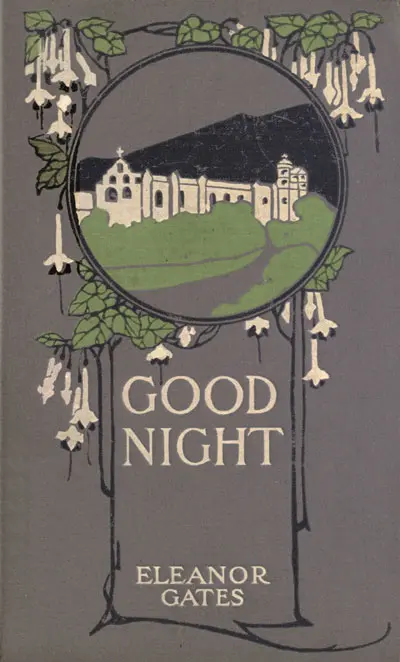
Eleanor Gates
BEHIND THE BOOK
This eBook is for the use of anyone anywhere in the United States and most other parts of the world at no cost and with almost no restrictions whatsoever. You may copy it, give it away or re-use it under the terms of the Project Gutenberg License included with this eBook or online at www.gutenberg.org. If you are not located in the United States, you will have to check the laws of the country where you are located before using this eBook. Read the source licence.
The original source file, including credits and licence, is retained by this library. Request an original-format copy at no charge. Please include the book title and Project Gutenberg identifier #22804.
KEEP YOUR CURIOSITY GOING
Coulson Kernahan

Maurice Baring
Frances Wright
Cécile Tormay

Frederic Jesup Stimson

W. H. P. (William Henry Pope) Jarvis