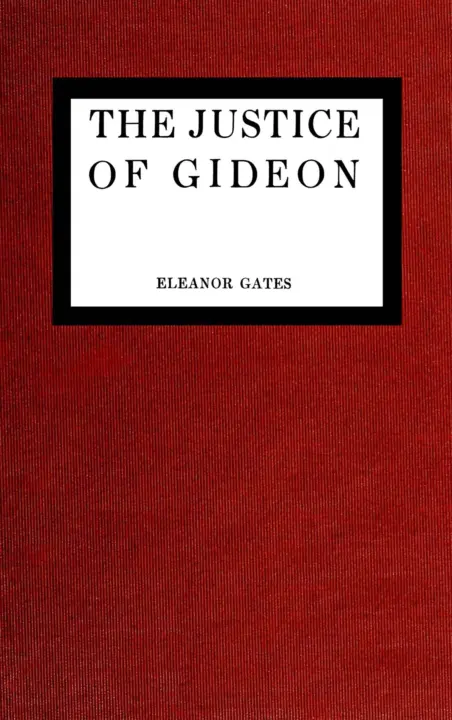
The justice of Gideon
Eleanor Gates
THE CLASSIC COLLECTION · 1917
"Apron-Strings" by Eleanor Gates is a novel written in the early 20th century. The story explores the complex dynamics between mothers and daughters, illuminating the various types of mothers that exist. Central to the narrative are the characters of Mrs. Milo and her daughter, Susan, along with a cast of supporting characters, including a bride named Hattie and the parish’s new rector, Mr. Farvel, weaving together themes of familial love and societal expectation. The opening of the book introduces us to the setting of a parish rectory as preparations are made for Hattie's wedding. Various conversations unfold, revealing the personalities and backgrounds of the characters, particularly focusing on Mrs. Milo, who exhibits a controlling and somewhat judgmental nature, contrasting with the more open-hearted and nurturing qualities of Susan. As Sue interacts with the orphan boys from the nearby orphanage, the underlying tensions between her and her mother become evident, suggesting deeper themes of maternal expectations and social responsibilities. The dialogue is rich with humor and light-heartedness, juxtaposed with poignant moments, setting the stage for the emotional developments to follow.
Introduction adapted from the source catalogue; source summaries may be automatically generated.
Free to read · English · 53,037 words · No account needed
MAKE TIME FOR A GOOD BOOK
On by default. Untick to stop anonymous reading totals. Each page counts after 10 seconds in view. How this works.
Anonymous counting is on unless you have switched it off.
"Let me explain. She couldn't stand conditions that weren't suited to her. At nineteen, she rebelled. I'm not going to say that she didn't also do wrong. But she was so young. While I--I have gone on and on, knowing in my secret heart----" She choked, and could not finish.
"I understand, Sue. It's a blamed shame! And you can't stop now----"
"I shall go with mother."
"Well, if you find that young woman you give her as much of that five thousand as you want to. And if you need more----"
"Oh, you dear, old, fat thing!"
He put his arm about her. She leaned her forehead against his shoulder.
"There! There! You're a good girl."
"You're a man in a million! How can any woman find you hard to live
with!"
"Momsey!" Ikey was standing beside them. His hair was disheveled, his
face white.
"Ikey boy!" The sight of him made her anxious.
"You--you go avay?"
"We-e-ell,----"
"A-a-a-ah!" She was trying to break it gently. But he understood. Two small begrimed hands went up to hide his face.
She drew him to her. "But I'll come back, dear! I'll come back! Oh,
don't! Don't!"
He clung to her wildly then. "Oh, how can I lif midoudt you! Oh, Momsey! Momsey! I nefer sing again!"
She led him to a bench. "Now listen!" she begged gently. "Listen! It's only for a little while."
He lifted his face. "Yes?"
"Yes, dear."
That comforted. "Und also," he observed philosophically, "de olt lady,
she goes mit."
"Ikey!" Sue sat back, displeased.
"Oh, scuses! Scuses!"
"She's my mother."
"You--you sure?"
"Why, Ikey!" she cried, astonished.
"Alvays I--I like to t'ink de oder t'ing."
"What other thing?"
"Dat you vas found in de basket."
Balcome laughed, and Sue laughed with him. Even Ikey, guessing that he had inadvertently been more than usually witty, allowed a smile to come into those wet eyes.
"There!" cried Sue, putting both arms about him. "Momsey forgives."
"T'ank you. Und now I like to question--you don't go avay mit de
preacher?"
"No! No!" Sue blushed like a girl.
"Den you don't marry mit him."
"N-n-n-n-no!"
"You feel better, don't you, old man?" inquired Balcome.
"Yes.--If I vas growed up, I vould marry mit her myself."
"Now little flattering chorister," said Sue, "there's something Momsey wants you to do. She'll have to leave here very soon. And before she goes she wants to hear that splendid voice again. So you go to the choirmaster, and ask him if he'll get all the boys together for Miss Susan, and have them sing something--something full of happiness, and hope."
"Momsey, can it be 'O Mutter Dear, Jerusalem?'"
Your reading position is saved on this browser. Take it to another device with a library code. Reading pages adapt to text, rather than matching a printed edition.
Eleanor Gates
Eleanor Gates
Eleanor Gates
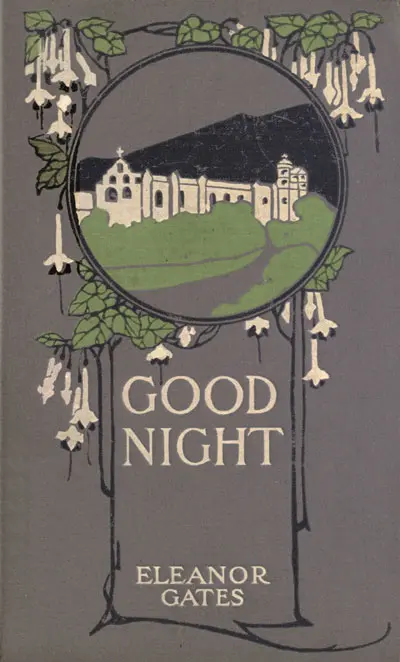
Eleanor Gates
BEHIND THE BOOK
This eBook is for the use of anyone anywhere in the United States and most other parts of the world at no cost and with almost no restrictions whatsoever. You may copy it, give it away or re-use it under the terms of the Project Gutenberg License included with this eBook or online at www.gutenberg.org. If you are not located in the United States, you will have to check the laws of the country where you are located before using this eBook. Read the source licence.
The original source file, including credits and licence, is retained by this library. Request an original-format copy at no charge. Please include the book title and Project Gutenberg identifier #22804.
KEEP YOUR CURIOSITY GOING
Coulson Kernahan

Maurice Baring
Frances Wright
Cécile Tormay

Frederic Jesup Stimson

W. H. P. (William Henry Pope) Jarvis