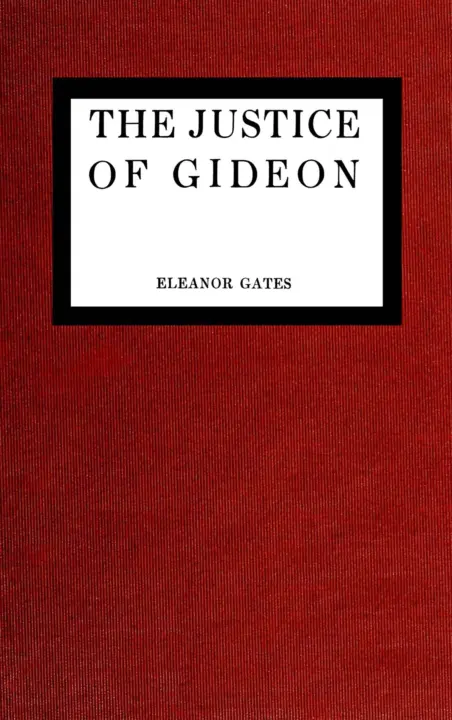
The justice of Gideon
Eleanor Gates
THE CLASSIC COLLECTION · 1917
"Apron-Strings" by Eleanor Gates is a novel written in the early 20th century. The story explores the complex dynamics between mothers and daughters, illuminating the various types of mothers that exist. Central to the narrative are the characters of Mrs. Milo and her daughter, Susan, along with a cast of supporting characters, including a bride named Hattie and the parish’s new rector, Mr. Farvel, weaving together themes of familial love and societal expectation. The opening of the book introduces us to the setting of a parish rectory as preparations are made for Hattie's wedding. Various conversations unfold, revealing the personalities and backgrounds of the characters, particularly focusing on Mrs. Milo, who exhibits a controlling and somewhat judgmental nature, contrasting with the more open-hearted and nurturing qualities of Susan. As Sue interacts with the orphan boys from the nearby orphanage, the underlying tensions between her and her mother become evident, suggesting deeper themes of maternal expectations and social responsibilities. The dialogue is rich with humor and light-heartedness, juxtaposed with poignant moments, setting the stage for the emotional developments to follow.
Introduction adapted from the source catalogue; source summaries may be automatically generated.
Free to read · English · 53,037 words · No account needed
MAKE TIME FOR A GOOD BOOK
On by default. Untick to stop anonymous reading totals. Each page counts after 10 seconds in view. How this works.
Anonymous counting is on unless you have switched it off.
Sue tightened her grip on his cassock. "And, oh, my soul, such grammar!" she mourned. "'He did said it!' You mean, He do said--he do say--he done--oh, now you've got me twisted!"
"Just de same, he called it to me," asserted Ikey.
"I never, I tell you! I never!"
"Ah! Ah!" Once more Sue struggled to hold them apart. "And what, Mr.
Ikey, did he call you?"
"He calls me," cried the insulted Ikey, "--he calls me a pie-faces!--Ach!"
"And what did you call him?"
"I didn't call him not'ing!" answered Ikey, beginning to wail again at the very thought of his failure to do himself justice; "not--von--t'ing!"
"But"--with a wisdom born of long choir experience--"you must have said
something."
"All I says," chanted Ikey, "--all I says is, 'You can't sing. What you do is----'" And lowering and raising his head, he emitted a long, lifelike bray.
"Yah!" burst forth the enraged Clarence, struggling to clutch his hated
fellow.
"Wa-a-a-ah!" wept Ikey, who had struck out and hurt his already injured digit. "You donkey!--donkey!"
Breathing hard, Sue managed to keep them apart; to bring them back to their proper distance. "Look at them!" she said with fine sarcasm. "Oh, look at Ikey Einstein!--Where's your handkerchief?"
Weeping, he indicated it by a duck of the chin.
At such a point of general melting, it was safe to release combatants. Sue freed the two, and took from Ikey's pocket a square of cotton once white, but now characteristically gray, and strangely heavy. "Here, put up that poor face," she comforted. But at this unpropitious moment, the handkerchief, clear of the pocket, sagged with its holdings and deposited upon the carpet several yellowish, black-spotted cubes. "Dice!" exclaimed Sue, horrified. "Dice!--Ikey Einstein, what do you call yourself!"
Pride stopped Ikey's tears. He thrust out his underlip and waved a hand at the scattered cubes. "Momsey," he answered stoutly, "don't you know? Why, ever since day before yesterdays, I am a t'ree-card-monte man!"
"You're a three-card-what?"
Unable longer to restrain their mirth, that portion of the choir that was in the bay-window now whooped with delight. And Sue, turning, beheld ten figures writhing with joy.
"So!" she began severely. The ten sobered, and their cottas billowed in a backward step. "So here you are!--where you have no business to be!"
Bobbie, the spokesman, ventured to the rescue of his mates. "But,
Momsey----"
Your reading position is saved on this browser. Take it to another device with a library code. Reading pages adapt to text, rather than matching a printed edition.
Eleanor Gates
Eleanor Gates
Eleanor Gates
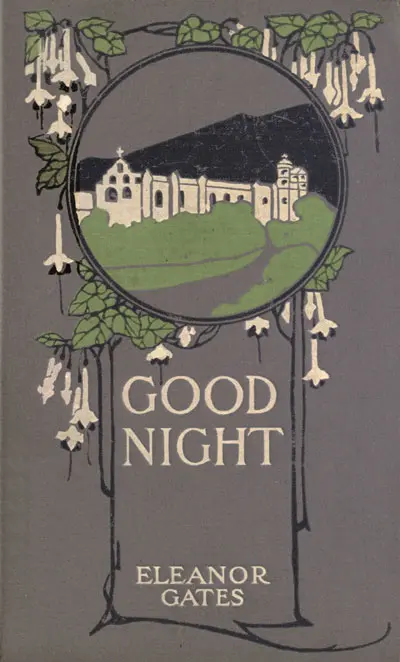
Eleanor Gates
BEHIND THE BOOK
This eBook is for the use of anyone anywhere in the United States and most other parts of the world at no cost and with almost no restrictions whatsoever. You may copy it, give it away or re-use it under the terms of the Project Gutenberg License included with this eBook or online at www.gutenberg.org. If you are not located in the United States, you will have to check the laws of the country where you are located before using this eBook. Read the source licence.
The original source file, including credits and licence, is retained by this library. Request an original-format copy at no charge. Please include the book title and Project Gutenberg identifier #22804.
KEEP YOUR CURIOSITY GOING
Coulson Kernahan

Maurice Baring
Frances Wright
Cécile Tormay

Frederic Jesup Stimson

W. H. P. (William Henry Pope) Jarvis