Death comes for the archbishop
Willa Cather
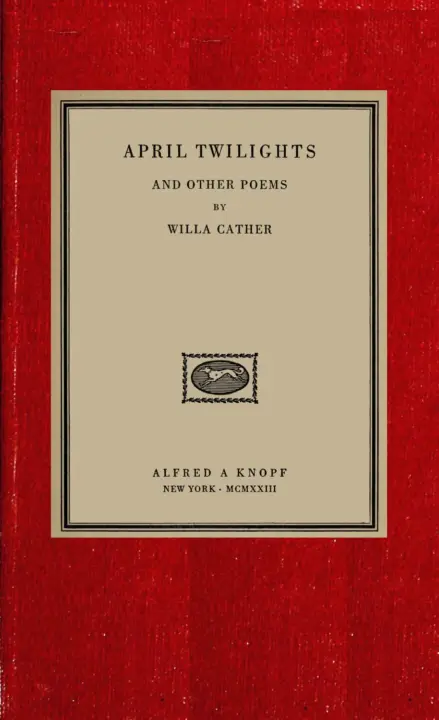
THE CLASSIC COLLECTION · 1923
"April Twilights, and Other Poems" by Willa Cather is a collection of poetry written in the early 20th century. This book comprises two parts: the first part, originally published in 1903, features Cather's early works, while the second part includes poems composed later. The themes explored in this collection revolve around nature, human emotion, nostalgia, and the fleeting essence of beauty and love. The poems in "April Twilights" reflect a rich tapestry of feelings and imagery, capturing moments of personal introspection and broader social observations. Through verses such as "Grandmither, Think Not I Forget" and "The Swedish Mother," Cather evokes a sense of longing for the past and the tenderness of familial connections. Many poems explore the contrasts between beauty and decay, as seen in pieces like "Poppies on Ludlow Castle," where vibrant imagery of nature is juxtaposed against the somber realities of mortality and loss. Cather's lyrical style and thoughtful exploration of universal themes make this collection resonate with readers who appreciate reflective and emotionally charged poetry.
Introduction adapted from the source catalogue; source summaries may be automatically generated.
Free to read · English · 7,307 words · No account needed
MAKE TIME FOR A GOOD BOOK
On by default. Untick to stop anonymous reading totals. Each page counts after 10 seconds in view. How this works.
Anonymous counting is on unless you have switched it off.
Still about the fire they tell
How it long ago befell
That a shepherd maid and lad
Met and trembled and were glad;
When the swift spring waters ran,
And the wind to boy or man
Brought the aching of his sires--
Song and love and all desires.
Ere the starry dogwoods fell
They were lovers, so they tell.
Woe is me to tell it thee,
Winter winds in Arcady!
Broken pipes and vows forgot,
Scattered flocks returning not,
Frozen brook and drifted hill,
Ashen sun and song-birds still;
Songs of summer and desire
Crooned about the winter fire;
Shepherd lads with silver hair,
Shepherd maids no longer fair.
On his little grave and wild,
Faustinus, the martyr child,
Candytuft and mustards grow.
Ah, how many a June has smiled
On the turf he lies below.
Ages gone they laid him there,
Quit of sun and wholesome air,
Broken flesh and tortured limb;
Leaving all his faith the heir
Of his gentle hope and him.
Yonder, under pagan skies,
Bleached by rains, the circus lies,
Where they brought him from his play.
Comeliest his of sacrifice,
Youth and tender April day.
“Art thou not the shepherd’s son?--
There the hills thy lambkins run?--
These the fields thy brethren keep?”
“On a higher hill than yon
Doth my Father lead His sheep.”
“Bring thy ransom, then,” they say,
“Gold enough to pave the way
From the temple to the Rhone.”
When he came, upon his day,
Slender, tremulous, alone,
Mustard flowers like these he pressed,
Golden, flame-like, to his breast,
Blooms the early weanlings eat.
When his Triumph brought him rest,
Yellow bloom lay at his feet.
Golden play-days came: the air
Called him, weanlings bleated there,
Roman boys ran fleet with spring;
Shorn of youth and usage fair,
Hope nor hill-top days they bring.
But the shepherd children still
Come at Easter, warm or chill,
Come with violets gathered wild
From his sloping pasture hill,
Play-fellows who would fulfill
Play-time to that martyr child.
No garlands in the winter-time,
No trumpets in the night!
The song ye praise was done lang syne,
And was its own delight.
O’ God’s name take the wreath away,
Since now the music’s sped;
Ye never cry, “Long live the king!”
Until the king is dead.
When I came piping through the land,
One morning in the spring,
With cockle-burrs upon my coat,
’Twas then I was a king:
A mullein sceptre in my hand,
My order daisies three,
With song’s first freshness on my lips--
And then ye pitied me!
Your reading position is saved on this browser. Take it to another device with a library code. Reading pages adapt to text, rather than matching a printed edition.
BEHIND THE BOOK
This eBook is for the use of anyone anywhere in the United States and most other parts of the world at no cost and with almost no restrictions whatsoever. You may copy it, give it away or re-use it under the terms of the Project Gutenberg License included with this eBook or online at www.gutenberg.org. If you are not located in the United States, you will have to check the laws of the country where you are located before using this eBook. Read the source licence.
The original source file, including credits and licence, is retained by this library. Request an original-format copy at no charge. Please include the book title and Project Gutenberg identifier #64318.
KEEP YOUR CURIOSITY GOING

Eric Mackay
Edmund Gosse
Sophia Margaretta Hensley
Gilbert Parker
George MacDonald

Elizabeth Bibesco