THE CLASSIC COLLECTION✦The snow manCLASSIC FREE BOOKS
The snow man
George Sand
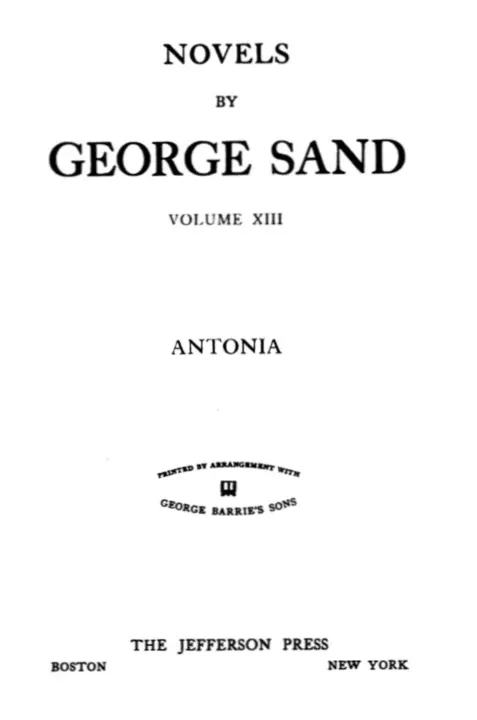
THE CLASSIC COLLECTION · 1863
"Antonia" by George Sand is a novel written in the early 19th century. The story unfolds in Paris during April of 1785 and centers around Julien Thierry, a young flower painter, and his mother, Madame Thierry, as they navigate life after the death of Julien's father. The narrative delves into themes of love, social status, and artistic ambition, with Julien becoming enamored with the Comtesse d'Estrelle, a widow facing her own challenges. At the start of the novel, we find Julien at work in his studio, deeply engaged in painting and communicating with his mother. Their conversation reveals a profound bond as they discuss their shared sorrow, memories of Julien's father, and the notion of love and happiness. Meanwhile, in the nearby hôtel d'Estrelle, the Comtesse grapples with her financial woes and societal expectations while also entering into a deeper reflection about her past decisions and the loneliness of her status. The narrative then highlights Julien's burgeoning feelings for the Comtesse, which intertwines their fates against a backdrop of social class and financial pressures.
Introduction adapted from the source catalogue; source summaries may be automatically generated.
Free to read · English · 87,044 words · No account needed
MAKE TIME FOR A GOOD BOOK
On by default. Untick to stop anonymous reading totals. Each page counts after 10 seconds in view. How this works.
Anonymous counting is on unless you have switched it off.
"You are right, monsieur," said Julie with a sigh, "I shall never make a promise and not keep it."
"Here we are then," continued Marcel, "face to face with an incredible, but very real, closely impending fact, conclusive concerning the existence of two persons who are dear to you, my aunt and Julien, since my reasoning places me outside of the reckoning. You must reflect seriously. Do you wish me to leave you alone for that purpose, or will you allow me to say to you at once what I would have said to you an hour ago if you had taken me for a confidant before Monsieur Antoine appeared?"
"Say it now, Marcel; you must tell me everything."
"Very well, madame; let us suppose that, despite his anger, Monsieur Antoine outbids the marchioness; see how straitened your circumstances will be; two or three thousand francs a year! You marry Julien, who has nothing in the world but his arms, and soon you will be a mother, with Madame Thierry to support and care for, a servant for her, and a nurse for yourself, and a manservant, unless Julien lays aside his brushes when the heavy work of the household is to be done, however modest it may be. You will certainly live honorably, for he will work; Madame Thierry will knit all the stockings for the family, and you will be economical. You will have a single silk dress and will wear calicoes. You will always walk when you go out, and you will not indulge yourself in a bit of ribbon without counting on your fingers to see if your little savings will stand it. That is how my wife began life when I purchased my office. Well, I can tell you, madame, that we were not very happy then, and yet we loved each other dearly; my wife was not vain, we had never been well-to-do, and we did not know what luxury was. We knew how to go without; but we were anxious,--my wife because I worked half the night and trotted about, tired out and with a cold in my head, at all hours and in all weathers; and I, because she had to go without fresh air and good food, forever harnessed to household duties and the labors of maternity. Each of us suffered from constant, painful solicitude for the other. I give you my word that the more dearly we loved each other, the more worried we were and the more we lacked real happiness. We lost two children; one that we had to put out to nurse in the country where he was not well cared for; the other we decided to keep at home, and the foul air of Paris, combined with the poor health he inherited from his mother, prevented him from developing. If we have succeeded in raising the third, it is only because we were in somewhat easier circumstances by dint of economy and industry. To-day we are very happy and free from anxiety; but we are forty years old and we have suffered terribly! Our earlier years were a constant struggle, and often a martyrdom. Such is the life of the petty bourgeois of Paris, madame la comtesse; that of the poor artist is even worse, for his profession is less reliable than mine. People constantly have matters in dispute, which cause them to have recourse to the solicitor; but they don't always need pictures, and most people never need them. They are pure luxuries. Julien will not make a small fortune, as his father did. His character and talent are even more highly esteemed perhaps; but he has not the attractive frivolity, the taste for society and the brilliant external qualities which cause a certain sort of people to become infatuated with an artist, bring him out, sing his praises, and make him shine resplendent. Let me tell you that my Uncle André's talent, genuine as it was, would never have extricated him from poverty, if he had not been a fine table-singer, a great man for clever remarks and piquant anecdotes, and if certain influential but volatile ladies had not from time to time made him unfaithful to his wife, whom he adored none the less, but of whom he said under his breath, innocently enough, that he must needs deceive her a little, in her own interest.--You lose color!--Julien will not follow that example of a time which has gone by; but it will be of no use for Julien to produce masterpieces, he will remain poor. Society does not become infatuated with modest merit, and does not travel about in quest of unknown virtue. His marriage with you will make a certain noise, a little scandal which will bring him into notice. His father's marriage had that result at the time; but, once more I say, times have changed: the world is more austere or more hypocritical to-day than in La Pompadour's day. Then, too, the same sort of adventure doesn't succeed twice. People will say that youngster is very presumptuous to try to mimic his father; and you will raise up more enemies than patrons for him. There will be a great outcry against you. I don't suppose that the marchioness will try to have you put in a convent and him in the Bastille, for the crime of misalliance: she has no rights over you; but she will injure you much more by crying you down, and you will not have the rigors of persecution to make you interesting. People know you, they know that you are rigidly virtuous; the reaction will be all the more violent and implacable, the old prudes will go about everywhere saying that as such marriages threaten to become common in society, they cannot be endured and must be severely condemned. Even the liberally-minded--some of whom are Julien's patrons now--will not dare to defend you. They too belong to society to-day. They are no longer persecuted but are caressed and flattered, and Paris is still quivering over the triumph awarded Monsieur de Voltaire after his long exile. People laugh at Jean-Jacques Rousseau, who believed that he was still a victim of the machinations of bigots, and who might have lived in peace and honor, so they say, if his heart had not been soured and his mind diseased. The philosophers have the upper hand to-day; they are no longer over-solicitous to fight against prejudice, and the remnant of the great crusade of free-thinkers will not mend its pen and sharpen its tongue to sustain your cause against the outcry of the salons. All these cowardly blows, all these insults will eventually fall on Julien's heart. He will live in never-ending anxiety, always on the quivive; he will fall out with all his friends; he may fight with some of them----"
Your reading position is saved on this browser. Take it to another device with a library code. Reading pages adapt to text, rather than matching a printed edition.
BEHIND THE BOOK
This eBook is for the use of anyone anywhere in the United States and most other parts of the world at no cost and with almost no restrictions whatsoever. You may copy it, give it away or re-use it under the terms of the Project Gutenberg License included with this eBook or online at www.gutenberg.org. If you are not located in the United States, you will have to check the laws of the country where you are located before using this eBook. Read the source licence.
The original source file, including credits and licence, is retained by this library. Request an original-format copy at no charge. Please include the book title and Project Gutenberg identifier #65170.
KEEP YOUR CURIOSITY GOING
Coulson Kernahan

Maurice Baring
Frances Wright
Cécile Tormay

Frederic Jesup Stimson

W. H. P. (William Henry Pope) Jarvis