THE CLASSIC COLLECTION✦The snow manCLASSIC FREE BOOKS
The snow man
George Sand
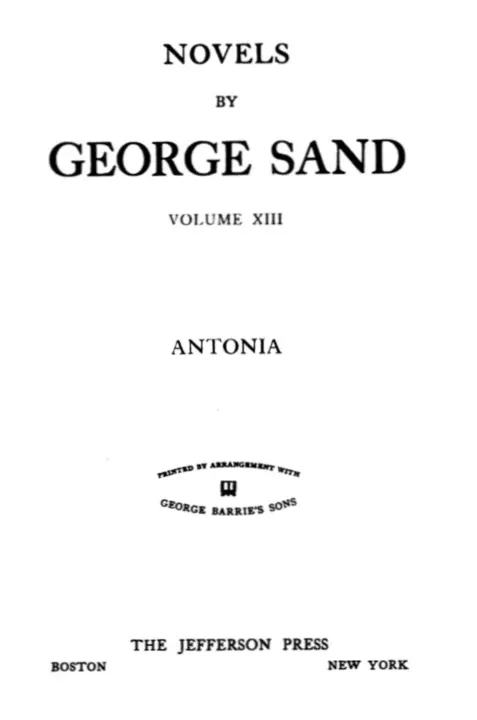
THE CLASSIC COLLECTION · 1863
"Antonia" by George Sand is a novel written in the early 19th century. The story unfolds in Paris during April of 1785 and centers around Julien Thierry, a young flower painter, and his mother, Madame Thierry, as they navigate life after the death of Julien's father. The narrative delves into themes of love, social status, and artistic ambition, with Julien becoming enamored with the Comtesse d'Estrelle, a widow facing her own challenges. At the start of the novel, we find Julien at work in his studio, deeply engaged in painting and communicating with his mother. Their conversation reveals a profound bond as they discuss their shared sorrow, memories of Julien's father, and the notion of love and happiness. Meanwhile, in the nearby hôtel d'Estrelle, the Comtesse grapples with her financial woes and societal expectations while also entering into a deeper reflection about her past decisions and the loneliness of her status. The narrative then highlights Julien's burgeoning feelings for the Comtesse, which intertwines their fates against a backdrop of social class and financial pressures.
Introduction adapted from the source catalogue; source summaries may be automatically generated.
Free to read · English · 87,044 words · No account needed
MAKE TIME FOR A GOOD BOOK
On by default. Untick to stop anonymous reading totals. Each page counts after 10 seconds in view. How this works.
Anonymous counting is on unless you have switched it off.
The time was the month of April, 1785, and the place Paris, where the spring that year was a genuine spring. The garden was in holiday attire, the greensward was studded with marguerites, the birds were singing, and the lilacs grew so straight and so close to Julien's window, that their fragrant clusters actually entered his room and strewed the white tiled floor of his studio with their little violet crosses.
Julien Thierry was a painter of flowers, like his father André Thierry, renowned under Louis XV. in the art of decorating spaces over doors, dining-room panels and boudoir ceilings. Those dainty ornaments became, under his skilful hands, objects of genuine, serious art, so that the artisan had became an artist, highly esteemed by people of taste, handsomely paid, and a person of much consideration in society. Julien, his pupil, had confined himself to painting on canvas. The fashion of his time frowned upon the fanciful and charming decorations of the Pompadour style. The Louis XVI. style was more severe; flowers were no longer strewn upon walls and ceilings, but were framed. Julien, then, painted flower and fruit pieces of the Mignon variety, mother-of-pearl shells, multi-colored butterflies, green lizards and drops of dew. He had much talent, he was handsome, he was twenty-four years old, and his father had left him nothing but debts.
André Thierry's widow was there in the studio where Julien was at work, and where the clusters of lilac shed their petals under the soft touch of a warm breeze. She was a woman of sixty, well-preserved, with eyes that were still beautiful, hair almost black, and slim, delicate hands. Short, slight, pale, dressed poorly, but with studied neatness, Madame Thierry was knitting mittens, and from time to time raised her eyes to glance at her son, who was absorbed in the study of a rose.
"Julien," she said, "why is it, I wonder, that you don't sing now when you are working? You might induce the nightingale to let us hear his voice."
"Listen, mother, there he is now," Julien replied. "He doesn't need anybody to give him the key."
And at that moment they did in fact hear the pure, sweet and resonant notes of the nightingale for the first time that year.
"Ah! so he has come!" exclaimed Madame Thierry. "To think that a whole year has passed!--Can you see him, Julien?" she asked, as the young man, putting aside his work, scrutinized the shrubs massed in front of the window.
"I thought I saw him," he replied with a sigh, "but I was mistaken."
And he returned to his easel. His mother watched him more closely, but she dared not question him.
Your reading position is saved on this browser. Take it to another device with a library code. Reading pages adapt to text, rather than matching a printed edition.
BEHIND THE BOOK
This eBook is for the use of anyone anywhere in the United States and most other parts of the world at no cost and with almost no restrictions whatsoever. You may copy it, give it away or re-use it under the terms of the Project Gutenberg License included with this eBook or online at www.gutenberg.org. If you are not located in the United States, you will have to check the laws of the country where you are located before using this eBook. Read the source licence.
The original source file, including credits and licence, is retained by this library. Request an original-format copy at no charge. Please include the book title and Project Gutenberg identifier #65170.
KEEP YOUR CURIOSITY GOING
Coulson Kernahan

Maurice Baring
Frances Wright
Cécile Tormay

Frederic Jesup Stimson

W. H. P. (William Henry Pope) Jarvis