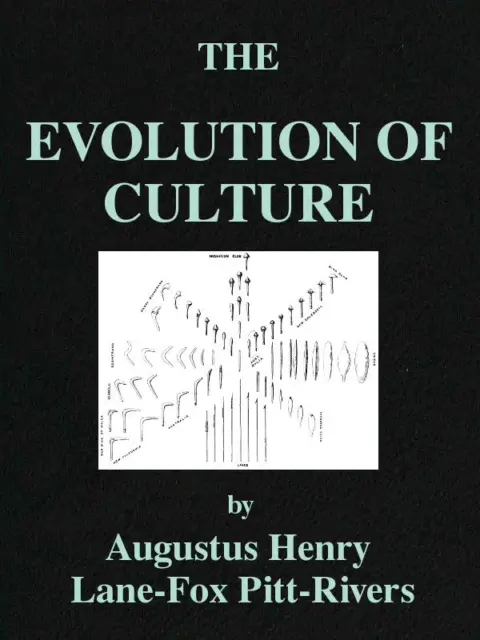
The Evolution of Culture, and Other Essays
Augustus Henry Lane-Fox Pitt-Rivers
THE CLASSIC COLLECTION · 1900
"Antique Works of Art from Benin" by Augustus Henry Lane-Fox Pitt-Rivers is a historical account written in the early 20th century. The publication focuses on the intricate art and artifacts recovered from Benin City following the punitive expedition of 1897 conducted by British forces. The book provides insights into the cultural significance of these works and their historical context, alluding to the influence of European contact on Benin's sophisticated art forms. The opening portion of this work introduces the early interactions between European nations, particularly the Portuguese, and the Kingdom of Benin, detailing its vibrant civilization before British colonial intervention. It recounts the disastrous expedition of 1896, which ended in tragedy, and the subsequent military campaign that led to the looting of exquisite artworks, primarily in brass, bronze, and ivory. Through a brief examination of artifacts, including plaques depicting warriors and various ceremonial objects, the introduction reveals their ceremonial use and connection to local beliefs, providing a foundation for understanding the advanced artistry of Benin culture and its implications in a colonial narrative.
Introduction adapted from the source catalogue; source summaries may be automatically generated.
Free to read · English · 16,145 words · No account needed
MAKE TIME FOR A GOOD BOOK
On by default. Untick to stop anonymous reading totals. Each page counts after 10 seconds in view. How this works.
Anonymous counting is on unless you have switched it off.
Figs. 113 and 114.--Bronze plaque, representing a figure standing; long spear, multibarbed, with ogee-sectioned blade in right hand, pointing downwards, knob at butt end. There are twelve ducts running from the ground of the plaque to the shaft of the spear. In left hand a broad leaf-shaped sword, with a ring attached to pommel, like Figs. 4, 13, 114, 131, 254, 255, &c. Dress like a nightshirt, and composed apparently of strings of coral, with bare arms. Dagger or short sword on left side. Quadrangular bell on neck; teeth necklace; coral choker, badge of rank. Head-dress of metal, in form somewhat resembling a grenadier cap. Six rosettes on ground, and quatrefoil leaves incised.
Fig. 115.--Brass key, a good deal filed and tooled all over. Handle ornamented with twisted rope pattern. The form of this key cannot be identified as Roman, and is probably European.
Fig. 116.--Bronze stand for the game of mancala, with ten holes and two irregular-shaped cavities in the centre. It is the same game as Figs. 184 and 185, Plate XXVIII, but with fewer holes. The sides are ornamented with interlaced strap-work, and the stem and the edge of the base with varieties of guilloche pattern. This game is distributed nearly all over Africa, and is said to be found wherever Arab influence is seen. It is also found in Palestine, Syria, Arabia, Maldive Islands, India, Ceylon, Malay Peninsula, Java, and the Philippine Islands.
Fig. 117.--Brass bell, with reticulated pierced work. Negro head on front. This bell is interesting as being a survival of the bells so often seen hanging from the necks of the figures on the plaques. It is evident that it never could have emitted any sound.
Fig. 118.--Entire tortoise shell, upper and under sides, in brass; ornamented on the upper side with geometrical pattern; each figure inlaid with a copper bolt or stud in the centre.
Figs. 119 and 120.--Bronze human head for holding carved elephants' tusks. The head-dress, pointed and reticulated, representing coral or agate. Four tribal marks over each eye. Six vertical bands of inlaid iron-work over the nose. The pupils of the eyes are of iron. The head-dress resembles Figs. 100 and 101, Plate XVII. Coral choker. Guilloche pattern on projecting base.
Fig. 121.--Head-dress composed entirely of agate. It serves to explain the construction of the head-dresses on the bronze plaques and figures, showing how the reticulated effect on the plaques is formed by beads of agate strung together in a kind of network. The rosettes of agate, and the tags and pendants are also explained by this figure. See Figs. 2, 4, 43, 44, 82, 83, 86, 87, 94, 95, 96, 97, 100, 101, 119, 120, 124, 125, 126, 127, 232-234, 277, 278, &c.
Your reading position is saved on this browser. Take it to another device with a library code. Reading pages adapt to text, rather than matching a printed edition.
Augustus Henry Lane-Fox Pitt-Rivers
Augustus Henry Lane-Fox Pitt-Rivers
BEHIND THE BOOK
This eBook is for the use of anyone anywhere in the United States and most other parts of the world at no cost and with almost no restrictions whatsoever. You may copy it, give it away or re-use it under the terms of the Project Gutenberg License included with this eBook or online at www.gutenberg.org. If you are not located in the United States, you will have to check the laws of the country where you are located before using this eBook. Read the source licence.
The original source file, including credits and licence, is retained by this library. Request an original-format copy at no charge. Please include the book title and Project Gutenberg identifier #44014.
KEEP YOUR CURIOSITY GOING
Cécile Tormay

Moritz Busch
John L. Ransom
Frances Wright
Cécile Tormay

Mabel Potter Daggett