THE CLASSIC COLLECTION✦The history of the condition of women in various ages and nationsCLASSIC FREE BOOKS
The history of the condition of women in various ages and nations
Lydia Maria Child
THE CLASSIC COLLECTION · 1836
"Anti-slavery catechism" by Lydia Maria Child is a significant treatise advocating for the abolition of slavery, composed in the early 19th century during a pivotal time in American history. The book is structured as a catechism, presenting questions and answers addressing various aspects and moral implications of slavery. As an informative and persuasive work, it aims to enlighten readers on the injustices faced by enslaved individuals and argues strongly for their emancipation. The content of the book systematically dismantles pro-slavery arguments while providing evidence of the brutal realities of slavery. Through a series of dialogues, Child explores the moral and ethical responsibilities of individuals and society as a whole regarding the institution of slavery, portraying it as fundamentally opposed to Christian values and human rights. She shares compelling anecdotes, statistics, and the testimonies of slaveholders and abolitionists alike to illustrate the true nature of slavery and the urgent need for its eradication. Child's passionate commitment to the cause of abolition is evident, as she challenges readers to confront their complicity and consider the far-reaching consequences of slavery on both enslaved individuals and the moral fabric of the nation.
Introduction adapted from the source catalogue; source summaries may be automatically generated.
Free to read · English · 14,688 words · No account needed
MAKE TIME FOR A GOOD BOOK
On by default. Untick to stop anonymous reading totals. Each page counts after 10 seconds in view. How this works.
Anonymous counting is on unless you have switched it off.
In June, 1794, Victor Hugo, a French republican general, retook Guadaloupe from the British, and immediately proclaimed freedom to all the slaves. They were 85,000 in number, and the whites only 13,000. No disasters occurred in consequence of this step. More than seven years after this, the Supreme Council of Guadaloupe, in an official document, alluding to the tranquillity which reigned throughout the island, observed: “We shall have the satisfaction of having given an example, which will prove that all classes of people may live in perfect harmony with each other, under an administration which secures justice to all classes.” In 1802, Bonaparte sent a powerful French force, and again reduced the island to slavery, at the cost of about 20,000 negro lives.
In July, 1828, thirty thousand Hottentots in Cape Colony were emancipated from their long and cruel bondage, and admitted by law to all the rights and privileges of the white colonists. Outrages were predicted, as the inevitable consequence of freeing human creatures so completely brutalized as the poor Hottentots; but all went on peaceably; and, as a gentleman facetiously remarked, “Hottentots as they were, they worked much better for Mr. Cash, than they had ever done for Mr. Lash.”
Q. But they say the British have had difficulties in their West
Indies.
A. The enemies of the cause have tried very hard to get up a “raw-head and bloody-bones” story; but even if you take their own accounts, you will find that they have not been able to adduce any instances of violence in support of their assertions. The real facts are these: The measure was not carried in a manner entirely satisfactory to the English abolitionists. Their knowledge of human nature, combined with the practical evidence afforded by history, led them to conclude that immediate and unqualified emancipation was safest for the master, as well as just to the slave; but the planters raised such a hue and cry concerning bloodshed and insurrection, that the British government determined to conciliate them by a gradual abolition of slavery. It was ordained that the slaves should work six years longer without wages, under the name of apprentices; but no punishment could be inflicted without the special order of magistrates. The colonies had a right to dispense with the apprenticeship system if they pleased; but out of the seventeen West India colonies, Antigua and Bermuda were the only ones that chose to do so. The act of Parliament provided that each apprentice should work for his master forty and a half hours a week, and have the rest of the time to himself. The masters were not satisfied with this; and they tried, by a series of petty vexations, to coerce the apprentices into individual contracts to work fifty hours in a week. While the people had been slaves, they were always allowed cooks to prepare their meals, a person to bring water to the gang during the hot hours, and nurses to tend the little children while their mothers were at work in the field; but because the Abolition Act did not expressly provide that these privileges should be continued, the masters saw fit to take them away. Each apprentice was obliged to quit his or her work, and go, sometimes a great distance, to the cabin to cook his meals, instead of having it served up in the field; and the time taken up in this operation was to be made up out of the apprentices’ own time. No water was allowed to be brought to quench their thirst; the aged and infirm, instead of being left, as formerly, to superintend the children under the shade, were ordered out into the burning fields; and mothers were obliged to toil at the hoe with their infants strapped at their backs. In addition to all these annoyances, the planters obtained a new proclamation from the governor, by which they were authorized to require extra labor of the apprentices in times of emergency, or whenever they should deem it necessary, in the cultivation, gathering, or manufacture of the crop, provided they repaid them an equal time at a convenient season of the year. This was very much like taking from a New England laborer the month of July, and paying it back to him in January. The negroes had behaved extremely well when emancipation was first proclaimed, and universally showed a disposition to be orderly, submissive, and thankful; but this system of privation and injustice soon created discontent. They knew that they were to receive no wages, however industrious they might be; and they were well aware that their masters no longer had a right to flog them. A bad stimulus to labor had been removed, without supplying a good one in its place. In three of the colonies, the apprentices refused to work on the terms required by their masters. In Jamaica, a very small military force was sent into one parish, and only on one occasion; but no violence was offered on either side; for the apprentices confined themselves to passive resistance—merely refusing to work on the required terms. In St. Christophers, difficulties of a similar kind occurred; but no outrage of any kind was committed. In one fortnight all the trouble was at an end; and out of twenty thousand apprentices, only thirty were found to be absent from their work; and some of these were supposed to be dead in the woods. In Demarara, the principal difficulty occurred. The laborers assembled together, and marched round with a flag staff; but the worst thing they did was to beat a constable with their fists. It is a solemn fact that a few fisty cuffs with a constable are the only violence to persons or property, that has been attempted by the eight hundred thousand slaves emancipated in the British Colonies!
Your reading position is saved on this browser. Take it to another device with a library code. Reading pages adapt to text, rather than matching a printed edition.
Lydia Maria Child
Lydia Maria Child
Lydia Maria Child
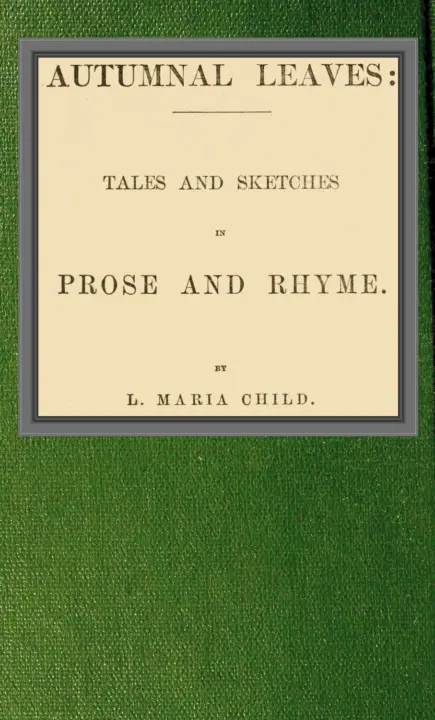
Lydia Maria Child
BEHIND THE BOOK
This eBook is for the use of anyone anywhere in the United States and most other parts of the world at no cost and with almost no restrictions whatsoever. You may copy it, give it away or re-use it under the terms of the Project Gutenberg License included with this eBook or online at www.gutenberg.org. If you are not located in the United States, you will have to check the laws of the country where you are located before using this eBook. Read the source licence.
The original source file, including credits and licence, is retained by this library. Request an original-format copy at no charge. Please include the book title and Project Gutenberg identifier #69376.
KEEP YOUR CURIOSITY GOING

David Patterson (Spirit) Hatch

David Patterson (Spirit) Hatch

David Patterson (Spirit) Hatch
Cécile Tormay

Moritz Busch
Coulson Kernahan