His Little World: The Story of Hunch Badeau
Samuel Merwin
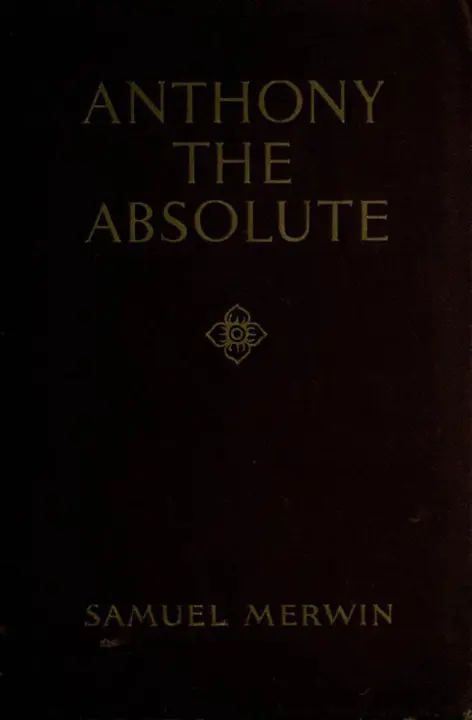
THE CLASSIC COLLECTION · 1914
"Anthony the Absolute" by Samuel Merwin is a novel written in the early 20th century. The story follows Anthony Ives Eckhart, a scientific man deeply interested in music and ethnomusicology, as he embarks on a voyage to the East, navigating the complex interactions with the various characters onboard, especially the boastful Sir Robert and a rugged fellow traveler, Archibald Crocker. As Eckhart attempts to assert the value of musical intervals—drawing distinctions between Eastern and Western music—his journey evolves into a profound exploration of culture, personal relationships, and human emotions against the backdrop of early 20th century transoceanic travel. At the start of the novel, we find Eckhart uncomfortable aboard a ship headed to Yokohama, troubled by Sir Robert's pretentious monologues and the chaos surrounding him. He wrestles with his own thoughts and dismisses the boisterous conversations around him, instead reflecting on the varied passengers' motives for their travels across the globe. Eckhart's ire ignites when Sir Robert belittles the music of Eastern cultures, propelling him into a passionate argument defending the native sounds. This confrontation hints at Eckhart's deeper commitments to his scientific pursuits, setting the stage for an encounter with the complexities of human desire and connection, particularly in the emerging context of East-West interactions. The opening illustrates not only Eckhart's intellectual rigor but also foreshadows the emotional trials he will face in his pursuit to understand the intrinsic nature of music and culture.
Introduction adapted from the source catalogue; source summaries may be automatically generated.
Free to read · English · 69,211 words · No account needed
MAKE TIME FOR A GOOD BOOK
On by default. Untick to stop anonymous reading totals. Each page counts after 10 seconds in view. How this works.
Anonymous counting is on unless you have switched it off.
This was getting us nowhere. Her eyes were dry now, and oh, so sad and tired. She was slowly shaking her head at me.
“You are killing--everything!” she said. But she said it gently.
I could not speak, I only looked at her--looked and looked. Then I went over to the phonograph and worked aimlessly over it. I think I wound it up.
She still sat there, her hands limp in her lap.
Finally she said, in a low voice that was y et steady--“I wish I could
love you.”
“You can,” I muttered. “You shall!”
She slowly shook her head. “No,” she breathed.
“But you must,” I went on. “It is the only thing now. It is the one way out for you and me.”
This had some effect on her. She pursed her lips, and thought.
But after a little she shook her head again, and made that listless gesture of her left hand that she had made that first day, when I broke into her room.
“Something has died in me,” she said. “I don't believe I can ever love a
man again.”
She rose, and moved toward her own room. On the sill she paused, and picked at the flaking paint of the door frame.
“I do not believe it is the only way out,” she said. “You will get over it, of course.” Then, at the shake of my head, she corrected--“At least, you will have your work, and the feeling that you are getting somewhere with your life. I should think that would be the one great thing, after all. And I shall at least know that I am not hurting another life. I hurt everybody, that cares for me. If I could--love you, I should undoubtedly hurt you.”
“Wait,” said I, “we will go on with our work, at least--in the morning.”
She pursed her lips again. “I don't know,” she replied, as if she were thinking aloud, “whether that is possible.”
“It must be possible!”
She shook her head. “You will have to let me think about that.”
Then she closed the door, and was gone.
I had meant to give her my life. I had only succeeded in taking away from her that part of it that had been helpful to her.
I find it difficult to reconstruct the hour that followed. I remember standing a long while by the window. Once I went to her door, just so that I might hear her moving about her room. But as I stood there it seemed like an intrusion, and I came away.
Your reading position is saved on this browser. Take it to another device with a library code. Reading pages adapt to text, rather than matching a printed edition.
Samuel Merwin
Samuel Merwin
Samuel Merwin
Samuel Merwin
BEHIND THE BOOK
This eBook is for the use of anyone anywhere in the United States and most other parts of the world at no cost and with almost no restrictions whatsoever. You may copy it, give it away or re-use it under the terms of the Project Gutenberg License included with this eBook or online at www.gutenberg.org. If you are not located in the United States, you will have to check the laws of the country where you are located before using this eBook. Read the source licence.
The original source file, including credits and licence, is retained by this library. Request an original-format copy at no charge. Please include the book title and Project Gutenberg identifier #52507.
KEEP YOUR CURIOSITY GOING
Wilfrid Scawen Blunt
Wilfrid Scawen Blunt

E. W. (Edgar Watson) Howe
Coulson Kernahan

Maurice Baring
Frances Wright