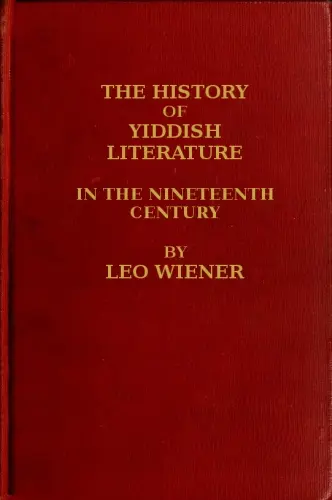
The History of Yiddish Literature in the Nineteenth Century
Leo Wiener
THE CLASSIC COLLECTION · 1902
"Anthology of Russian Literature from the Earliest Period to the Present Time" by Leo Wiener is a comprehensive collection of Russian literary works spanning from the 10th century to the modern era, published during the early 20th century. This anthology aims to provide readers, particularly those who speak English, with a critical and biographical overview of important Russian authors and significant literary contributions that shape the evolution of Russian literature. It features representative excerpts that offer insight into the historical context and literary styles inherent in Russian works. The opening portion of the anthology begins with a preface that establishes the importance and growing interest in Russian literature within the context of Anglo-Saxon and Slavic relations. Wiener argues for the significance of understanding and appreciating Russian literary traditions, highlighting how Russian literature has largely been overlooked outside of translated works. He discusses the challenges faced by the Russian language and literature throughout history due to geographical and political barriers, as well as the influences from neighboring cultures. Furthermore, he outlines the goals of the anthology: to present a wide array of literary selections that reflect historical episodes and the unique evolution of Russian literature, from its ancient roots to contemporary expressions, thus inviting readers to engage with Russia's rich literary heritage.
Introduction adapted from the source catalogue; source summaries may be automatically generated.
Free to read · English · 160,981 words · No account needed
MAKE TIME FOR A GOOD BOOK
On by default. Untick to stop anonymous reading totals. Each page counts after 10 seconds in view. How this works.
Anonymous counting is on unless you have switched it off.
He went, and thus he meditated on his walk: “The beginning never daunts the singers: you simply say what first occurs to you. The trouble only begins when you have to praise the hero. I know not with whom to compare him; with Rumyántsev, with Greyg or with Orlóv? What a pity I have not read the ancients! For it does not seem proper to compare to the moderns. Well, I’ll simply write: ‘Rejoice, hero, rejoice, O thou!’ That’s good! But what now? Ah, now comes the ecstasy! I’ll say: ‘Who has rent the veil of eternity for me! I see the gleam of lightning! From the upper world I hear, and so on.’ And then? Of course: ‘Many a year!’ Most excellent! I have caught the plan, and thoughts, and all! Hail to the poet! All I have to do now, is to sit down and write, and boldly print!” He hurries to his garret, scribbles, and the deed is done! And his ode is printed, and already they wrap shoeblacking in his ode. Thus has he Pindarised, and all his ilk who are scarcely capable to write a proper shop sign! “I wish Phœbus would tell them in their dream: ‘He who in Catherine’s loud age of glory cannot by his eulogy move the hearts of others, nor water his sweet lyre with tears, let him throw it away, break it and know he is not a poet!’”
[166] Yermák defeated Kuchúm Khan in 1579; Kuchúm Khan fell into the hands of Calmucks, who killed him.
[167] The translator misunderstood the passage. Mehmed-Kul was the King’s brother, whom Ermák made prisoner and sent to John the Terrible.
[168] God of the Ostiaks.
[169] The Tsar of Russia; the origin of the appellation is not certain.
[170] A German poet who translated the odes of Horace and wrote odes of
his own.
[171] Master of masquerades at St. Petersburg.
[172] St. Petersburg tailor.
[173] Magazines.
[174] Suvórov.
Ablesímov, A. O., his comic opera, 36;
biographical sketch and extract, 370 seq.
Academy founded, 316 seq.
Achronism, of Russ. literature, 9;
of legends, 14
Addison’s influence on Russ. literature, 30 seq., 291, 327
Alexander the Great in legend, 14
Alexander I., 304 seq., 378
Alexis Mikháylovich, school established during his reign, 17;
and the theatre, 26;
and see 35
All Kinds of Things, 272, 326
American interest in Russ. literature, vii. seq.
Anacreon, translated, 224
Andover, see Biblical Repository
Anglo-Russian Literary Society’s studies in Russ. literature, x.
Anthologies of Russ. literature, viii., x.
Apocrypha, 12 seq.;
legends, 114 seq.;
stories, 152 seq.
Aprakos, 11
Apuleius, 33, 358, 374
Athenæum, yearly reports on Russ. literature, xi.
Bain, R. N., translation of fairy tales, 189
Baldwin, Prince, and Daniel the Abbot, 57 seq.
Your reading position is saved on this browser. Take it to another device with a library code. Reading pages adapt to text, rather than matching a printed edition.
BEHIND THE BOOK
This eBook is for the use of anyone anywhere in the United States and most other parts of the world at no cost and with almost no restrictions whatsoever. You may copy it, give it away or re-use it under the terms of the Project Gutenberg License included with this eBook or online at www.gutenberg.org. If you are not located in the United States, you will have to check the laws of the country where you are located before using this eBook. Read the source licence.
The original source file, including credits and licence, is retained by this library. Request an original-format copy at no charge. Please include the book title and Project Gutenberg identifier #71933.
KEEP YOUR CURIOSITY GOING

Charles G. (Charles Griffith) Ross
Hannah Webster Foster

Emily Lawless
Edwin Hamlin Carr

Charles De Lano Hine
Andrew Ure