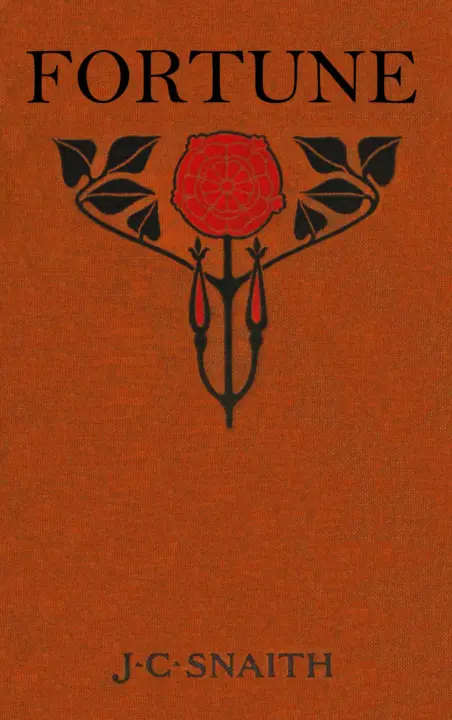
Fortune
J. C. (John Collis) Snaith

THE CLASSIC COLLECTION · 1914
"Anne Feversham" by J. C. Snaith is a historical novel written in the early 20th century. Set during the time of William Shakespeare, the story revolves around the iconic playwright and his interactions with key characters, including a young noblewoman, Anne Feversham. The narrative intricately weaves themes of love, societal constraints, and the consequences of actions within a vibrant historical backdrop. The opening of "Anne Feversham" introduces the distinguished actor and playwright, William Shakespeare, as he enters a tailor's shop in Nottingham. Through his conversation with the tailor, a dire sense of foreboding arises regarding the execution of a young man, Mr. Gervase Heriot, accused of plotting against the Queen. In a chance encounter, Shakespeare meet the spirited Anne Feversham, who showcases her audacity and rebellious spirit, especially with her choice of attire that defies societal norms for women of her status. Tension mounts as Anne's disdain for actors and her father's harsh views come into conflict with her growing admiration for Shakespeare and an emerging sense of independence, suggesting rich character dynamics and impending drama as the story unfolds.
Introduction adapted from the source catalogue; source summaries may be automatically generated.
Free to read · English · 86,461 words · No account needed
MAKE TIME FOR A GOOD BOOK
On by default. Untick to stop anonymous reading totals. Each page counts after 10 seconds in view. How this works.
Anonymous counting is on unless you have switched it off.
“You have good friends, Master Shakespeare.” The tone of the Queen was so matter-of-fact, that she might have been merely discussing a plain affair of business. “And no man can have friends so true as these and so honorable in reputation without having a character sufficiently worthy to entitle him to them. Therefore, it is for this reason, and for none other, that I have decided to hear you in your own behalf. But, pray understand, I hold out no prospect of leniency. You have been guilty of such wicked folly that I do not doubt that a charge of high treason will lie against you.”
By this time, the playwright was once more completely master of himself. He stood to confront the Queen simply and without fear.
“Let us hear your defence, Master Shakespeare, if defence you will
venture to make.”
“Your grace,” said the player, in his gentle voice, “on my own part, I offer no defence. Freely and fully I accept all responsibility for any hurt I have done to justice. But having done none that I know, I take my stand upon the innocence of my intention.”
The light of anger flamed in the Queen’s eyes.
“Don’t use so many words, sirrah,” she said, sharply. “Come to the issue. I am a plain woman, and I ask for plain words and few. For what reason, I will ask you, have you embraced these devious ways?”
The player met with calm eyes the harsh glance of the Sovereign.
“If it be treason, your grace, to befriend the innocent,” he said, “I will gladly pay the penalty of my crime.”
The eyes of the Queen sparkled ominously.
“The innocent, sirrah! Pray, what do you mean by the innocent? Is it the part of innocence, I ask you, to engage in a plot to take away my life?”
“No, your grace,” said the player. “And may it never be permitted to one of your subjects to say otherwise.”
“Then may I ask why you take the part of those who have done so?”
“I have but taken the part, your grace, of one accused wrongfully.”
“Do not impugn the Queen’s justice, sirrah!”
“God forbid! But, in this instance, I make so bold as to affirm that a grievous miscarriage has occurred.”
“God’s blood, sirrah!” cried the Queen, “I would have you be wary. If you dare to impugn the integrity of our courts, and you cannot make good your ill words in every particular, you shall make heavy payment for such a contumacy.”
Your reading position is saved on this browser. Take it to another device with a library code. Reading pages adapt to text, rather than matching a printed edition.
J. C. (John Collis) Snaith
J. C. (John Collis) Snaith
J. C. (John Collis) Snaith
J. C. (John Collis) Snaith
BEHIND THE BOOK
This eBook is for the use of anyone anywhere in the United States and most other parts of the world at no cost and with almost no restrictions whatsoever. You may copy it, give it away or re-use it under the terms of the Project Gutenberg License included with this eBook or online at www.gutenberg.org. If you are not located in the United States, you will have to check the laws of the country where you are located before using this eBook. Read the source licence.
The original source file, including credits and licence, is retained by this library. Request an original-format copy at no charge. Please include the book title and Project Gutenberg identifier #67774.
KEEP YOUR CURIOSITY GOING
Cécile Tormay

Moritz Busch
Coulson Kernahan
John L. Ransom

Maurice Baring
Frances Wright