
Letters to a Friend, Written to Mrs. Ezra S. Carr, 1866-1879
John Muir
THE CLASSIC COLLECTION · 1888
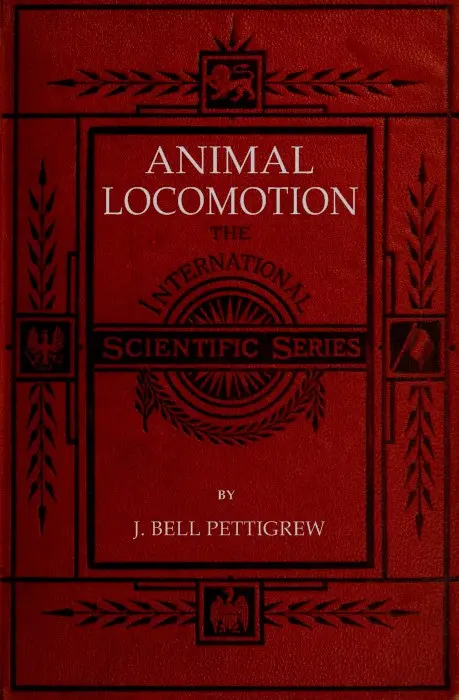
"Animal Locomotion; or, Walking, Swimming, and Flying" by James Bell Pettigrew is a scientific publication written in the late 19th century. This work explores the mechanics of movement in various animals, focusing specifically on their modes of locomotion across different environments—on land, in water, and through the air. The book aims to elucidate the principles underlying the physical forces and structures that enable animals to move effectively and elegantly. The opening of the book introduces the topic of animal locomotion as a fundamental aspect of life that is inherently intertwined with the survival and well-being of creatures. Pettigrew emphasizes that motion is not isolated to the animal kingdom but is a characteristic of all matter, drawing connections between natural phenomena and the potential for artificial movement. Through engaging descriptions, he illustrates the beauty and complexity of animal movement, setting the stage for a detailed examination of walking, swimming, and flying as interconnected themes of progression within the natural world.
Introduction adapted from the source catalogue; source summaries may be automatically generated.
Free to read · English · 96,637 words · No account needed
MAKE TIME FOR A GOOD BOOK
On by default. Untick to stop anonymous reading totals. Each page counts after 10 seconds in view. How this works.
Anonymous counting is on unless you have switched it off.
When artificial wings constructed on the plan of natural ones, with stiff roots, tapering semi-rigid anterior margins, and thin yielding posterior margins, are allowed to drop from a height, they describe double curves in falling, the roots of the wings reaching the ground first. This circumstance proves the greater buoying power of the tips of the wings as compared with the roots. I might refer to many other experiments made in this direction, but these are sufficient to show that weight, when acting upon wings, or, what is the same thing, upon elastic twisted inclined planes, must be regarded as an independent moving power. But for this circumstance flight would be at once the most awkward and laborious form of locomotion, whereas in reality it is incomparably the easiest and most graceful. The power which rapidly vibrating wings have in sustaining a body which tends to fall vertically downwards, is much greater than one would naturally imagine, from the fact that the body, which is always beginning to fall, is never permitted actually to do so. Thus, when it has fallen sufficiently far to assist in elevating the wings, it is at once elevated by the vigorous descent of those organs. The body consequently never acquires the downward momentum which it would do if permitted to fall through a considerable space uninterruptedly. It is easy to restrain even a heavy body when beginning to fall, while it is next to impossible to check its progress when it is once fairly launched in space and travelling rapidly in a downward direction.
Weight, Momentum, and Power, to a certain extent, synonymous in Flight.--When a bird rises it has little or no momentum, so that if it comes in contact with a solid resisting surface it does not injure itself. When, however, it has acquired all the momentum of which it is capable, and is in full and rapid flight, such contact results in destruction. My friend Mr. A. D. Bartlett informed me of an instance where a wild duck terminated its career by coming violently in contact with one of the glasses of the Eddystone Lighthouse. The glass, which was fully an inch in thickness, was completely smashed. Advantage is taken of this circumstance in killing sea-birds, a bait being placed on a board and set afloat with a view to breaking the neck of the bird when it stoops to seize the carrion. The additional power due to momentum in heavy bodies in motion is well illustrated in the start and progress of steamboats. In these the slip, as it is technically called, decreases as the speed of the vessel increases; the strength of a man, if applied by a hawser attached to the stern of a moderate-sized vessel, being sufficient to retard, and, in some instances prevent, its starting. In such a case the power of the engine is almost entirely devoted to “slip” or in giving motion to the fluid in which the screw or paddle is immersed. It is consequently not the power residing in the paddle or screw which is cumulative, but the momentum inhering in the mass. In the bird, the momentum, alias weight, is made to act upon the inclined planes formed by the wings, these adroitly converting it into sustaining and propelling power. It is to this circumstance, more than any other, that the prolonged flight of birds is mainly due, the inertia or dead weight of the trunk aiding and abetting the action of the wings, and so relieving the excess of exertion which would necessarily devolve on the bird. It is thus that the power which in living structures resides in the mass is conserved, and the mass itself turned to account. But for this reciprocity, no bird could retain its position in the air for more than a few minutes at a time. This is proved by the comparatively brief upward flight of the lark and the hovering of the hawk when hunting. In both these cases the body is exclusively sustained by the action of the wings, the weight of the trunk taking no part in it; in other words, the weight of the body does not contribute to flight by adding its momentum and the impulse which momentum begets. In the flight of the albatross, on the other hand, the momentum acquired by the moving mass does the principal portion of the work, the wings for the most part being simply rotated on and off the wind to supply the proper angles necessary for the inertia or mass to operate upon. It appears to me that in this blending of active and passive power the mystery of flight is concealed, and that no arrangement will succeed in producing flight artificially which does not recognise and apply the principle here pointed out.
Your reading position is saved on this browser. Take it to another device with a library code. Reading pages adapt to text, rather than matching a printed edition.
BEHIND THE BOOK
This eBook is for the use of anyone anywhere in the United States and most other parts of the world at no cost and with almost no restrictions whatsoever. You may copy it, give it away or re-use it under the terms of the Project Gutenberg License included with this eBook or online at www.gutenberg.org. If you are not located in the United States, you will have to check the laws of the country where you are located before using this eBook. Read the source licence.
The original source file, including credits and licence, is retained by this library. Request an original-format copy at no charge. Please include the book title and Project Gutenberg identifier #56427.
KEEP YOUR CURIOSITY GOING
John Muir

Asa Gray
Asa Gray

Florence Nightingale
Elizabeth Robins Pennell
Denison Olmsted