
Letters to a Friend, Written to Mrs. Ezra S. Carr, 1866-1879
John Muir
THE CLASSIC COLLECTION · 1888
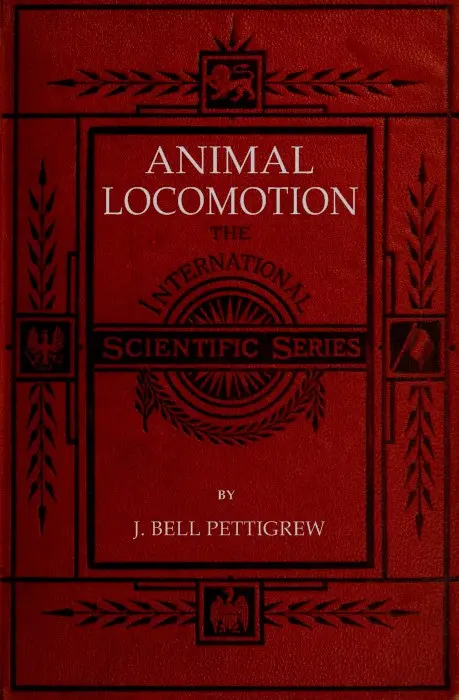
"Animal Locomotion; or, Walking, Swimming, and Flying" by James Bell Pettigrew is a scientific publication written in the late 19th century. This work explores the mechanics of movement in various animals, focusing specifically on their modes of locomotion across different environments—on land, in water, and through the air. The book aims to elucidate the principles underlying the physical forces and structures that enable animals to move effectively and elegantly. The opening of the book introduces the topic of animal locomotion as a fundamental aspect of life that is inherently intertwined with the survival and well-being of creatures. Pettigrew emphasizes that motion is not isolated to the animal kingdom but is a characteristic of all matter, drawing connections between natural phenomena and the potential for artificial movement. Through engaging descriptions, he illustrates the beauty and complexity of animal movement, setting the stage for a detailed examination of walking, swimming, and flying as interconnected themes of progression within the natural world.
Introduction adapted from the source catalogue; source summaries may be automatically generated.
Free to read · English · 96,637 words · No account needed
MAKE TIME FOR A GOOD BOOK
On by default. Untick to stop anonymous reading totals. Each page counts after 10 seconds in view. How this works.
Anonymous counting is on unless you have switched it off.
Ligaments, elastic, more highly differentiated in wings which
vibrate quickly, 193
Locomotion, the active organs of, 24
Locomotion, the passive organs of, 21
Locomotion of the horse, 39
Locomotion of the ostrich, 45
Locomotion of man, 51
Marey’s artificial wings, 233
Membranous wings, 170
Motion associated with the life and well-being of animals, 1
Motion not confined to the animal kingdom, 2
Motion, natural and artificial, 4
Motion, of uniform, 17
Motion uniformly varied, 17
Muscles, their properties, mode of action, etc., 24
Muscles arranged in longitudinal, transverse, and oblique spiral
lines, 28
Muscles, oblique spiral, necessary for spiral bones and joints, 31
Muscles take precedence of bones in animal movements, 29
Muscular cycles, 26
Muscular waves, 26
Pendulums, the extremities of animals act as, in walking,
9, 18, 56, 57
Plane, inclined, as applied to the air, 211
Pettigrew’s method of constructing and applying artificial wings as contradistinguished from that of Borelli, Chabrier, Durckheim, Marey, etc., 235
Pettigrew’s wave wing, 236
Pettigrew’s compound wave wing, 242
Progression on the land, 37
Do. on or in the water, 64
Do. in or through the air, 103
Quadrupeds walk, fishes swim, and insects, bats, and birds fly, by figure-of-8 movements, 15, 16
Screws--the wing of the bird and the extremity of the biped and quadruped screws, structurally and functionally, 12
Screws--difference between those formed by the wings and those
employed in navigation, 151
Sculling action of the wing, 231
Speed attained by insects, 188
Speed of wing movements partly accounted for, 120
Spine, spiral movements of, transferred to the extremities, 33
Straus-Durckheim’s artificial wings, 233
Swimming of the fish, whale, porpoise, etc., 66
Swimming of the seal, sea-bear, and walrus, 74
Swimming of man, 78
Swimming of the turtle, triton, crocodile, etc., 89
Terrestrial animals have smaller travelling surfaces than amphibia, amphibia than fishes, and fishes than insects, bats, and birds, 8
The travelling surfaces of animals increase as the density of the media traversed decreases, 7, 8
The travelling surfaces of animals variously modified and adapted to the media on or in which they move, 34
Walking, swimming, and flying correlated, 5
Walking of the quadruped, biped, etc., 9, 10, 11
Wave wing of Pettigrew, 236
Do. how to construct on insect type, 240
Do. how to construct to evade the superimposed air during the up
stroke, 241
Do. can be driven at any speed, 251, 255
Do. can create currents and rise upon them, 253
Do. can make new currents and utilize existing ones, 251, 255
Do. as a propeller, 256
Do. as an aërial screw, 256
Do. forces required to apply to the air, 245, 246
Do. necessity for supplying root of, with elastic structures, 247
Wave wing, compound, 242
Weight necessary to flight, 110
Weight contributes to flight, 112
Weight, momentum, and power to a certain extent synonymous in
flight, 114
Wing of the bird and the extremity of the biped and quadruped are screws, structurally and functionally, 12, 136
Wing in flight describes figure-of-8 curves, 12
Wing during its action reverses its planes and describes a
figure-of-8 track in space, 140
Your reading position is saved on this browser. Take it to another device with a library code. Reading pages adapt to text, rather than matching a printed edition.
BEHIND THE BOOK
This eBook is for the use of anyone anywhere in the United States and most other parts of the world at no cost and with almost no restrictions whatsoever. You may copy it, give it away or re-use it under the terms of the Project Gutenberg License included with this eBook or online at www.gutenberg.org. If you are not located in the United States, you will have to check the laws of the country where you are located before using this eBook. Read the source licence.
The original source file, including credits and licence, is retained by this library. Request an original-format copy at no charge. Please include the book title and Project Gutenberg identifier #56427.
KEEP YOUR CURIOSITY GOING
John Muir

Asa Gray
Asa Gray

Florence Nightingale
Elizabeth Robins Pennell
Denison Olmsted