
Letters to a Friend, Written to Mrs. Ezra S. Carr, 1866-1879
John Muir
THE CLASSIC COLLECTION · 1888
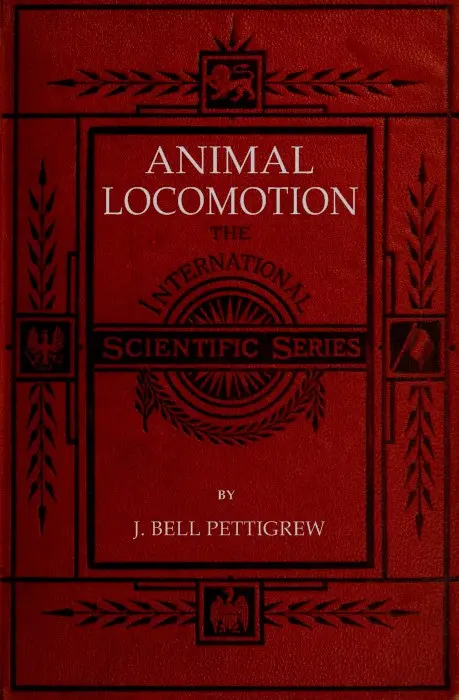
"Animal Locomotion; or, Walking, Swimming, and Flying" by James Bell Pettigrew is a scientific publication written in the late 19th century. This work explores the mechanics of movement in various animals, focusing specifically on their modes of locomotion across different environments—on land, in water, and through the air. The book aims to elucidate the principles underlying the physical forces and structures that enable animals to move effectively and elegantly. The opening of the book introduces the topic of animal locomotion as a fundamental aspect of life that is inherently intertwined with the survival and well-being of creatures. Pettigrew emphasizes that motion is not isolated to the animal kingdom but is a characteristic of all matter, drawing connections between natural phenomena and the potential for artificial movement. Through engaging descriptions, he illustrates the beauty and complexity of animal movement, setting the stage for a detailed examination of walking, swimming, and flying as interconnected themes of progression within the natural world.
Introduction adapted from the source catalogue; source summaries may be automatically generated.
Free to read · English · 96,637 words · No account needed
MAKE TIME FOR A GOOD BOOK
On by default. Untick to stop anonymous reading totals. Each page counts after 10 seconds in view. How this works.
Anonymous counting is on unless you have switched it off.
How the Wave Wing creates currents, and rises upon them, and how the Air assists in elevating the Wing.--In order to ascertain in what way the air contributes to the elevation of the wing, I made a series of experiments with natural and artificial wings. These experiments led me to conclude that when the wing descends, as in the bat and bird, it compresses and pushes before it, in a downward and forward direction, a column of air represented by a, b, c of fig. 129, p. 253.[119] The air rushes in from all sides to replace the displaced air, as shown at d, e, f, g, h, i, and so produces a circle of motion indicated by the dotted line s, t, v, w. The wing rises upon the outside of the circle referred to, as more particularly seen at d, e, v, w. The arrows, it will be observed, are all pointing upwards, and as these arrows indicate the direction of the reflex or back current, it is not difficult to comprehend how the air comes indirectly to assist in elevating the wing. A similar current is produced to the right of the figure, as indicated by l, m, o, p, q, r, but seeing the wing is always advancing, this need not be taken into account.
[119] The artificial currents produced by the wing during its descent may be readily seen by partially filling a chamber with steam, smoke, or some impalpable white powder, and causing the wing to descend in its midst. By a little practice, the eye will not fail to detect the currents represented at d, e, f, g, h, i, l, m, o, p, q, r of fig. 129, p. 253.
If fig. 129 be made to assume a horizontal position, instead of the oblique position which it at present occupies, the manner in which an artificial current is produced by one sweep of the wing from right to left, and utilized by it in a subsequent sweep from left to right, will be readily understood. The artificial wave wing makes a horizontal sweep from right to left, i.e. it passes from the point a to the point c of fig. 129. During its passage it has displaced a column of air. To fill the void so created, the air rushes in from all sides, viz. from d, e, f, g, h, i; l, m, o, p, q, r. The currents marked g, h, i; p, q, r, represent the reflex or artificial currents. These are the currents which, after a brief interval, force the flame of the candle from right to left. It is those same currents which the wing encounters, and which contribute so powerfully to its elevation, when it sweeps from left to right. The wing, when it rushes from left to right, produces a new series of artificial currents, which are equally powerful in elevating the wing when it passes a second time from right to left, and thus the process of making and utilizing currents goes on so long as the wing is made to oscillate. In waving the artificial wing to and fro, I found the best results were obtained when the range of the wing and the speed with which it was urged were so regulated as to produce a perfect reciprocation. Thus, if the range of the wing be great, the speed should also be high, otherwise the air set in motion by the right stroke will not be utilized by the left stroke, and vice versâ. If, on the other hand, the range of the wing be small, the speed should also be low, as the short stroke will enable the wing to reciprocate as perfectly as when the stroke is longer and the speed quicker. When the speed attained is high, the angles made by the under surface of the wing with the horizon are diminished; when it is low, the angles are increased. From these remarks it will be evident that the artificial wave wing reciprocates in the same way that the natural wing reciprocates; the reciprocation being most perfect when the wing is vibrating in a given spot, and least perfect when it is travelling at a high horizontal speed.
Your reading position is saved on this browser. Take it to another device with a library code. Reading pages adapt to text, rather than matching a printed edition.
BEHIND THE BOOK
This eBook is for the use of anyone anywhere in the United States and most other parts of the world at no cost and with almost no restrictions whatsoever. You may copy it, give it away or re-use it under the terms of the Project Gutenberg License included with this eBook or online at www.gutenberg.org. If you are not located in the United States, you will have to check the laws of the country where you are located before using this eBook. Read the source licence.
The original source file, including credits and licence, is retained by this library. Request an original-format copy at no charge. Please include the book title and Project Gutenberg identifier #56427.
KEEP YOUR CURIOSITY GOING
John Muir

Asa Gray
Asa Gray

Florence Nightingale
Elizabeth Robins Pennell
Denison Olmsted