
Letters to a Friend, Written to Mrs. Ezra S. Carr, 1866-1879
John Muir
THE CLASSIC COLLECTION · 1888
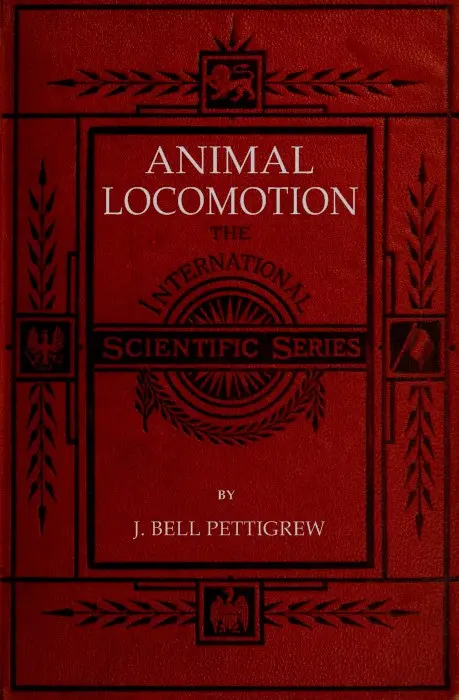
"Animal Locomotion; or, Walking, Swimming, and Flying" by James Bell Pettigrew is a scientific publication written in the late 19th century. This work explores the mechanics of movement in various animals, focusing specifically on their modes of locomotion across different environments—on land, in water, and through the air. The book aims to elucidate the principles underlying the physical forces and structures that enable animals to move effectively and elegantly. The opening of the book introduces the topic of animal locomotion as a fundamental aspect of life that is inherently intertwined with the survival and well-being of creatures. Pettigrew emphasizes that motion is not isolated to the animal kingdom but is a characteristic of all matter, drawing connections between natural phenomena and the potential for artificial movement. Through engaging descriptions, he illustrates the beauty and complexity of animal movement, setting the stage for a detailed examination of walking, swimming, and flying as interconnected themes of progression within the natural world.
Introduction adapted from the source catalogue; source summaries may be automatically generated.
Free to read · English · 96,637 words · No account needed
MAKE TIME FOR A GOOD BOOK
On by default. Untick to stop anonymous reading totals. Each page counts after 10 seconds in view. How this works.
Anonymous counting is on unless you have switched it off.
Elytra or Wing-cases, Membranous Wings--their shape and uses.--The wings of insects consist either of one or two pairs. When two pairs are present, they are divided into an anterior or upper pair, and a posterior or under pair. In some instances the anterior pair are greatly modified, and present a corneous condition. When so modified, they cover the under wings when the insect is reposing, and have from this circumstance been named elytra, from the Greek ἔλυτρον, a sheath. The anterior wings are dense, rigid, and opaque in the beetles (fig. 89, r); solid in one part and membranaceous in another in the water-bugs (fig. 90, r); more or less membranous throughout in the grasshoppers; and completely membranous in the dragon-flies (fig. 91, e e, p. 172). The superior or upper wings are inclined at a certain angle when extended, and are indirectly connected with flight in the beetles, water-bugs, and grasshoppers. They are actively engaged in this function in the dragon-flies and butterflies. The elytra or anterior wings are frequently employed as sustainers or gliders in flight,[81] the posterior wings acting more particularly as elevators and propellers. In such cases the elytra are twisted upon themselves after the manner of wings.
[81] That the elytra take part in flight is proved by this, that when they are removed, flight is in many cases destroyed.
The wings of insects present different degrees of opacity--those of the moths and butterflies being non-transparent; those of the dragon-flies, bees, and common flies presenting a delicate, filmy, gossamer-like appearance. The wings in every case are composed of a duplicature of the integument or investing membrane, and are strengthened in various directions by a system of hollow, horny tubes, known to entomologists as the neuræ or nervures. The nervures taper towards the extremity of the wing, and are strongest towards its root and anterior margin, where they supply the place of the arm in bats and birds. They are variously arranged. In the beetles they pursue a somewhat longitudinal course, and are jointed to admit of the wing being folded up transversely beneath the elytra.[82] In the locusts the nervures diverge from a common centre, after the manner of a fan, so that by their aid the wing is crushed up or expanded as required; whilst in the dragon-fly, where no folding is requisite, they form an exquisitely reticulated structure. The nervures, it may be remarked, are strongest in the beetles, where the body is heavy and the wing small. They decrease in thickness as those conditions are reversed, and entirely disappear in the minute chalcis and psilus.[83] The function of the nervures is not ascertained; but as they contain spiral vessels which apparently communicate with the tracheæ of the trunk, some have regarded them as being connected with the respiratory system; whilst others have looked upon them as the receptacles of a subtle fluid, which the insect can introduce and withdraw at pleasure to obtain the requisite degree of expansion and tension in the wing. Neither hypothesis is satisfactory, as respiration and flight can be performed in their absence. They appear to me, when present, rather to act as mechanical stays or stretchers, in virtue of their rigidity and elasticity alone,--their arrangement being such that they admit of the wing being folded in various directions, if necessary, during flexion, and give it the requisite degree of firmness during extension. They are, therefore, in every respect analogous to the skeleton of the wing in the bat and bird. In those wings which, during the period of repose, are folded up beneath the elytra, the mere extension of the wing in the dead insect, where no injection of fluid can occur, causes the nervures to fall into position, and the membranous portions of the wing to unfurl or roll out precisely as in the living insect, and as happens in the bat and bird. This result is obtained by the spiral arrangement of the nervures at the root of the wing; the anterior nervure occupying a higher position than that further back, as in the leaves of a fan. The spiral arrangement occurring at the root extends also to the margins, so that wings which fold up or close, as well as those which do not, are twisted upon themselves, and present a certain degree of convexity on their superior or upper surface, and a corresponding concavity on their inferior or under surface; their free edges supplying those fine curves which act with such efficacy upon the air, in obtaining the maximum of resistance and the minimum of displacement; or what is the same thing, the maximum of support with the minimum of slip (figs. 92 and 93).
Your reading position is saved on this browser. Take it to another device with a library code. Reading pages adapt to text, rather than matching a printed edition.
BEHIND THE BOOK
This eBook is for the use of anyone anywhere in the United States and most other parts of the world at no cost and with almost no restrictions whatsoever. You may copy it, give it away or re-use it under the terms of the Project Gutenberg License included with this eBook or online at www.gutenberg.org. If you are not located in the United States, you will have to check the laws of the country where you are located before using this eBook. Read the source licence.
The original source file, including credits and licence, is retained by this library. Request an original-format copy at no charge. Please include the book title and Project Gutenberg identifier #56427.
KEEP YOUR CURIOSITY GOING
John Muir

Asa Gray
Asa Gray

Florence Nightingale
Elizabeth Robins Pennell
Denison Olmsted