THE CLASSIC COLLECTION✦History of HollandCLASSIC FREE BOOKS
History of Holland
George Edmundson
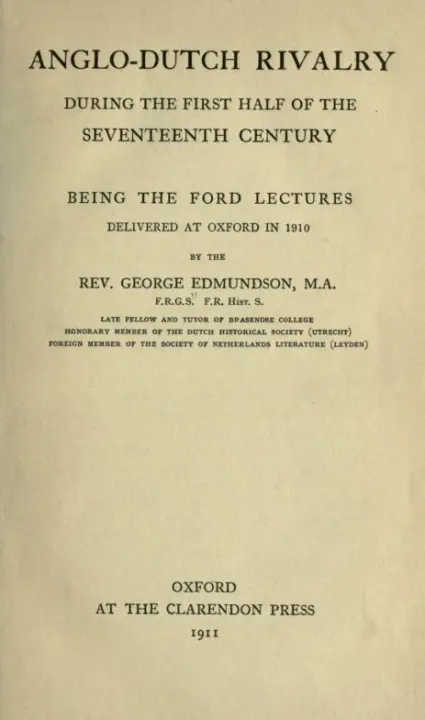
THE CLASSIC COLLECTION · 1911
"Anglo-Dutch Rivalry During the First Half of the Seventeenth Century" by George Edmundson is a historical account written in the early 20th century. The work examines the complex relationships and conflicts between England and the Dutch Republic during a pivotal period marked by maritime and commercial competition. Specifically, the book aims to analyze the causes and developments of the ongoing rivalry that eventually led to open hostilities between the two seafaring nations. The opening of the text sets the tone for an in-depth investigation into the political and economic dynamics that ignited tensions between England and the Netherlands. Edmundson introduces the backdrop of maritime prowess and trade interests that characterized both nations during the late 16th and early 17th centuries, emphasizing the shared history against a common enemy, Spain, while foreshadowing the inevitable conflicts that arose from their competitive spirits. He highlights key events, such as the Dutch wars and the interactions between influential leaders, which laid the groundwork for the escalating rivalry over fishing rights and trade supremacy. This initial exploration establishes the foundational context for the detailed analysis that follows in subsequent chapters.
Introduction adapted from the source catalogue; source summaries may be automatically generated.
Free to read · English · 50,252 words · No account needed
MAKE TIME FOR A GOOD BOOK
On by default. Untick to stop anonymous reading totals. Each page counts after 10 seconds in view. How this works.
Anonymous counting is on unless you have switched it off.
From the nature of the land, Holland and Zeeland were always the home of fisher-folk. The herring fishery off the coast of Great Britain was from early times an industry pursued by many Hollanders and Zeelanders, but it was comparatively limited, until the invention of 'curing' made by Willem Beukelsz of Biervliet in the latter part of the fourteenth century (he probably died in 1397) converted a perishable article of food into a commercial commodity. The method of Beukelsz, which remained practically unchanged for some five centuries, without going into minute particulars, consisted in the following processes. Immediately after the hauling in of the nets the guts were in a particular manner removed from the fish, which were then packed in layers in barrels with salt between the layers. In the brine or pickle that was formed they were allowed to lie some time, fresh salt being added every fortnight. At first the Zeelanders were the chief herring fishers, but afterwards the towns on the Zuyder Zee and on the Maas became the head-quarters of the industry. During the Burgundian period many laws were enacted regulating the herring fisheries, but the edict[49] of Charles V, May 18, 1519, which extended and codified all previous enactments, remained the permanent basis of future legislation on the subject. The chief regulations concerned the branding of the barrels, the sorting of the fish, and the date of the beginning of the fishing. This date was originally August 24 (St. Bartholomew), but was afterwards changed first to July 25 (St. James), and finally to June 24 (St. John the Baptist). It is possible that some change in the habits of the herring shoals may have led to this considerable shifting of the date. After 1519 there were many fresh enactments made, referring particularly to matters concerning convoys and their cost, the duties levied, and many details in regard to the boats, tackle, and crews, and again a codification of all laws was carried out by a series of edicts in 1580, 1582, and 1584. These edicts of 1580 and 1582 (Groot Placaetboek van Holland en West Vriesland, tom i., 684-691, 696-707, 715-727, 748-751), continued to regulate the fisheries during the period with which these lectures deal; i.e. the first half of the seventeenth century. Especial attention was given in these regulations to the branding of the barrels in which the herrings were packed. Each fishing town had its official inspectors, who themselves branded the barrels with the mark of the cooper and that of the town, and no others were allowed to be used. The kind of salt for the curing was rigorously prescribed, and careful precautions taken that no other kind or damaged salt was smuggled on board. Not less minute were the regulations to ensure that the quality of the fish which came to the market should be guaranteed. All fish had to be sorted. Such as were caught before July 25 (St. James), being not fully developed, had to be kept apart. Such as were caught after July 25 had to be divided according to technical categories, 'full and sweet', 'empty', 'undersized or damaged'; and the skipper was enjoined under oath to place his own mark upon each barrel and to be personally responsible for the quality assigned, and not only so, the fisherman who packed the fish in the barrel was required to place his mark upon it. The most stringent rules were laid down as the correct method of curing. In fact, everything was done to show the importance of the industry, and the necessity of securing that the market was supplied with no counterfeit article, but only with herrings prepared in Dutch fashion by Dutch hands. In order to keep a fast hold upon the monopoly, the fishermen were forbidden under heavy penalties to sell their fish in foreign ports. In the seventeenth century, the interests of those engaged in this profitable trade were vigilantly looked after by a body known as the 'College of the Great Fishery', which met at Delft. The College consisted of five deputies from the towns of Enkhuysen, Schiedam, Delft, Rotterdam, and Brill, and so exclusive were they that during the period with which we are concerned other towns, even such important places as Amsterdam, Dordrecht, and Hoorn, were refused admission. One of the chief tasks of the College was to enforce the carrying out of the regulations.
Your reading position is saved on this browser. Take it to another device with a library code. Reading pages adapt to text, rather than matching a printed edition.
BEHIND THE BOOK
This eBook is for the use of anyone anywhere in the United States and most other parts of the world at no cost and with almost no restrictions whatsoever. You may copy it, give it away or re-use it under the terms of the Project Gutenberg License included with this eBook or online at www.gutenberg.org. If you are not located in the United States, you will have to check the laws of the country where you are located before using this eBook. Read the source licence.
The original source file, including credits and licence, is retained by this library. Request an original-format copy at no charge. Please include the book title and Project Gutenberg identifier #48697.
KEEP YOUR CURIOSITY GOING
Cécile Tormay

Moritz Busch
John L. Ransom
Frances Wright
Cécile Tormay

Mabel Potter Daggett