THE CLASSIC COLLECTION✦History of HollandCLASSIC FREE BOOKS
History of Holland
George Edmundson
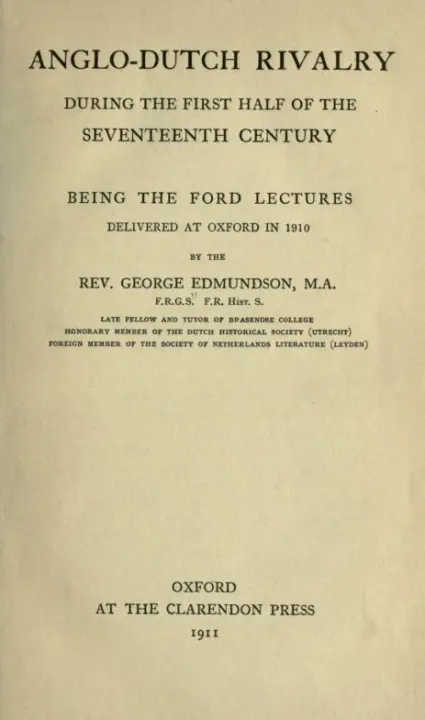
THE CLASSIC COLLECTION · 1911
"Anglo-Dutch Rivalry During the First Half of the Seventeenth Century" by George Edmundson is a historical account written in the early 20th century. The work examines the complex relationships and conflicts between England and the Dutch Republic during a pivotal period marked by maritime and commercial competition. Specifically, the book aims to analyze the causes and developments of the ongoing rivalry that eventually led to open hostilities between the two seafaring nations. The opening of the text sets the tone for an in-depth investigation into the political and economic dynamics that ignited tensions between England and the Netherlands. Edmundson introduces the backdrop of maritime prowess and trade interests that characterized both nations during the late 16th and early 17th centuries, emphasizing the shared history against a common enemy, Spain, while foreshadowing the inevitable conflicts that arose from their competitive spirits. He highlights key events, such as the Dutch wars and the interactions between influential leaders, which laid the groundwork for the escalating rivalry over fishing rights and trade supremacy. This initial exploration establishes the foundational context for the detailed analysis that follows in subsequent chapters.
Introduction adapted from the source catalogue; source summaries may be automatically generated.
Free to read · English · 50,252 words · No account needed
MAKE TIME FOR A GOOD BOOK
On by default. Untick to stop anonymous reading totals. Each page counts after 10 seconds in view. How this works.
Anonymous counting is on unless you have switched it off.
The parliamentary ambassadors were really alarmed, remembering the fate of Doreslaar, at this hostile reception. Neither they nor their attendants dared to venture into the streets but in parties of five or six and sword in hand; and everywhere they were followed by the cry of 'Regicides'. On March 29, St. John and Strickland presented their credentials before the 'Great Gathering', and in a long speech expressed the desire of the English Government for the establishment of good relations of enduring friendship between the two republics. 'It is the wish of the Parliament to conclude', they said, 'a closer union of the two States, which would be for both more advantageous than heretofore, since it would not be dependent upon the life and will and private interests of a single individual.' Six commissioners were appointed by the Assembly to discuss their proposals, and a conference was opened on April 4. The grounds on which the English proposed to the Netherlanders that 'a more strict and intimate Alliance and Union bee entred into by them, whereby there may bee a more intrinsecall and mutual interest of each other, than hath hitherto beene for the good of both', were: (1) community of religion, (2) community of political liberty, (3) community of interest in freedom of trade and navigation. The Dutch, however, showed themselves very wary. They had no intention of giving their consent to any general propositions before informing themselves of their precise meaning. There was considerable variety of opinion in the different provinces and much indecision. On April 6, the commissioners were only empowered to reply, that the States were willing 'not only to renew the ancient friendship between the two nations, but also to conclude a treaty for common interests'. This response did not satisfy the English envoys, who rejoined that 'the union for common interests' they had in view 'was one closer than at any previous time'. These words required explanation, but it seemed that they could only point to an alliance so intimate and binding as to be another term for coalition. Such was indeed its meaning in the minds of those who proposed it, and so the Dutch interpreted it. To them, however, not unnaturally, the only idea suggested by a coalition with the English Commonwealth was the loss by the smaller republic of its independence, and its practical absorption in the larger. Such an idea was simply unthinkable to men who had just won the recognition of their independence after eighty years of heroic struggle. The reply of the Assembly was not hurriedly given. At last, on April 26, it came, and was so far unsatisfactory that, while expressing their readiness for a closer union, the reservation was made that it must be one 'in which both States could better promote their interests for themselves and for the common welfare'. St. John and Strickland now went a step further, and gave a hint that if an offensive and defensive confederation such as they had in mind could be accomplished, it would be accompanied by many advantageous concessions to the Dutch. At this point the negotiations came to an end. The Parliament did not believe that in the present temper of the Dutch their proposals were likely to be received in the spirit in which they were offered, and the ambassadors were recalled. They and their attendants were constantly insulted by Royalists and Orangists whenever they showed themselves out of doors, and though the provincial authorities strictly forbade such outrages on pain of severe penalties, and urged the citizens to assist in the protection of the representatives of a foreign power, they effected little. Some of the offenders were of high rank[48], and they openly braved the threats of the magistracy and remained unpunished. Earnest representations were now made to the English Parliament on behalf of the States of Holland by their agent, Gerard Schaep, who was still residing in London, that they would allow the envoys of the Commonwealth to remain awhile longer and continue the negotiations. The Parliament, however, would only consent to do this on condition that full satisfaction be made to St. John and Strickland for all that they had endured, and that the attacks upon them should cease. The States of Holland promised to do this. Prince Edward of the Palatine and other prominent offenders were summoned before a court of justice, and warned; some of their servants were punished. It was a sorry piece of business. But it was an index to the real feeling of the populace that such a state of things should have been possible in a town like the Hague.
Your reading position is saved on this browser. Take it to another device with a library code. Reading pages adapt to text, rather than matching a printed edition.
BEHIND THE BOOK
This eBook is for the use of anyone anywhere in the United States and most other parts of the world at no cost and with almost no restrictions whatsoever. You may copy it, give it away or re-use it under the terms of the Project Gutenberg License included with this eBook or online at www.gutenberg.org. If you are not located in the United States, you will have to check the laws of the country where you are located before using this eBook. Read the source licence.
The original source file, including credits and licence, is retained by this library. Request an original-format copy at no charge. Please include the book title and Project Gutenberg identifier #48697.
KEEP YOUR CURIOSITY GOING
Cécile Tormay

Moritz Busch
John L. Ransom
Frances Wright
Cécile Tormay

Mabel Potter Daggett