THE CLASSIC COLLECTION✦History of HollandCLASSIC FREE BOOKS
History of Holland
George Edmundson
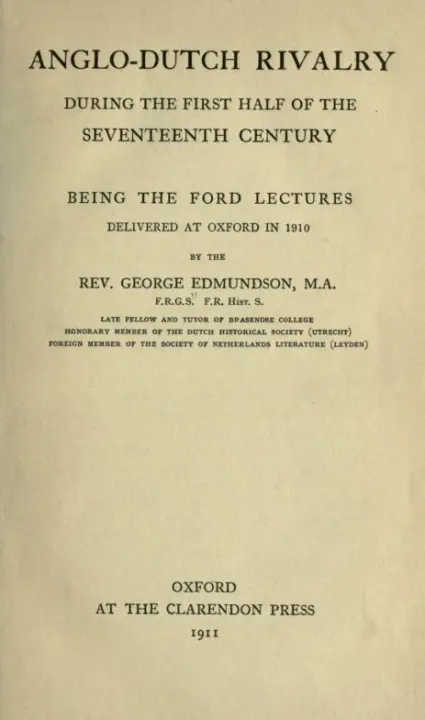
THE CLASSIC COLLECTION · 1911
"Anglo-Dutch Rivalry During the First Half of the Seventeenth Century" by George Edmundson is a historical account written in the early 20th century. The work examines the complex relationships and conflicts between England and the Dutch Republic during a pivotal period marked by maritime and commercial competition. Specifically, the book aims to analyze the causes and developments of the ongoing rivalry that eventually led to open hostilities between the two seafaring nations. The opening of the text sets the tone for an in-depth investigation into the political and economic dynamics that ignited tensions between England and the Netherlands. Edmundson introduces the backdrop of maritime prowess and trade interests that characterized both nations during the late 16th and early 17th centuries, emphasizing the shared history against a common enemy, Spain, while foreshadowing the inevitable conflicts that arose from their competitive spirits. He highlights key events, such as the Dutch wars and the interactions between influential leaders, which laid the groundwork for the escalating rivalry over fishing rights and trade supremacy. This initial exploration establishes the foundational context for the detailed analysis that follows in subsequent chapters.
Introduction adapted from the source catalogue; source summaries may be automatically generated.
Free to read · English · 50,252 words · No account needed
MAKE TIME FOR A GOOD BOOK
On by default. Untick to stop anonymous reading totals. Each page counts after 10 seconds in view. How this works.
Anonymous counting is on unless you have switched it off.
The Dutch herring fleet having recovered from their alarm had ventured out, as was their custom, about the middle of September, to the English coasts for a second catch of fish. The Earl of Northumberland had been charged with the collection of the toll from them. He had, however, at this time but three ships with him, and learning that a Dutch squadron of sixteen sail was near at hand he promptly sent for reinforcements. In response, twelve vessels were dispatched from the Thames, October 8. Actual hostilities, however, did not take place. One large detachment of 'busses', not having a sufficient convoy, was made to pay, the rest were left unmolested. The English commander finding himself in the presence of thirteen Dutch war-ships did not venture to attack them. Both sides showed in fact more caution than aggressiveness. The authorities in Holland, however, did not approve Van Dorp's attitude and conduct, and he was requested to resign his command.
The course of events was fortunately to relieve a strain that was rapidly approaching the breaking point. Charles's negotiations with the Emperor had led to no satisfactory result. It was at last made clear to him that by this means there was no hope of obtaining a restoration of the Palatinate. Van Beveren seized the opportunity of placing himself in communication with Charles Lewis, at this time residing in London, with the hope of securing through his aid a better understanding between England and the States. Charles Lewis was only too willing in his own interests to act as intermediatory, and his influence with his uncle was great. His mother, the Queen of Bohemia, was at this time writing pressing letters to her brother begging for his active intervention, and it was urged upon King Charles that the assistance of the Dutch army and navy would be far more valuable to him than any sum of money that could be extracted in the shape of toll from the fisher fleet. On the point of the toll the King showed himself not unwilling to yield, but not one inch would he concede of his claims to the undisputed sovereignty of the sea. If he withdrew his proclamation and allowed the Dutch, as heretofore, freedom of fishing without licence, it would be in compensation for services rendered in the cause of the Palatinate, not as a right based upon ancient treaties and long usage. The Dutch, on the other hand, were keenly alive to all that was involved in any admission of such a dominion of the sea as that claimed by the English King, and were determined not to grant it. On Charles's side, however, financial difficulties at this time rendered any straightforward course impracticable. The King had not the means to fit out an expedition for the help of his nephew, and he hovered hither and thither between divergent policies in the vain hope that without recourse to a Parliament he could find some way of furthering the cause of Charles Lewis, without involving himself in an outlay that he was unable to meet. Scheme after scheme floated before his mind, all of them equally visionary when confronted with the stern realities of impecuniousness. From Ferdinand and Philip he turned to Richelieu. The French armies were advancing in Lorraine and Elsass, and were co-operating with the Dutch in the Netherlands, and with the Swedes and their Protestant allies in Germany. For awhile it appeared as if Richelieu were inclined to an English alliance. In February and March, 1637, a treaty was indeed actually drawn up. It is strongly suspected, however, that the Cardinal was never in real earnest, and only wished to amuse the English King with negotiations, and thus at any rate keep him back from purchasing Spain's goodwill on the Rhine by an offer to take part in a joint naval attack upon the United Provinces. Charles was quite aware of the solidarity of the bond which united France and the States, and that a French alliance implied friendly relations with the Dutch. On February 13 therefore he sent the Secretary of State, Coke, to Van Beveren, who was still in London, to reopen direct negotiations. It was now proposed that there should be a combined Anglo-Dutch naval expedition in which a French squadron should be invited to participate, which, after driving the Spanish fleets from the sea, should effect a landing in the Peninsula and dictate terms to Philip IV. Meanwhile the King expressed his willingness to allow the Dutch fishermen to pursue their industry along the coasts of his kingdoms freely and without hindrance. During the following season the English fleet would blockade the Flemish ports, but would not appear on the fishing grounds nor make any demands for licences. But with this latter concession the States were not satisfied. Such an act of toleration implied that Charles maintained to the full his claim to the undisputed sovereignty of the sea. He would not during the time of the allied operations press his rights to issue licences and exact toll, he only waived them as a favour. Further than this he could not go. On the question of the dominium maris, despite the earnest entreaties of Charles Lewis, he refused any compromise. But on the other side there was no less obstinacy. The Prince of Orange himself wrote (March 1) to Van Beveren, that he was on no account to commit himself or assent to any terms unless the proclamation concerning the fishing licences was first withdrawn. With France the negotiations for an alliance appeared to be proceeding smoothly, the treaty lay ready for signature, and on March 4 Charles sent full powers to his ambassador at Paris to conclude the matter. On the 23rd came the news that difficulties had arisen, and that France also required that the proclamation should be withdrawn, at least during the period of the treaty. But Charles, though the negotiations still dragged on, absolutely declined to discuss a question which concerned his rights and honour, and so he now once more lent a not unwilling ear to the tempting offers made to him by the Spanish ambassador. Spain was willing in return for an offensive and defensive alliance against the United Provinces to recognize the King's sovereign rights on the seas, and to hand over at once the Lower Palatinate. They even went so far as to promise the surrender of certain towns in Flanders as pledges for the ultimate restitution of the Upper Palatinate and the electoral dignity to Charles Lewis. It is extremely doubtful whether these proposals were serious, in any case they were not seriously entertained.
Your reading position is saved on this browser. Take it to another device with a library code. Reading pages adapt to text, rather than matching a printed edition.
BEHIND THE BOOK
This eBook is for the use of anyone anywhere in the United States and most other parts of the world at no cost and with almost no restrictions whatsoever. You may copy it, give it away or re-use it under the terms of the Project Gutenberg License included with this eBook or online at www.gutenberg.org. If you are not located in the United States, you will have to check the laws of the country where you are located before using this eBook. Read the source licence.
The original source file, including credits and licence, is retained by this library. Request an original-format copy at no charge. Please include the book title and Project Gutenberg identifier #48697.
KEEP YOUR CURIOSITY GOING
Cécile Tormay

Moritz Busch
John L. Ransom
Frances Wright
Cécile Tormay

Mabel Potter Daggett