THE CLASSIC COLLECTION✦History of HollandCLASSIC FREE BOOKS
History of Holland
George Edmundson
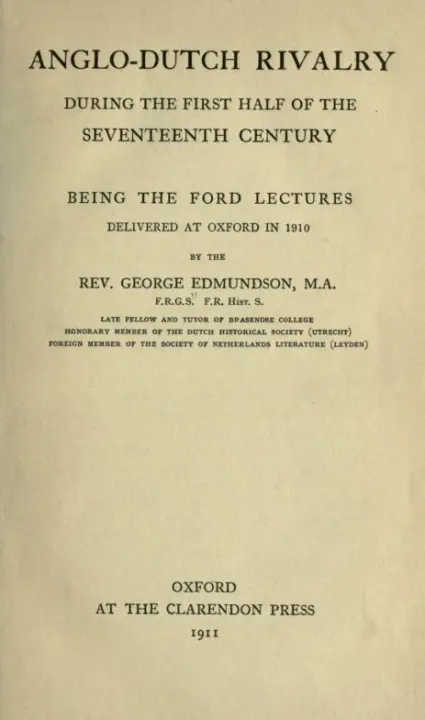
THE CLASSIC COLLECTION · 1911
"Anglo-Dutch Rivalry During the First Half of the Seventeenth Century" by George Edmundson is a historical account written in the early 20th century. The work examines the complex relationships and conflicts between England and the Dutch Republic during a pivotal period marked by maritime and commercial competition. Specifically, the book aims to analyze the causes and developments of the ongoing rivalry that eventually led to open hostilities between the two seafaring nations. The opening of the text sets the tone for an in-depth investigation into the political and economic dynamics that ignited tensions between England and the Netherlands. Edmundson introduces the backdrop of maritime prowess and trade interests that characterized both nations during the late 16th and early 17th centuries, emphasizing the shared history against a common enemy, Spain, while foreshadowing the inevitable conflicts that arose from their competitive spirits. He highlights key events, such as the Dutch wars and the interactions between influential leaders, which laid the groundwork for the escalating rivalry over fishing rights and trade supremacy. This initial exploration establishes the foundational context for the detailed analysis that follows in subsequent chapters.
Introduction adapted from the source catalogue; source summaries may be automatically generated.
Free to read · English · 50,252 words · No account needed
MAKE TIME FOR A GOOD BOOK
On by default. Untick to stop anonymous reading totals. Each page counts after 10 seconds in view. How this works.
Anonymous counting is on unless you have switched it off.
The embassy of 1622 returned to the Netherlands early in February, 1623. A few weeks later Prince Charles, accompanied by the Duke of Buckingham, was on his way to Madrid to woo in person his prospective Spanish bride. No more conclusive proof could have been shown of the lack of success of Aerssen in obtaining any assurance of armed support from King James for the States in their renewed war with Spain or for the recovery of the Palatinate.
Yet, strangely enough, at this very time of increasing political alienation, four English and two Scottish regiments formed (as indeed was the case throughout the remainder of the eighty years' war) the very kernel of the States army, and campaign after campaign bore the brunt of the fighting. When the Spaniards laid siege to Bergen-op-Zoom in July, 1622, Maurice had reinforced the garrison by fourteen English and Scottish companies. The gallant defence of the town first by Colonel Henderson, then, after this officer fell mortally wounded, by Sir Charles Morgan, excited general admiration in Europe. In October, Spinola, after making repeated and desperate efforts to capture the place, was compelled to raise the siege. These troops were recruited by royal permission in England and Scotland, remained British subjects, and were distinguished by their national uniforms and colours, by the beat of the drum and the march. They were, however, in Dutch pay, and took an oath of allegiance to the States-General, from whom the officers received their commissions.[34]
[34] See special note F.
This same period saw also the beginnings of rivalry in the West as well as in the East. In 1621 a Charter was granted to the Dutch West India Company. This Charter was framed on the model of that of the East India Company, and it was hoped that the new venture might be attended by the same good fortune and phenomenal success as had followed Dutch enterprise in Java and the Malayan Archipelago. Far from being a mere commercial undertaking, it was intended from the first that the West India Company should be required to equip considerable armed forces, naval and military, wherewith to strike a blow at the Spanish power in America, and cut off those sources of revenue which supplied King Philip with the sinews of war. In carrying out such projects of aggression in the Spanish main there was less risk of disputes arising between the Dutch and English than had been the case in the East Indies. Nevertheless, the colonists and traders of the two nationalities were in America also rivals and competitors in the same localities. Netherlanders and Englishmen had already for some years before 1621 been carrying on traffic with the natives and setting up trading posts side by side in the estuary of the Amazon, and in the various river mouths along the coast of Guiana. In 1609, by letters patent, a grant was made by James I to Robert Harcourt, of Stanton Harcourt, in the county of Oxford, for the planting and inhabiting of the whole coast of Guiana between the rivers Amazon and Essequibo, and this grant was renewed to Roger North in 1619, and again by Charles I to the Duke of Buckingham in 1626. Yet within the limits of these grants the Dutch in 1616 established themselves permanently on the river Essequibo, and in 1627 on the river Berbice, while a number of abortive attempts were made to set up trading posts and colonies at other points of this coast. More important than any of these, a settlement had been made in 1614 on the island of Manhattan at the mouth of the Hudson river, a grant having been given at that date by the States-General to a body of Amsterdam merchants of all unoccupied land between Chesapeake Bay and Newfoundland. This settlement and those in Guiana were in 1622 taken over by the newly erected West India Company. Thus in North America the Dutch took possession of the best harbour on the coast, and their colony of New Netherland with its capital New Amsterdam (afterwards New York) was thrust in like a wedge between the English colonies of Virginia and New England. In the West Indian islands and on the Gold Coast of West Africa the keen traders of the two nations also found themselves side by side, with the result in almost all cases, as has been well said, that the Dutch extracted the marrow, leaving the English the bone.[35] It will at once be seen therefore that the activities of the Dutch West India Company, though it came into being primarily for the purpose of 'bearding the King of Spain in his treasure house', were certain, sooner or later, to come into conflict with English enterprise and to enlarge the area within which their respective interests and claims were divergent.
Your reading position is saved on this browser. Take it to another device with a library code. Reading pages adapt to text, rather than matching a printed edition.
BEHIND THE BOOK
This eBook is for the use of anyone anywhere in the United States and most other parts of the world at no cost and with almost no restrictions whatsoever. You may copy it, give it away or re-use it under the terms of the Project Gutenberg License included with this eBook or online at www.gutenberg.org. If you are not located in the United States, you will have to check the laws of the country where you are located before using this eBook. Read the source licence.
The original source file, including credits and licence, is retained by this library. Request an original-format copy at no charge. Please include the book title and Project Gutenberg identifier #48697.
KEEP YOUR CURIOSITY GOING
Cécile Tormay

Moritz Busch
John L. Ransom
Frances Wright
Cécile Tormay

Mabel Potter Daggett