THE CLASSIC COLLECTION✦History of HollandCLASSIC FREE BOOKS
History of Holland
George Edmundson
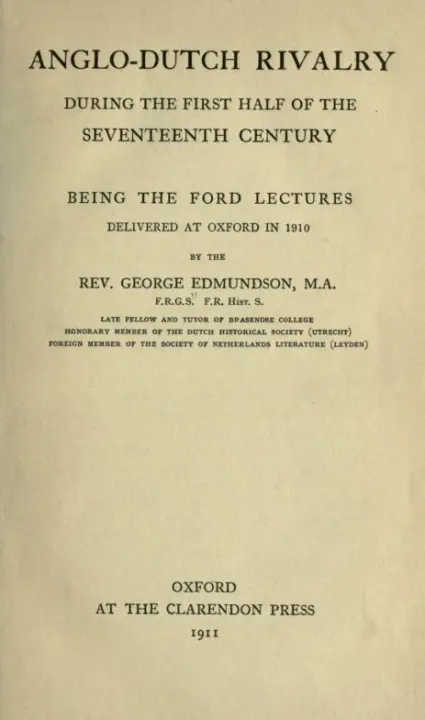
THE CLASSIC COLLECTION · 1911
"Anglo-Dutch Rivalry During the First Half of the Seventeenth Century" by George Edmundson is a historical account written in the early 20th century. The work examines the complex relationships and conflicts between England and the Dutch Republic during a pivotal period marked by maritime and commercial competition. Specifically, the book aims to analyze the causes and developments of the ongoing rivalry that eventually led to open hostilities between the two seafaring nations. The opening of the text sets the tone for an in-depth investigation into the political and economic dynamics that ignited tensions between England and the Netherlands. Edmundson introduces the backdrop of maritime prowess and trade interests that characterized both nations during the late 16th and early 17th centuries, emphasizing the shared history against a common enemy, Spain, while foreshadowing the inevitable conflicts that arose from their competitive spirits. He highlights key events, such as the Dutch wars and the interactions between influential leaders, which laid the groundwork for the escalating rivalry over fishing rights and trade supremacy. This initial exploration establishes the foundational context for the detailed analysis that follows in subsequent chapters.
Introduction adapted from the source catalogue; source summaries may be automatically generated.
Free to read · English · 50,252 words · No account needed
MAKE TIME FOR A GOOD BOOK
On by default. Untick to stop anonymous reading totals. Each page counts after 10 seconds in view. How this works.
Anonymous counting is on unless you have switched it off.
As a proof of the very close relations subsisting at this time between England and the United Provinces, it may be mentioned that in the very same months that the Wijngaerden embassy was thus holding ineffectual conferences in London with the King of England and his Privy Council, the Fellowship of the Merchant Adventurers were transferring their Court to the Prinsenhof at Delft.
Driven from Antwerp in 1582 the Adventurers had, as already related, set up their Great Court first at Emden, then at Hamburg and Stade. But in 1598 the enmity of the Hanse towns compelled them to leave Stade, and to establish themselves at Middelburg in Zeeland. Until the suppression of the Adventurers' Charter in 1615, this town was the staple for English cloth and wool in the Netherlands, though the 'interlopers' as they were called, succeeded in carrying on an active smuggling trade through Amsterdam and Flushing. After the renewal of the Charter in 1617 the Adventurers returned to Middelburg, but on account of the unhealthiness of the place, and other reasons, they determined to remove to Delft. To effect this involved elaborate negotiations with the Town Corporation, with the States of Holland, and with the States-General. Moreover, the consent of the King was necessary as a preliminary step. Sir Dudley Carleton was largely instrumental in bringing the matter to a successful issue. James gave his consent that the Court should move from Zeeland within the borders of Holland, 'to show his Majesty's great affection for that Province'. On April 21, 1621, the contract with Delft was signed, just as the Dutch envoys were leaving England. But Amsterdam, with whose cloth merchants the 'interlopers' had been engaged in a profitable trade, sent in to the States of Holland a very strongly worded remonstrance. They objected to the privileges which the Delft Corporation had granted to the Adventurers as injurious to themselves and the interests of the province. The States of Holland on receiving this remonstrance resolved that the contract made by Delft and the monopoly of the Adventurers should be examined by a commission. Against this Delft and a number of other towns sent in a counter-remonstrance, but the influence of Amsterdam outweighed theirs in the provincial States, who by a majority of votes persisted in their determination. The Merchant Adventurers, however, appealed from the provincial authorities to the States-General, who had always been their protectors. And now began one of those curious struggles so common in Dutch history between the town of Delft, the States of Holland, and the States-General, all of them claiming independent authority to deal with the matter. The Corporation of Delft refused to hand over their contract with the Merchant Adventurers to be examined by the Commission of the States of Holland. At last, however, it was agreed by both parties that it should be placed in the hands of Prince Maurice and some impartial persons, who should then confer with the States, and draw 'a good regulation for the preserving of the common industries'. Maurice appointed a commission on which the ten towns interested in the cloth trade (of which naturally Delft was one) were represented, to take the matter in hand, and on June 19, 1621, the 'Regulation' was drawn up which defined the privileges and conditions under which the Adventurers henceforth for many years carried on their trade in Holland. Its terms therefore deserve to be briefly indicated. The old privileges giving freedom from import and export duties, harbour and market tolls, &c., originally granted in 1598, were not revoked, but defined afresh and modified. Art. i gave the Fellowship permission to have their Court at Delft, but only with the licences 'which we [the States of Holland] and the States-General shall be pleased to accord, in trust that the Netherlanders shall enjoy their old privileges in England.' This last clause clearly referred to the fishing rights, with which at that very moment the English Government were proposing to interfere. Art. ii reminded the Adventurers that when residing in Holland 'they would be subject to all our edicts and enactments made or still to make.' Art. iii dealt with the excise recently imposed on foreign woollen cloth. On this no concession was made; it must be promptly paid. Art. iv insisted on the strict carrying out of the edict of 1614 forbidding the importation of dyed or prepared cloth, and also of the edict on the 'tare', which had been renewed in 1617. Both these edicts were regarded as grievances by the English, and had in 1618 and in 1621 been among the subjects on which negotiations had proved fruitless.
Your reading position is saved on this browser. Take it to another device with a library code. Reading pages adapt to text, rather than matching a printed edition.
BEHIND THE BOOK
This eBook is for the use of anyone anywhere in the United States and most other parts of the world at no cost and with almost no restrictions whatsoever. You may copy it, give it away or re-use it under the terms of the Project Gutenberg License included with this eBook or online at www.gutenberg.org. If you are not located in the United States, you will have to check the laws of the country where you are located before using this eBook. Read the source licence.
The original source file, including credits and licence, is retained by this library. Request an original-format copy at no charge. Please include the book title and Project Gutenberg identifier #48697.
KEEP YOUR CURIOSITY GOING
Cécile Tormay

Moritz Busch
John L. Ransom
Frances Wright
Cécile Tormay

Mabel Potter Daggett