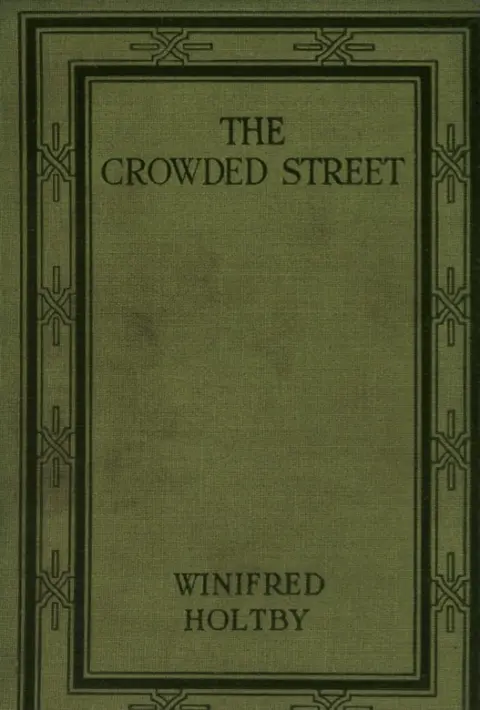
The Crowded Street
Winifred Holtby
THE CLASSIC COLLECTION · 1923
"Anderby Wold" by Winifred Holtby is a novel written in the early 20th century. The story revolves around the lives of the Robson family, particularly focusing on Mary Robson, who has recently married John and inherited the family farm at Anderby Wold. The narrative delves into themes of social dynamics, gender roles, and familial relationships as Mary navigates her responsibilities and challenges, striving to uphold her family's legacy amidst societal expectations. At the start of the book, readers are introduced to Sarah Bannister as she and her husband drive to a tea-party at Anderby Wold to celebrate the clearance of the mortgage on the family farm. The opening scenes illustrate the tension between Sarah and her sister-in-law Mary, revealing Sarah's disdain for the modernity Mary embodies and her attempts to assert her own importance and superiority. The narrative captures the intricate social interactions and domestic dynamics that underscore the relationships among various family members, painting a vivid picture of life in a rural English community during that time. As Sarah grapples with her jealousy and discontent about Mary's marriage and position, the stage is set for a deeper exploration of individual aspirations and societal pressures.
Introduction adapted from the source catalogue; source summaries may be automatically generated.
Free to read · English · 74,430 words · No account needed
MAKE TIME FOR A GOOD BOOK
On by default. Untick to stop anonymous reading totals. Each page counts after 10 seconds in view. How this works.
Anonymous counting is on unless you have switched it off.
The lantern held by the stranger cast a delta of golden light on the stony road and the pony's hoof, which Mary raised to her knee. There, safely embedded behind the iron shoe, lay an ugly-looking flint.
"Have you a knife?" asked Mary.
Her hands were trembling, because the pony's breath came short and nervously. Every minute she expected him to start forward, and her imagination depicted her prostrate figure trampled below his hoofs.
"I've got a knife, but it isn't much good. One blade's broken. I might try, though, if you'll let me. You'll get so muddy."
"I won't," lied Mary stoutly. One knee was in a puddle, and she felt very wet, but she hated being seen at a disadvantage, and thought that her dignity could only be maintained by independence. "Give me the knife, please."
He passed it to her in silence, and she fumbled with frozen fingers at
the blade.
"Can't you undo it for me?" she complained querulously.
The stranger unfastened the blade and stood silently holding the lamp. Mary struggled with the flint, but her usually capable hands were incapacitated by cold. The lamplight danced and glimmered across the snow. Cold trickles of melting sleet insinuated themselves between her collar and her neck. The flint did not move.
The stranger spoke again, very meekly:
"Won't you let me try?"
Mary stiffened herself for a refusal. Then he added plaintively: "After all, it's my knife, and you're breaking the only whole blade."
It was a young voice, certainly cultured, and possibly might have been attractive, had its owner not been suffering from an obvious cold.
"All right." Her assent was ungracious. "You can come if you like."
She rose stiffly to her feet and took the lantern. The stranger knelt in her place. She could see slim shoulders below a mackintosh and the back of a bent head covered with red hair.
The shoulders worked for a moment. Then a triumphant "Got it!" announced the success of masculine superiority. Unfortunately at that moment Starlight also "Got it." His foot being at last released he sprang forward, ungratefully knocking his benefactor to the ground.
Mary seized the pony's head. The stranger rolled adroitly towards the middle of the road and there was a small confusion.
Mary cried, "Are you hurt?"
The stranger said "Damn!" calmly and without prejudice.
Starlight backed slowly towards the hedge.
Then things became more peaceable.
The stranger rose rubbing his shoulder and announcing strangely:
"There are no bones broken, but the patient must be kept quiet." It was then that Mary first suspected him of not being quite sane.
Your reading position is saved on this browser. Take it to another device with a library code. Reading pages adapt to text, rather than matching a printed edition.
Winifred Holtby
BEHIND THE BOOK
This eBook is for the use of anyone anywhere in the United States and most other parts of the world at no cost and with almost no restrictions whatsoever. You may copy it, give it away or re-use it under the terms of the Project Gutenberg License included with this eBook or online at www.gutenberg.org. If you are not located in the United States, you will have to check the laws of the country where you are located before using this eBook. Read the source licence.
The original source file, including credits and licence, is retained by this library. Request an original-format copy at no charge. Please include the book title and Project Gutenberg identifier #74443.
KEEP YOUR CURIOSITY GOING
Coulson Kernahan

Maurice Baring
Frances Wright
Cécile Tormay

Frederic Jesup Stimson

W. H. P. (William Henry Pope) Jarvis