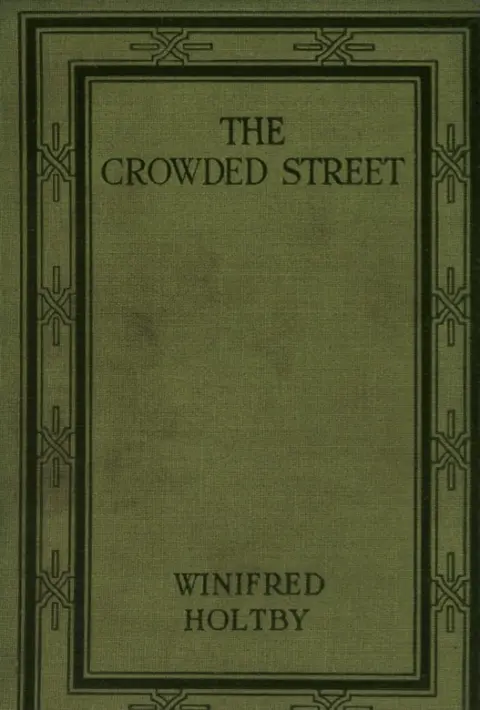
The Crowded Street
Winifred Holtby
THE CLASSIC COLLECTION · 1923
"Anderby Wold" by Winifred Holtby is a novel written in the early 20th century. The story revolves around the lives of the Robson family, particularly focusing on Mary Robson, who has recently married John and inherited the family farm at Anderby Wold. The narrative delves into themes of social dynamics, gender roles, and familial relationships as Mary navigates her responsibilities and challenges, striving to uphold her family's legacy amidst societal expectations. At the start of the book, readers are introduced to Sarah Bannister as she and her husband drive to a tea-party at Anderby Wold to celebrate the clearance of the mortgage on the family farm. The opening scenes illustrate the tension between Sarah and her sister-in-law Mary, revealing Sarah's disdain for the modernity Mary embodies and her attempts to assert her own importance and superiority. The narrative captures the intricate social interactions and domestic dynamics that underscore the relationships among various family members, painting a vivid picture of life in a rural English community during that time. As Sarah grapples with her jealousy and discontent about Mary's marriage and position, the stage is set for a deeper exploration of individual aspirations and societal pressures.
Introduction adapted from the source catalogue; source summaries may be automatically generated.
Free to read · English · 74,430 words · No account needed
MAKE TIME FOR A GOOD BOOK
On by default. Untick to stop anonymous reading totals. Each page counts after 10 seconds in view. How this works.
Anonymous counting is on unless you have switched it off.
Mary, locking and unlocking her fingers, endeavoured to curb her growing desire to push John's lumbering ineffectiveness aside, and herself deal with the envoys of the union. While she fretted Parker found his word, a drifting echo of Hunting's Saturday night oration.
"We want a living wage," he said.
"Living wage?" repeated John dully. This was an entirely unfamiliar situation, and he was equipped neither by temperament nor training to deal with unfamiliar situations. Mary realized the misery of his hesitation. "How much do you want?' he asked.
"Three pound," began Parker.
Waite elbowed him roughly.
"Three pund ten, you fool!" he prompted.
"Three pund ten, maister," repeated Parker. The "maister" came
scornfully.
John's eyes glanced from one to the other to find a single light of friendliness. One by one the men turned away except Parker and Waite, who looked straight at him, one with surly defiance the other with barely concealed contempt.
"Look here, haven't I always treated you decently?"
John's voice sounded strained and feeble. He ran his hand round the collar of his shirt. Beads of perspiration stood out on his forehead.
Mary could bear it no longer. She came forward and stood by her husband.
"Well, Parker, what have you got to say to that? Well, Deane, you know us better. Haven't we always treated you decently?" she asked sharply.
"Oh, ay." Old Deane shuffled clumsy boots on the stone pavement.
One of the boys at the back of the little crowd sniggered nervously. Deane glared round for a minute then replied, "Oh, ay. I haven't nowt to say agin you."
"You can't, you see. Have either of us done you a single bad turn since you decided to stay on ten years ago?"
"Nay, but----"
"Did my father ever hurt you?"
"Nay, but----"
"And are you treating us decently now?"
Deane looked up with a suspicion of the old twinkle in his eye.
"Nay, missus. We're treating you about as badly as we can. But a man must live. We've got oursens to look to."
"Oh. And aren't you living now! Which of you has been hungry in Anderby or ill-clothed or ill-fed?" Mary had quite taken her husband's place now, and John, glad to relinquish it, stood back among the shadows of the passage. "Hearing you weren't satisfied with what we offered we--all the farmers--talked together and are giving you what we can afford."
"Ay," broke in Parker. "An' if ye can't afford more than that we'll go to others who can. Farmers is tyrants, an' you as much as any on 'ere, and we'll have our rights in spite of you."
"Tyrants, are we?"
Your reading position is saved on this browser. Take it to another device with a library code. Reading pages adapt to text, rather than matching a printed edition.
Winifred Holtby
BEHIND THE BOOK
This eBook is for the use of anyone anywhere in the United States and most other parts of the world at no cost and with almost no restrictions whatsoever. You may copy it, give it away or re-use it under the terms of the Project Gutenberg License included with this eBook or online at www.gutenberg.org. If you are not located in the United States, you will have to check the laws of the country where you are located before using this eBook. Read the source licence.
The original source file, including credits and licence, is retained by this library. Request an original-format copy at no charge. Please include the book title and Project Gutenberg identifier #74443.
KEEP YOUR CURIOSITY GOING
Coulson Kernahan

Maurice Baring
Frances Wright
Cécile Tormay

Frederic Jesup Stimson

W. H. P. (William Henry Pope) Jarvis