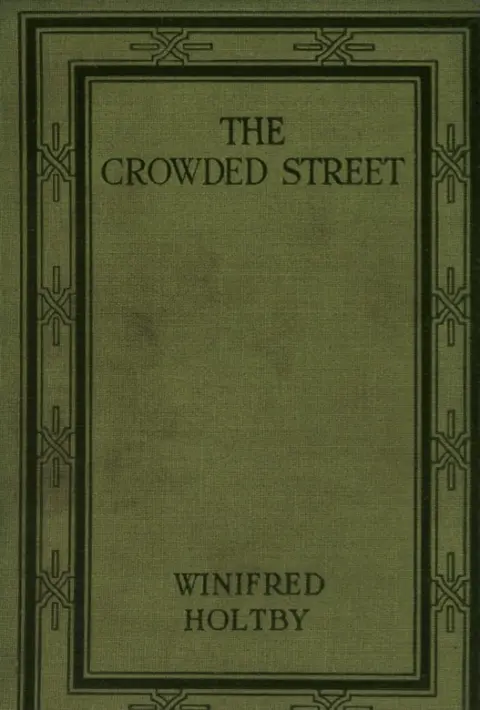
The Crowded Street
Winifred Holtby
THE CLASSIC COLLECTION · 1923
"Anderby Wold" by Winifred Holtby is a novel written in the early 20th century. The story revolves around the lives of the Robson family, particularly focusing on Mary Robson, who has recently married John and inherited the family farm at Anderby Wold. The narrative delves into themes of social dynamics, gender roles, and familial relationships as Mary navigates her responsibilities and challenges, striving to uphold her family's legacy amidst societal expectations. At the start of the book, readers are introduced to Sarah Bannister as she and her husband drive to a tea-party at Anderby Wold to celebrate the clearance of the mortgage on the family farm. The opening scenes illustrate the tension between Sarah and her sister-in-law Mary, revealing Sarah's disdain for the modernity Mary embodies and her attempts to assert her own importance and superiority. The narrative captures the intricate social interactions and domestic dynamics that underscore the relationships among various family members, painting a vivid picture of life in a rural English community during that time. As Sarah grapples with her jealousy and discontent about Mary's marriage and position, the stage is set for a deeper exploration of individual aspirations and societal pressures.
Introduction adapted from the source catalogue; source summaries may be automatically generated.
Free to read · English · 74,430 words · No account needed
MAKE TIME FOR A GOOD BOOK
On by default. Untick to stop anonymous reading totals. Each page counts after 10 seconds in view. How this works.
Anonymous counting is on unless you have switched it off.
Mr. Coast presided over the entertainment. At intervals that seemed all too short for perspiring players desperately pursuing the odd trick, he blew a shrill whistle, and fifty-six wooden chairs shrieked and grated along the well scrubbed boards.
Mrs. Robson was not playing. Instead she stood near the door, now talking to the schoolmaster, now vanishing into the adjoining class room to superintend the making of coffee, the arrangement of tarts and jellies, and the fair distribution of ham and chicken sandwiches that awaited the supper interval.
The vicar, arriving shortly after nine o'clock, approached the schoolmaster as the one unengrossed person in the room.
"Dear me, yes. A nice gathering you have here to-night. A very nice little gathering. I have just spoken to Mrs. Robson in the passage. Very, good supper there--ha? Very good indeed."
"Excuse me," remarked Coast dryly, and blew the whistle.
The chairs scraped. Miss Taylor, who was left for the seventh consecutive game at the corner table, sighed expansively.
"Oh, dear, isn't that just too bad now?" she lamented. "If only Mr. Armstrong had returned my lead in diamonds we should have got the odd that time. Mr. Slater, isn't it just vexing that when I get to the only broken chair in the room I should be kept sitting on it seven times running? I'll be sprouting roots into it if I don't get a move on soon."
"Clubs," gloomily announced Mrs. Armstrong, turning up the last card, and frowning at Miss Taylor.
"Well, of all the dreadful luck! When I haven't----"
"If you talked less, Miss Taylor," suggested Coast severely, "both you and your partner might have more chance of moving on, unless, of course, you want to get the booby prize."
Miss Taylor flushed, and bent disconsolately over her cards.
"Never mind, Miss Taylor." Mary had returned from the class room. "Luck in cards isn't everything. I never saw the supper room more prettily arranged, and if you can decorate as nicely as that you deserve the toast-rack at least, even if you don't make the highest score."
"May I beg you not to talk to the players, while the game is in progress, Mrs. Robson? Strictly a matter of formality of course, but rules are rules."
"Ha ha! we can't have our hostess called to order, can we, Miss Taylor?" laughed the vicar jocularly. "Not before supper anyway, Mr. Coast. She might go off with all the jellies--and the chocolate moulds, ha? Mustn't kill the goose that lays the golden eggs."
Your reading position is saved on this browser. Take it to another device with a library code. Reading pages adapt to text, rather than matching a printed edition.
Winifred Holtby
BEHIND THE BOOK
This eBook is for the use of anyone anywhere in the United States and most other parts of the world at no cost and with almost no restrictions whatsoever. You may copy it, give it away or re-use it under the terms of the Project Gutenberg License included with this eBook or online at www.gutenberg.org. If you are not located in the United States, you will have to check the laws of the country where you are located before using this eBook. Read the source licence.
The original source file, including credits and licence, is retained by this library. Request an original-format copy at no charge. Please include the book title and Project Gutenberg identifier #74443.
KEEP YOUR CURIOSITY GOING
Coulson Kernahan

Maurice Baring
Frances Wright
Cécile Tormay

Frederic Jesup Stimson

W. H. P. (William Henry Pope) Jarvis