THE CLASSIC COLLECTION✦A Bed of RosesCLASSIC FREE BOOKS
A Bed of Roses
Walter Lionel George
THE CLASSIC COLLECTION · 1915
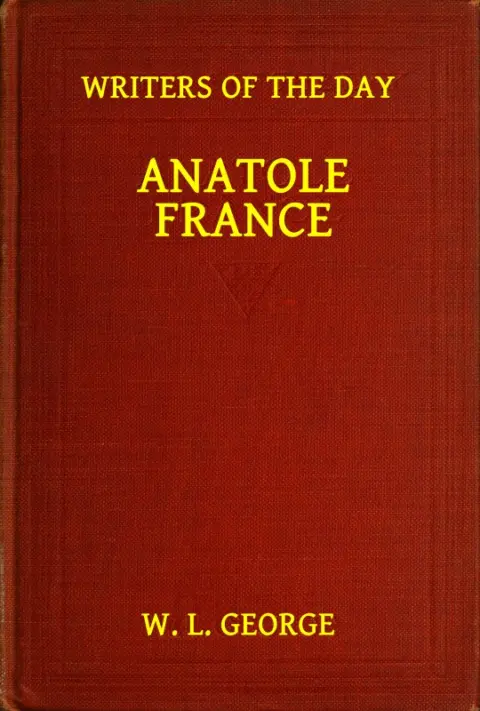
"Anatole France" by Walter Lionel George is a critical monograph written in the early 20th century. The work explores the life, literary significance, and philosophical outlook of the French author Anatole France, delving into his views on irony, politics, religion, and social issues. It appears that George admires France for his sharp wit and critical insight while simultaneously addressing the complexities and controversies surrounding his literary contributions. The opening of the book introduces the context in which the author wrote, notably during the backdrop of World War I. George reflects on how the tumultuous atmosphere of war contrasts with France's pacifist ideologies and literary style. He emphasizes the importance of understanding France not just as an individual, but as a product of various French historical epochs, highlighting his remarkable ability to intertwine irony with compassion in his works. George's personal reflections and observations set the stage for a deeper analysis of France’s literary achievements and provide an engaging exploration of the author’s nuanced perspectives.
Introduction adapted from the source catalogue; source summaries may be automatically generated.
Free to read · English · 20,927 words · No account needed
MAKE TIME FOR A GOOD BOOK
On by default. Untick to stop anonymous reading totals. Each page counts after 10 seconds in view. How this works.
Anonymous counting is on unless you have switched it off.
Here speaks the old Gaul who feasted on roast meats, drank much hydromel, and as he caressed the long droop of his fair moustache cast a negligent, amiable glance over his white-skinned, blue-eyed, black-haired women. For the Gaul never forgot women; he had anticipated Nietzsche by two thousand years or so, and decided that man was for war and woman for the recreation of the warrior. This offends some of us moderns, for the sensuality of the Frenchman, so strong in Anatole France, the sensuality of eating and drinking, of burlesque, of gross stories, some of them concerned with an apartment ignored in the English household since the days of William IV., lies thick over love.
It seems a pity to us that, in spite of all his æstheticism, of his sense of beauty, it should look as if Anatole France’s view of love were contained in the famous phrase of Alphonse Karr, or Gustave Droz, I forget which:
“Love? A matter of skin.”
Well, love is not a matter of skin, at least for us, and one would wish that Anatole France should have found something ethereal, symbolic in the union of man and woman. I cannot explain what I mean: I detest the word “spirituality,” and I hardly know what I miss in this French view of love that Anatole France holds, but I miss it. This view is not exactly: “One woman is as good as another,” but it certainly is: “One woman is as good as another if she is good-looking.” It is all flesh, and æsthetics, which do redeem the flesh, do not redeem it fully. The French heroine, beloved of Anatole France’s heroes, is merely Galatea animate; she is just the beautiful woman descended from her pedestal at the call of her chosen lover. Nothing calls to him save the warm body that once was beautiful marble, and he is content. The Red Lily illustrates that idea. Here we have two people, an unfaithful wife and her lover. We are convinced by the suggestion of extreme passion that these people have reached the apogee of love. It is an unhappy, tormented love, unrolling near the Arno. It develops among a curious society of literary people, is coloured by the usual literary and artistic ideas of Anatole France. Dechartre, the lover, is tormented because his mistress had before him another lover; he is not tormented by the existence of her husband. His distress grows so intense when he begins to suspect, quite wrongly, that she is unfaithful to him with her first lover, produces a strain so great, that their alliance breaks. Well, that is natural enough, for, as Anatole France himself remarks, man is possessive and woman is not, because she has had to get used to sharing, but it is difficult to understand at first sight why Dechartre should be jealous of another lover, and not jealous of a husband. The answer, which is not evident to everybody, is that the act of love is symbolic and that a husband, taken as a social base, is not comparable with a lover taken for love.[6] That is true enough, but where fault must be found with the Gallic view is that there is not a single phrase in the book to show that Dechartre, represented as in the throes of extreme love, wishes to detach his mistress from her husband. He never suggests that he wants her to live with him always, that he wants her society, her presence, the subtle delight of hearing her walk in the room above. He wants nothing but her body from four to six, twice a week: he is honourable, he is an artist, but he is vile, he is a beast. Big words these, but I have come to think that if we differ at all from the brute it is by the courage with which we face the consequences of our deeds, by delicacies of feeling in which caresses have no place, by something that is more than elegance, that can maintain love when sickness, ugliness appear and æsthetics fall to the ground. There is not in the works of Anatole France a line devoted to love. Whether in The Red Lily or in The Merrie Tales of Jacques Tournebroche, or in any of the episodes, “love” is either light and false and lying, or coarse and brutal, or limited by the passing efflorescence of a beauty that must die. He seems, like every other Frenchman I can think of, unable to understand what the Anglo-Saxon means by idealism in love, by that idealism so often made absurd by sentiment, but yet delightful, and distinguished from the impulse of a stag in rut.
Your reading position is saved on this browser. Take it to another device with a library code. Reading pages adapt to text, rather than matching a printed edition.
Walter Lionel George
Walter Lionel George
Walter Lionel George
BEHIND THE BOOK
This eBook is for the use of anyone anywhere in the United States and most other parts of the world at no cost and with almost no restrictions whatsoever. You may copy it, give it away or re-use it under the terms of the Project Gutenberg License included with this eBook or online at www.gutenberg.org. If you are not located in the United States, you will have to check the laws of the country where you are located before using this eBook. Read the source licence.
The original source file, including credits and licence, is retained by this library. Request an original-format copy at no charge. Please include the book title and Project Gutenberg identifier #58792.
KEEP YOUR CURIOSITY GOING

Charles G. (Charles Griffith) Ross
Hannah Webster Foster

Emily Lawless
Edwin Hamlin Carr

Charles De Lano Hine
Andrew Ure