
Last letters from the living dead man
David Patterson (Spirit) Hatch
THE CLASSIC COLLECTION · 1829
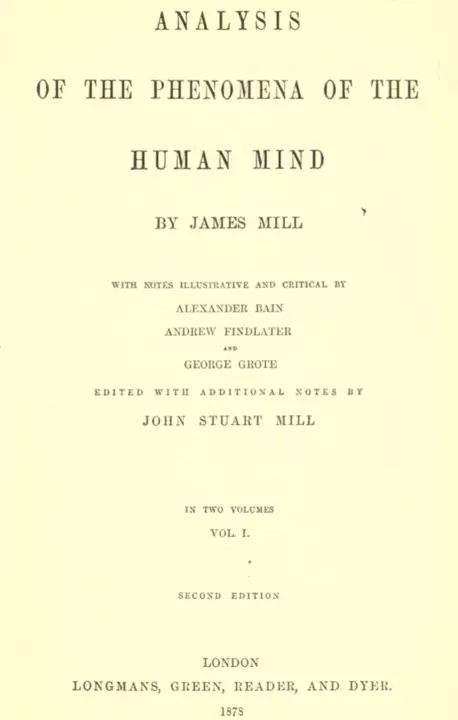
"Analysis of the Phenomena of the Human Mind" by James Mill is a scientific treatise written in the late 19th century. This work focuses on exploring the intricacies of human mental phenomena, aiming to break down complex mental processes into simpler components for better understanding. Mill endeavors to advance the field of psychology by examining feelings, sensations, and the laws that govern mental processes. The opening of the treatise sets the stage for a deep analysis of human sensations, beginning with a discussion on the necessity of understanding the simple elements that make up our more complex mental experiences. Mill outlines his goal to explore how various feelings—resulting from sensory experiences—are interrelated, and he emphasizes the importance of classifying these sensations. He prepares the reader for a methodological breakdown of the senses, such as smell and hearing, illustrating how each operates individually while also forming a holistic understanding of human consciousness as interconnected sensations and experiences. This analytical framework invites readers, particularly those new to philosophical inquiries, to reflect upon their own perceptions systematically.
Introduction adapted from the source catalogue; source summaries may be automatically generated.
Free to read · English · 263,558 words · No account needed
MAKE TIME FOR A GOOD BOOK
On by default. Untick to stop anonymous reading totals. Each page counts after 10 seconds in view. How this works.
Anonymous counting is on unless you have switched it off.
My idea of an animal is still more complex. The {80} word thrush, for example, not only suggests an idea of a particular colour and shape, and size, but of song, and flight, and nestling, and eggs, and callow young, and others.
My idea of a man is the most complex of all; including not only colour, and shape, and voice, but the whole class of events in which I have observed him either the agent or the patient.
2. As the ideas of the sensations which occurred synchronically, rise synchronically, so the ideas of the sensations which occurred successively, rise successively.
Of this important case of association, or of the successive order of our ideas, many remarkable instances might be adduced. Of these none seems better adapted to the learner than the repetition of any passage, or words; the Lord's Prayer, for example, committed to memory. In learning the passage, we repeat it; that is, we pronounce the words, in successive order, from the beginning to the end. The order of the sensations is successive. When we proceed to repeat the passage, the ideas of the words also rise in succession, the preceding always suggesting the succeeding, and no other. Our suggests Father, Father suggests which, which suggests art; and so on, to the end. How remarkably this is the case, any one may convince himself, by trying to repeat backwards, even a passage with which he is as familiar as the Lord's Prayer. The case is the same with numbers. A man can go on with the numbers in the progressive order, one, two, three, &c. scarcely thinking of his act; and though it is possible for him to repeat them backward, because he is accustomed {81} to subtraction of numbers, he cannot do so without an effort.
Of witnesses in courts of justice it has been remarked, that eye-witnesses, and ear-witnesses, always tell their story in the chronological order; in other words, the ideas occur to them in the order in which the sensations occurred; on the other hand, that witnesses, who are inventing, rarely adhere to the chronological order.
3. A far greater number of our sensations are received in the successive, than in the synchronical order. Of our ideas, also, the number is infinitely greater that rise in the successive than the synchronical order.
4. In the successive order of ideas, that which precedes, is sometimes called the suggesting, that which succeeds, the suggested idea; not that any power is supposed to reside in the antecedent over the consequent; suggesting, and suggested, mean only antecedent and consequent, with the additional idea, that such order is not casual, but, to a certain degree, permanent.
Your reading position is saved on this browser. Take it to another device with a library code. Reading pages adapt to text, rather than matching a printed edition.
BEHIND THE BOOK
This eBook is for the use of anyone anywhere in the United States and most other parts of the world at no cost and with almost no restrictions whatsoever. You may copy it, give it away or re-use it under the terms of the Project Gutenberg License included with this eBook or online at www.gutenberg.org. If you are not located in the United States, you will have to check the laws of the country where you are located before using this eBook. Read the source licence.
The original source file, including credits and licence, is retained by this library. Request an original-format copy at no charge. Please include the book title and Project Gutenberg identifier #56441.
KEEP YOUR CURIOSITY GOING
David Patterson (Spirit) Hatch
Coulson Kernahan

Ralph Waldo Emerson
Frances Wright

Edwin Abbott Abbott

Joseph Droz