
Last letters from the living dead man
David Patterson (Spirit) Hatch
THE CLASSIC COLLECTION · 1829
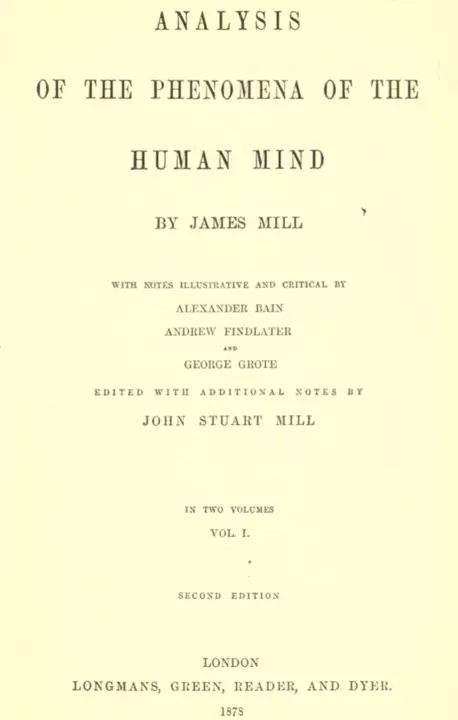
"Analysis of the Phenomena of the Human Mind" by James Mill is a scientific treatise written in the late 19th century. This work focuses on exploring the intricacies of human mental phenomena, aiming to break down complex mental processes into simpler components for better understanding. Mill endeavors to advance the field of psychology by examining feelings, sensations, and the laws that govern mental processes. The opening of the treatise sets the stage for a deep analysis of human sensations, beginning with a discussion on the necessity of understanding the simple elements that make up our more complex mental experiences. Mill outlines his goal to explore how various feelings—resulting from sensory experiences—are interrelated, and he emphasizes the importance of classifying these sensations. He prepares the reader for a methodological breakdown of the senses, such as smell and hearing, illustrating how each operates individually while also forming a holistic understanding of human consciousness as interconnected sensations and experiences. This analytical framework invites readers, particularly those new to philosophical inquiries, to reflect upon their own perceptions systematically.
Introduction adapted from the source catalogue; source summaries may be automatically generated.
Free to read · English · 263,558 words · No account needed
MAKE TIME FOR A GOOD BOOK
On by default. Untick to stop anonymous reading totals. Each page counts after 10 seconds in view. How this works.
Anonymous counting is on unless you have switched it off.
[Editor's footnote 48: The objection commonly made to the psychological analyses which resolve Beauty into association, is that they confound the Beautiful with the merely agreeable. This objection is urged, for example, by Coleridge, in his Biographia Literaria. He admits, with every one else, that things not in themselves agreeable, are often made agreeable by association; that is, the pleasantness which belongs to the ideas with which they are associated, adheres to themselves: but this cannot, it is asserted, be the cause of their producing the particular emotion to which we attach the name of Beauty; because, as no feeling of beauty belongs to the ideas that are supposed to generate the emotion, no such feeling can be transferred from them to what they are associated with.
Any one who has studied the Analysis up to this point, is aware of the inconclusiveness of this last argument. That a complex feeling generated out of a number of single ones, should be as unlike to any of those from which it is generated, as the sensation of white is unlike the sensations of the seven prismatic colours, is no unexampled or rare fact in our sensitive nature.
But it will also, I think, be found, in the case of our feelings of Beauty, and still more, of Sublimity, that the theory which refers their origin mainly to association, is not only not contradictory to facts, but is not even paradoxical. For if our perceptions of beauty and sublimity are of a more imposing character than the feelings ordinarily excited in us by the contemplation of objects, it will be found that the associations which form those impressions are themselves of a peculiarly imposing nature. This is apparent even from Alison; and if the Author of the Analysis had written later, he might have referred to a deeper thinker than Alison, and a more valuable because an unconscious witness to the truth of the Association theory. Mr. Ruskin, with profounder and more thoughtful views respecting the beauties both of Nature and of Art than any {253} psychologist I could name, undertakes, in the second volume of "Modern Painters," to investigate the conditions of Beauty. The result he brings out is, that every thing which gives us the emotion of the Beautiful, is expressive and emblematic of one or other of certain lofty or lovely ideas, which are, in his apprehension, embodied in the universe, and correspond to the various perfections of its Creator. He holds these ideas to be, Infinity, Unity, Repose, Symmetry, Purity, Moderation, and Adaptation to Ends. And he is, in my judgment, to a very considerable degree successful in making out his case. Mr. Ruskin, it is true, never thinks of inferring that our feelings of Beauty are the actual consequence of our having those elevating or cheering ideas recalled to us through manifold channels of association. He deems the emotion to be arbitrarily attached to these ideas by a pre-established harmony. But the evidence which he adduces goes far to prove the other point. If he succeeds, as I think he does, in showing that the things which excite the emotions of beauty or sublimity are always things which have a natural association with certain highly impressive and affecting ideas (whether the catalogue which he has made of those ideas is correct and complete or not), we need no other mode of accounting for the peculiar character of the emotions, than by the actual, though vague and confused, recal of the ideas. It cannot be deemed surprising that a state of consciousness made up of reminiscences of such ideas as Mr. Ruskin specifies, and of the grand and interesting objects and thoughts connected with ideas like those, must be of a more elevated character, and must stir our nature to a greater depth, than those associations of commonplace and every-day pleasures, which often combine with them as parts of the mass of pleasurable feeling set up in us by the objects of Nature and Art. In a windy country, a screen of trees so placed as to be a barrier against the prevailing winds, excites ideas of warmth, comfort, and shelter, which belong to the "agreeable," as distinguished by Coleridge from the Beautiful; and these enter largely into the pleasurable feeling with which we contemplate the trees, without contributing to give {254} them the peculiar character distinctive of æsthetic feelings. But besides these there are other elements constituting the beauty, properly speaking, of the trees, which appeal to other, and what we are accustomed, not without meaning, to call higher, parts of our nature; which give a stronger stimulus and a deeper delight to the imagination, because the ideas they call up are such as in themselves act on the imagination with greater force.
Your reading position is saved on this browser. Take it to another device with a library code. Reading pages adapt to text, rather than matching a printed edition.
BEHIND THE BOOK
This eBook is for the use of anyone anywhere in the United States and most other parts of the world at no cost and with almost no restrictions whatsoever. You may copy it, give it away or re-use it under the terms of the Project Gutenberg License included with this eBook or online at www.gutenberg.org. If you are not located in the United States, you will have to check the laws of the country where you are located before using this eBook. Read the source licence.
The original source file, including credits and licence, is retained by this library. Request an original-format copy at no charge. Please include the book title and Project Gutenberg identifier #56441.
KEEP YOUR CURIOSITY GOING
David Patterson (Spirit) Hatch
Coulson Kernahan

Ralph Waldo Emerson
Frances Wright

Edwin Abbott Abbott

Joseph Droz